


Tech giant Oracle launched a new round of layoffs today as the company seeks to offset massive artificial intelligence infrastructure spending. Oracle informed affected workers via email early this morning.
Business Insider reported last month tha…
We’re all using generative AI to write now. Articles, LinkedIn posts, emails, even the comments under other people’s LinkedIn posts. The volume of auto-generated prose is so vast it’s drowning the channels and exhausting whatever attention we have left. And it’s boring us. We’ve all learned to spot the tells by now, the stock phrases, the hollow transitions, the syntactic patterns that sound machine-like.
So why do we keep doing it, at the risk of producing gray, flavorless mush that nobody actually wants to read? Why is it so hard to resist handing the machine a task we’re perfectly capable of doing ourselves?
The usual explanation is time and laziness. We outsource because it’s the path of least resistance. Our appetite for creativity and our taste for doing things ourselves keep losing to plain inertia. Naturally, it flatters us more to say we’re simply too busy and buying back precious hours. Important, productive people insist AI lets them get so much more done. (Though if what comes out is worse, are you really more productive? If “more” keeps getting less good, is there actually more value?)
For what it’s worth: I write every first draft myself, by hand, and then I usually run my draft through an AI to “improve” it. The improvement often isn’t one. It sands down my stranger, better phrasings. It occasionally makes me say things I wouldn’t have said. Reworking the text throws me into doubt. Plenty of the machine’s sentences irritate me, yet I hand myself over to it anyway, because I’m convinced that it’ll be “better.”
Which tells you that our use of AI has at least as much to do with self-confidence as with laziness or output.
Writing intimidates people; for anyone who’s felt shut out of it, AI is a release
I’ve been writing for a living for decades, and I’m not blind to this. Writing is a class marker. It’s the thing that exposes you to judgment, that keeps a record of every mistake. Schools sort kids by their prose: the graded essay, the SAT writing section, the whole apparatus that decides who “writes well” and who doesn’t.
Generations came out of that system convinced they had no business picking up a pen. For dyslexic kids, getting a diagnosis is partly the hope that years of corrections won’t leave a permanent complex. And still: “Correct” writing is a badge. It tracks with class and education, and for the people it excludes, it’s a source of insecurity. Spelling in particular induces a lot of anxiety.
Sociolinguists have a name for this. They call it linguistic insecurity, the anxiety and sense of illegitimacy felt by a speaker who’s convinced their own usage isn’t “proper.” William Labov tied it directly to social position back in the 1960s.
Seen that way, AI is a genuine liberation. It takes a few badly typed prompts and returns “correct” text of any length, for any purpose. If writing well is a toll gate, ChatGPT and its cousins let people slip barriers that went up in childhood. The typo-riddled prompt isn’t judged. It stays invisible. And if AI lets more people put their ideas and their creativity into the world with fewer barriers, good, right?
I’d like to believe that. But there’s a flip side: dependence, and the quiet destruction of originality. You don’t actually clear the block. You lean on the tool while the inhibition stays exactly where it was. Worse, you start outsourcing not just the labor of writing but the ideas themselves. And even strong writers reach for AI out of a lack of confidence, and let their originality get flattened in the process.
A few biases that push us toward the machine
We convince ourselves the machine did it better, and at least three things are working on us.
Conformity. Solomon Asch demonstrated it in the 1950s, in his famous line-length experiment: We tend to bring our judgment into line with the group’s, even when the group is plainly wrong. Popularity gets read as proof of validity.
Authority. We give more weight to a claim when it comes from a source that seems competent. AI answers fluently, confidently, in clean structure, almost instantly, so it reads like a superior intelligence. We tell ourselves the hallucinations are the exception.
Negativity toward our own work. We judge our own writing with a severity we’d never turn on anyone else’s. We know the effort, the false starts that got our sentences to exist, and from the machine we see only the finished product, clean and done. So we feel inadequate.
By now, we can tell
Machines and humans alike now catch the statistical fingerprints of AI text. Pangram, for one, does a decent job of “recognizing” AI by measuring statistical properties. And we’ve had plenty of practice ourselves. We know. We see the AI paragraphs coming. Which means the whole exercise misfires: Instead of being caught off guard or impressed, mostly I feel irritation and fatigue. Some feat, routing around your lack of confidence only to produce annoyance.
On the predictability of AI text, tools like GPTZero lean on two ideas.
Low perplexity: When a model picks each word by what’s most probable given its training, you get very predictable text, where the next word is the “expected” one. A human can surprise you more. A human can write that they eat a bowl of spiders for breakfast. (I eat sardines, but since that’s fashionable now, maybe sardines is already the expected word after breakfast.)
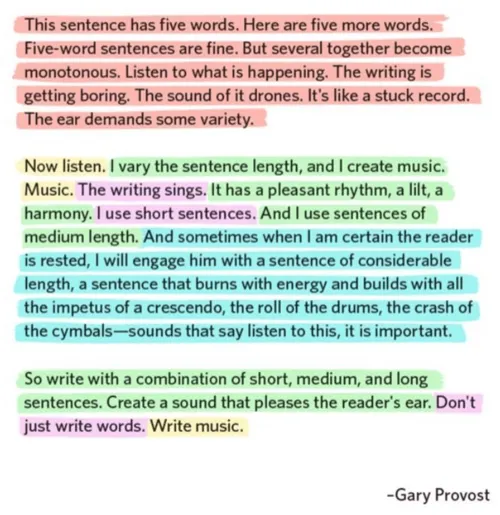
The other idea is burstiness. A human writes with a rhythm that varies like breathing: long sentences, then short ones. AI pours every sentence into the same mold. The sequences stay even. You can literally measure the variance in sentence length.
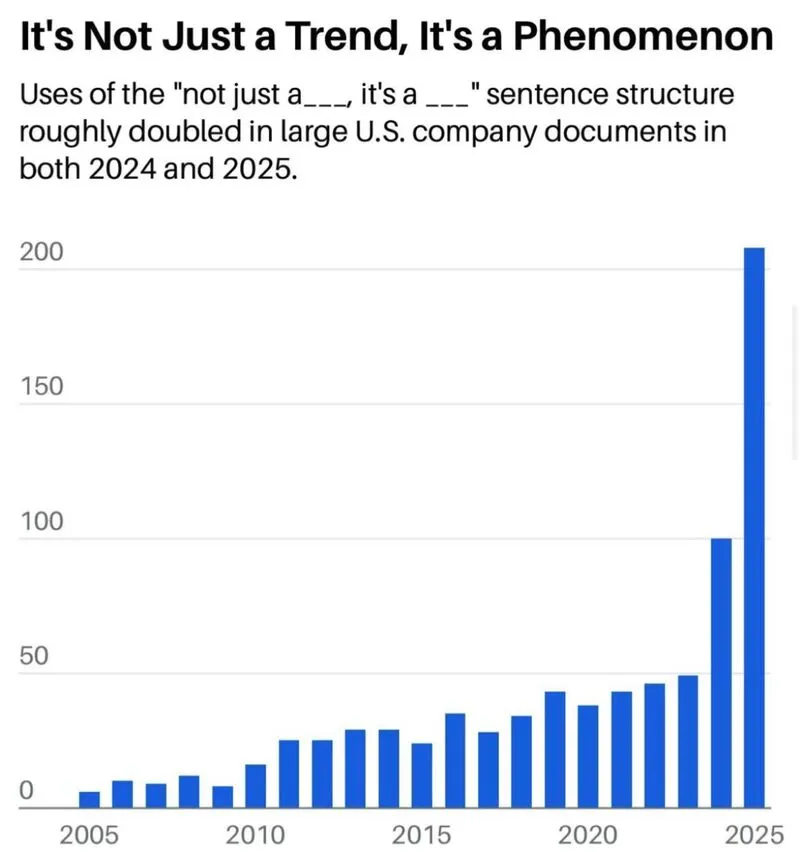
And some words are wildly overrepresented in AI text. You know the ones. There are rhetorical moves that show up constantly, too, like the antithesis, the “it’s not just X, it’s Y” or “the real question isn’t . . . but . . .,” a tic so ubiquitous it’s become the signature of the machine.
The other stock gestures: the rule of three (“clear, concise, and convincing”), the short stand-alone sentence deployed for drama (which “lands” in LinkedIn posts), the compulsive recap, the cautious neutrality that refuses to take a side, the little moralizing conclusion. No digressions. No shift in tone. No swearing.
(I was always told not to overdo the digressions or lean on parentheses, so, as you’ll have noticed, I’ve abused the parentheses throughout, the better to tell AI to get lost.)
If we can now recognize AI writing on sight, then the ability to write without it—typos, oddities, spiders-for-breakfast and all—becomes a source of distinction. So to hell with the confidence problem.
In April 2026, the collaboration software company Atlassian gave Avani Prabhakar a new job. She had been running a 700-person HR team. Now she oversees 3,500 people responsible for AI transformation across the company’s 14,000 employees. Her new title: chief people and AI enablement officer.
She was not the first. In May 2025, Moderna, the biotech company, merged its HR and IT departments and put the combined organization under Tracey Franklin, its chief human resources officer (CHRO), now chief people and digital technology officer. In March 2026, Lumen Technologies, a communications services company, expanded the role of its chief people officer to chief people and AI enablement officer.
Three companies in 12 months have put the head of Human Resources in charge of artificial intelligence transformation because they grasped something that most leaders still have not: The hard part of AI is not deploying the technology. It is reimagining the work and the workforce that will be doing it.
The job is no longer a stable unit
For a century, the job has been the fundamental unit of the organization. We hire into jobs, pay by job title, promote from job to job, and plan head count using the job as the basic unit of measure. And this is absolutely fine as long as the jobs in question map closely to the units of work that the company needs its employees to perform. But AI is breaking that connection.
How? Well, a job is really a bundle of tasks, and AI does not affect every task in every bundle equally. Some tasks can be automated outright. Some can be delegated to an AI agent with a human checking the result. Others become more valuable precisely because they require judgment, context, or accountability. When we decompose most of the jobs that have traditionally been done by humans, it is rare to find that an AI system can straightforwardly take over every task. And this means we cannot use the human job as the lens for understanding how to integrate AI into the workforce.
The World Economic Forum projects that 39% of the skills workers rely on today will be transformed or obsolete by 2030, largely because of AI. And we cannot predict with any certainty right now what the skill demands of 2030 will be, because AI transformation is both radically quick and profoundly uncertain. As models improve, work that required a person last year may not require one next year, while entirely new tasks will appear around the technology.
The result is that the skills a job requires, the shape of the job itself, and the value of its outputs are all moving targets. And what this means—as Atlassian, Moderna, and Lumen have realized—is that the people function must be fundamentally reimagined.
From credentials to adaptability
Traditionally, hiring has followed credentials and experience, because these were taken as evidence of competence. But they matter less and less now. When roles are shifting, the most important thing to hire for isn’t a Harvard degree or work experience at Apple. As my friend Alec Litowitz argues in his new book, The Adaptability Quotient: Rewiring Your Mind for Success in the Next Human Era, the most important asset a hire can have is adaptability.
Employees who can repeatedly change what they are good at will be the gold that companies pan for in the new era of work. Recruiting and training need to be rebuilt around that ability. IBM has already moved partway in this direction. Its skills-first approach to hiring explicitly looks at candidates’ skills and their ability to learn, rather than relying only on formal qualifications.
The lesson for anyone concerned with recruitment and development is that instead of simply asking what skills someone has, it’s much more instructive to ask how they got those skills. How quickly did they learn their last new skill? What did they do when the demands of their job changed? In a word, the best predictor of talent in this new era may not be what someone is good at today, but how quickly they can become good at something else tomorrow.
From layoffs to redesigning work
The question for HR used to be, how many people do we need in which roles? And indeed, most AI restructuring still, for now, starts with head count: Set a target for roles to cut, then look for technology that can replace them. But if the job is no longer a stable unit, then it is a mistake to design AI transformation around the goal of head count reduction.
Instead, as my coauthors and I discussed in a recent article for Harvard Business Review, organizations should ask what work needs to get done, what capabilities does that work require, and what combination of humans and AI can provide them? For example, Citigroup began with 50 processes flagged for greater automation, examined where technology and process redesign could change each one, and then made staffing decisions on that basis. The analysis came first; the restructuring followed.
That is the new discipline HR needs to build. Leaders need to decompose the work and decide what AI should do, what humans should do, and where oversight belongs. This may well have an effect on head count, but these effects should be the consequence of redesigning the work, not the objective.
From measuring output to judging contribution
As I argued recently, AI-assisted work can be excellent without it telling you much about the excellence of the person who contributed to producing it.
That creates a problem for performance management. Speed and volume of output are easy to measure, and traditionally, this is what we have rewarded. But AI allows vast production at high speed, and the value of the human contribution lies increasingly in what people broadly call judgment—things like setting direction, catching mistakes, and deciding what context matters and how.
What gets rewarded gets done, goes the old leadership maxim, and it applies here too. If companies keep rewarding the old proxies for performance, that’s what employees will optimize for. Incentive systems must therefore change, and an early pioneer is the professional services firm EY. Just last month, the firm announced $100 million in bonuses for employees who demonstrate qualities including judgment, business acumen, adaptability, and leadership, alongside technology adoption.
That is the shift HR needs to make: Keep judging the quality of the work, but start rewarding the quality of the human contribution to it.
4 Moves for the CHRO
Here are four moves that CHROs can make right now to start adapting to the new world of work.
1. Put adaptability into the rubric. Pick one high-volume role and rewrite the hiring and promotion criteria so that demonstrated learning carries explicit weight alongside existing expertise.
2. Require a work map before a head count decision. Before approving an AI-driven restructuring, require the responsible individuals to show what tasks are changing, what AI can actually do in that context, where human oversight and accountability remain necessary, and what capabilities would disappear with the people being removed.
3. Separate output from contribution. Add one question to performance reviews for AI-assisted work: What did this person contribute to the result? Managers should be able to identify the judgment, framing, context, error-catching, or accountability the employee provided rather than equating greater volume with better performance.
4. Build routes between jobs, not just ladders within them. If roles are going to keep changing, employees need ways to move toward emerging work before their current job disappears. Mastercard’s Unlocked, for example, matches employees to projects, mentors, and roles based on the skills they have and want to build.
HR in the Age of AI
For most of its history, HR has operated on an assumption that the organization knew what a job was. AI changes that starting point. And that makes the people function responsible for something much bigger than managing the workforce. It must also help the organization decide how human and machine capabilities should fit together as both keep changing.
This is not ultimately a question of how much work AI can take over. It is a question of how to build an organization in which people and AI each do the work they are best suited to do, and can keep adjusting that division as the technology changes.
Today’s job market is being called historically unusual because of how challenging it is to get hired. As a result, nurturing your career and cultivating the unique factors that make you a great hire—current or future—are very wise. They are helpful n…
I just returned from a family vacation through France, Spain, and Portugal, and we had an amazing time. However, I couldn’t help but notice a new tourist trap that could have potentially cost me hundreds of dollars.
The trap has to do with a practi…
A finance director stands in front of hundreds of employees to reveal the annual figures. No, it’s not the start of the most corporate joke ever, but something I saw a few weeks ago.
Right away, he reveals he’s nervous. This isn’t his natural habi…
For more than 25 years, I’ve been the “Computer Guy” for friends, family, and colleagues who call when something digital goes sideways. Lately, those calls have changed. The questions used to be about slow computers and forgotten pas…
Below, Dr. Itamar Shatz shares five key insights from his new book, Solving Procrastination: The Science of Why We Put Things Off and How to (Finally!) Stop.
Itamar is an Affiliated Lecturer at Cambridge University. He helps people understand why t…
In 2017, I bought my first Birkin.
Not because I wanted to impress anyone. Not because it was a status symbol. I bought it because I saw it as an investment. As an entrepreneur, I naturally look at assets differently. If something has the potential…
In 2024 almost 50,000 Americans died by suicide, making it the 10th leading cause of death in the United States. And the ripple effects are even wider. According to research, each suicide is connected to 135 people who knew the deceased, including cow…


