


In a bid to avoid the stifling bureaucracy within their company, intrapreneurs often create innovation labs that are separate units from the main organization. Not only do they seek to be physically separate but they also actively avoid aligning the work they do in the lab with the strategic goals of their company. While this may provide an initial, positive feeling of freedom to be creative, it is not a good long term strategy for sustaining innovation.

A month ago, I was in the United States working with an innovation team at one of the large financial institutions in the Midwest. They had invited me to help them craft their strategic guidance for choosing innovation projects to pursue. During our meeting, one member of the team explained to me why they had decided to do more work to clarify their innovation strategy.
When they first started working on innovation, they used to call themselves the home for homeless ideas. They viewed themselves as the place where people with ideas that the main business did not want to work on would come for support. They would nurse these ‘unwanted’ ideas, give them resources, test and validate them. Sounds like a great role for an innovation team, right?
Well, the intrapreneur I was speaking to made one statement that speaks to the fallacy of the separate and independent innovation lab. He said:
“After a while we realised that if an idea is homeless when it gets here, it will be homeless when it leaves!�
What this reflects is the reality that innovation labs have to face. It might be fun to work on early stage ideas without any interference from the mother company. But there comes a time when those ideas will need approval and a larger investment of resources to scale. It is at this moment that the lack of alignment with the main company can rear its ugly head.
Most innovation labs struggle with finding leaders inside the organization that will give them the resources needed to scale the ideas they are working on. This is why, it is important that intrapreneurs align with their leadership in terms of the strategic goals for innovation. We need to make sure that we are working on ideas that have a good chance of being taken to scale by our company. We don’t want our labs to be the home for homeless ideas.
For more information and insights on aligning your innovation projects with the strategic vision of your company, have a look at our Innovation Readiness Assessment Tool.
There are super-technologies which are emerging that will define the 21st century. The highest potential super-technologies are ones which will enhance intelligence and human control of the material…
[[ This is a content summary only. Visit my website for full links, other content, and more! ]]


No matter the decade in which you grew up, the future promised one thing: flying cars. And yet generation after generation has been disappointed as our technological progress that has given us everything from angry birds to nanotechnology, but… still no Bladerunner vehicles.
The post The Three Roles You Need to Have on Your Innovation Team appeared first on Innovation Management.
Research shows that people remember branded content twice as long as they remember a traditional advertisement. But creating your own branded videos, blogs, or podcasts can require a lot of bandwidth.
If you’ve always wanted to experiment with this strategy, but haven’t had the time or resources to produce your own campaigns, sponsoring content from other companies or influencers might be the right strategy for you.
Sponsored content has been around for decades and got its start in print publications. But as online marketing has taken over the way we consume content, we’ve seen sponsorships move from print to web. Now, sponsored content is even thriving on social platforms like Instagram.
But, you might ask, “What makes sponsored content more appealing than traditional online ads?”
To answer that question, this post will explain what sponsored content is. We’ll also offer you a few best practices and solid examples of sponsored videos, podcasts, social media, and blog format. At the end, we’ll also give you a few tips on how to sponsor great content while still following federal advertising guidelines.
This type of content is most engaging when you sponsor a company or influencer who targets your core audience and already discusses topics that align with your brand. When this is done right, any mention of your brand feels like a natural fit rather than an invasive advertisement.
Instead of thinking they just saw an advertisement, audiences should come away from sponsored content feeling like they’ve learned something interesting. This makes your brand look more credible, memorable, and — most importantly — trustworthy.
When it comes to branded or sponsored content, trust is a major factor that engages potential customers. In fact, when marketers sponsor content from a trusted publisher, they see a 50% higher brand lift than marketers who make their own content.
As branded and sponsored content gains steam, research continues to show that marketing your product with quality content can be incredibly effective. In fact, content marketing gets three times more leads than paid search advertising.
How to Distinguish Sponsored Content
Although sponsored content is engaging and effective, it still occasionally gets confused with more-traditional native ads.
Native advertising is when a brand creates editorial content that centers around their product. Then, they might pay a website or publisher to share it in a way that naturally flows within a list of content on their homepage.
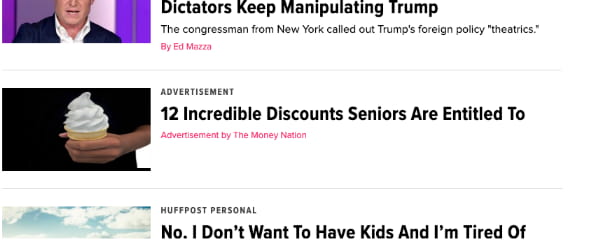
Here’s an example of a native ad that appeared on Huffington Post’s homepage. Aside from the advertisement attribution under the headline, the post about senior entitlements is designed to show up on the page just like a regular news story.
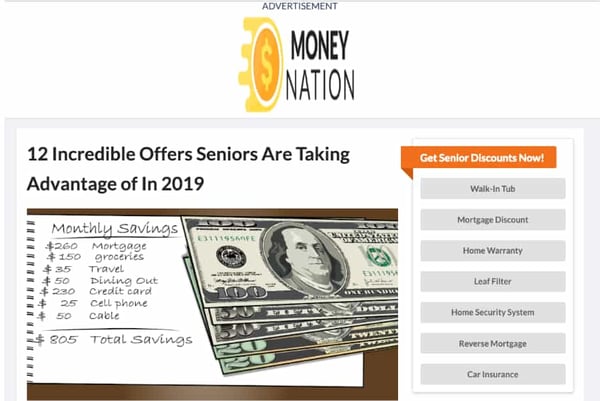
 When you click it expecting a regular post, you’re sent to a branded article that purely highlights services and discounts from Money Nation.
While you might want to consider a native ad that goes directly to a product page for immediate sales or traffic purposes, leading readers down a conversion path too soon could turn off audiences.
Since people may scroll past or tune out when they see content that’s obviously created by an advertiser, a piece of sponsored content created by a trusted source might be a stronger alternative.
Once you’re ready to start sponsoring content, it can still be difficult to come up with a list of content ideas or identify brands that you could sponsor. To help inspire you, here are a few great examples.
Sponsored Content Examples
Sponsored Photo or Video Content
Most consumers want to see videos from brands, so it’s no surprise that video and photo content are gaining attention from sponsors. Here are three great examples of video and photo posts:
Michelob Ultra
Michelob recently sponsored a Tastemade recipe video which used the beer as an ingredient in a shrimp ceviche tostada dish. The video shows how the beer is used as a flavoring ingredient and lists its name in the video caption.
View this post on Instagram
A post shared by Tastemade (@tastemade) on Jul 2, 2019 at 12:06pm PDT
In this example, Michelob was able to sponsor relevant content and get a natural product plug without altering Tastemade’s video recipe style.
Another great thing about this content is that it doesn’t just cater to beer drinkers or Michelob-specific fans. Someone who doesn’t drink beer regularly, but wants to cook this recipe as shown, might still have a reason to purchase Michelob Ultra.
In the small-business world, a local restaurant might sponsor a recipe video like this created by a food blogger to show off a meal they cook at their restaurant. You might also see a food or ingredient vendor similar sponsor a recipe video where there ingredients are listed.
Nude by Nature
In this Youtube video, a Global Ambassador from Nude by Nature gives a tutorial to a beauty reporter from the Evening Standard, a London newspaper.
This type of sponsorship works well because it aligns with the editorial style of the Evening Standard’s beauty section.
This type of sponsored tutorial could be helpful to companies that offer beauty supplies. An expert demonstration on how to use a certain brand of products may be valuable to readers who enjoy wearing makeup and learning about new brands.
Some viewers might even want to buy the exact same products that they saw in a tutorial so they can follow along and recreate the model’s look on themselves.
Seedip
This Instagram post from Imbibe, a blog that informs users of interesting alcoholic beverages, shows off photos of Seedip, a non-alcoholic spirit.
The caption directs audiences to the account’s bio where they can find the link to a recipe that includes Seedip as an ingredient. It also describes the drink and uses hashtags like #sponsored to signal that the content was paid for.
View this post on Instagram
A post shared by Stella • LABsurdity Dogumented (@dognamedstella) on Jul 1, 2019 at 6:32pm PDT
This is another example of how sponsoring content from a brand that aligns well with yours can create a more natural feeling campaign.
This type of sponsored style might be helpful to other companies in the food and beverage industry. For example, if a local wine brewery sponsored a restaurant’s social post which highlighted a new line of wines, this could help the wine brand gain awareness and potential purchases from the restaurant’s followers.
Sponsored Podcasts
Podcasting is growing. In fact, in 2018, we discovered that 17% of marketers planned to add podcasting to their strategy.
While big brands like GE and Microsoft have already created their own shows, other marketers have focused on sponsoring podcasts that relate to their field or have a similar target audience. Sponsoring a podcast allows marketers to gain awareness from listeners without having to put time and effort into creating their own content from scratch.
Here are two examples:
Rise and Grind
This 10-episode podcast series was sponsored by ZipRecruiter and hosted by Shark Tank’s Daymon John. The series ran in correlation with the launch of John’s book, also titled Rise and Grind.
The content aligned well with both John and ZipRecruiter as it included interviews from entrepreneurs and business leaders, career and interview tips, and motivational advice. ZipRecruiter is occasionally mentioned, but the content is mainly editorial in nature.
Here’s one of the podcast’s mini-episodes, titled “Motivational Minute: Take the Shot.�
For companies in B2B or highly-professional fields, sponsoring a podcast that features executive-level tips and advice allows your audience to see how in touch your brand is with its industry.
A sponsored podcast might also inform new audiences with similar interests about your brand when they tune in to hear an interview.
My Brother, My Brother and Me
The My Brother, My Brother and Me podcast, also known as MBMBaM, is a comedic show that touches on news and pop culture. When they have a sponsor, they come up with a topic that relates to the advertiser or use product placement strategies.
One of the most notable and extreme examples was in 2016 when they hosted a “Family Fun Hour� sponsored by Totinos. During the episode, they gave a brief history of Totino’s, discussed their favorite snacks from the company, and played games that included Totino’s foods. This was considered as a brand new strategy at the time and was noted on sites like Vulture.
While this is an unusual example where product placement takes up most of the show, it demonstrates how content creators can develop something unique and still centered around a product.
Sponsored Influencer Content
Currently, 80% of marketers report that influencer marketing is an effective strategy. While many marketers have taken part in co-marketing with influencers, some have also sponsored their content.
One of the platforms where influencer marketing thrives most is Instagram. Here are a few examples of how brands are sponsoring influencer content on the platform:
CR7 Footwear Sponsors Cristiano Rinaldo
In this post, Cristiano Rinaldo, a soccer star and the most-followed person on Instagram, shares a picture of himself relaxing in CR7 Footwear.
View this post on Instagram
Sit back and chill out, it’s vacation time. @cr7_footwear #espadrilles #handmade
A post shared by Cristiano Ronaldo (@cristiano) on Jun 21, 2019 at 10:16am PDT
Cristiano is no stranger to sponsored posts and he has mastered the art of natural product plugs. Because the photo shows him lounging and reading a book, rather than just his shoes, fans might feel like they’re seeing a behind-the-scenes photo of him, rather than a promotion.
Since Cristiano is a major athlete and influencer who’s recommended apparel in the past, viewers of this post might trust and follow his shoe endorsements, even if the footwear isn’t athletic.
While the sponsorship of an athlete seems ideal for companies that sell sporting goods or clothing, this placement shows how a major influencer can successfully promote a number of products that aren’t just limited to their industry.
Coach Sponsors Selena Gomez
Here’s an example where Coach sponsored an Instagram post from Selena Gomez, the former most-followed person on Instagram. In the post’s caption, she shares details about a Coach outfit she’s wearing.
View this post on Instagram
All @Coach combo -biker jacket and butterfly parker bag #CoachNY
A post shared by Selena Gomez (@selenagomez) on May 24, 2019 at 12:15pm PDT
This is a good example of sponsor and promoter alignment. Coach is a high-fashion company and Selena Gomez regularly shares her outfits and thoughts about fashion on her social platforms. To viewers, this might feel like her usual posts where she casually shares what she’s wearing.
On a smaller scale, this sponsored content strategy could be helpful for ecommerce stores or boutiques who want to promote their products by paying someone with a large following to take photos with them.
Lulus Sponsors Lexi Mars
Influencer Lexi Mars has published a few sponsored Instagram posts for Lulus. In these posts, she puts on a few of their outfits and shows off other accessories from the brand.
Like other influencers on this list, she tags Lulus in her posts. This enables her fans to visit their account, learn more about their brand, and potentially follow them.
In the video post below, she tries on dresses from Lulus and captions the video as “outfit ideas for graduation.”
Like the Selena Gomez example, this sponsorship aligns well with both the clothing company and the influencer’s brands.
Lexi regularly posts pictures of her outfits and videos with fashion tips, so this video will not seem unusual or forced to her fans. The style of clothing is also similar to the outfits she wears in other pictures, so fans who remember her usual fashion choices might not be disrupted by the ad.
Because Lexi also highlights that these are graduation outfits, she might engage members of her following who are graduating, as people searching Instagram for graduation dress inspiration.
This type of influencer strategy might be helpful to boutiques, physical stores, or ecommerce shops that want to promote their seasonal or event-related clothing.
Tractor Supply Sponsors A Dog Named Stella
In this sponsored post from @ADogNamedStella, Stella’s owner films her exploring s Tractor Supply store with her family. In the video, the dog and children play with toys and items on the shelves and there are ample shots taken around the store. The video also shows friendly staff playing with the dog.
Although there are some detailed shots of the store, this video is still focused on telling the dog’s story, which makes the content a bit more interesting than a generic marketing video.
View this post on Instagram
A post shared by Stella • LABsurdity Dogumented (@dognamedstella) on Jul 1, 2019 at 6:32pm PDT
By sponsoring the content of a popular dog influencer, who has over 284,000 followers, Tractor Supply might be spreading awareness about its products to dog owners and dog lovers that might not know they sell items other than landscaping supplies.
Unlike many sponsored pieces, which often highlight online services on products, this content also creatively shows off a physical business. Sponsored content like this could be an effective way to show off products in a small or local shop that doesn’t offer an online store just yet.
Sponsored Articles
Sponsored articles have been around for years. While they were common in print publications, they have easily made the jump to blogs and online news sites.
According to a study by Neilsen and Mode Media, consumers spend 2.5 minutes reading a sponsored article. That’s roughly the same amount of time that they spend reading a standard editorial piece.
Here’s one example of sponsored article content from Huffington Post.
Sleep Number
In a piece sponsored by the Sleep Number mattress company, Huffington Post readers are offered a quiz and a slideshow on the science of sleep.
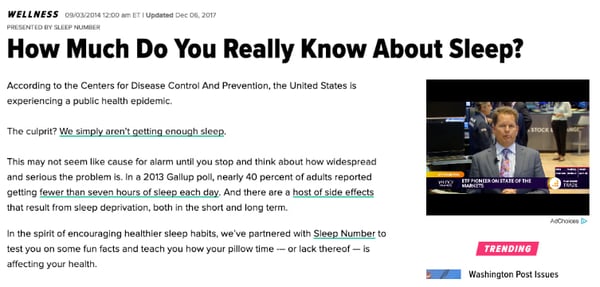
Unlike the native ad from Huffington Post that was shown above, this piece has the same design as all the other editorial posts on the website. It also has editorial newspegs and credibly sourced information including a fact from the CDC.
In the meat of the post, there is only one mention of Sleep Number. They also include sponsorship language at the end rather than in the middle or at the beginning. This makes the post feel more editorial and less like an ad.
This example seems like it would be of value to audiences who want to learn more about the science of sleep.
The quiz and scientific facts also make it feel more engaging and credible. A user who reads this or takes the quiz might think that Sleep Number is a go-to mattress company because they’ve been affiliated with editorial content about sleep.
Sponsoring editorial content like this could be a good strategy for businesses with an audience base that has interests in reading news or blogs online.
For example, a gym might sponsor a piece on fitness tips for the elderly in the health section of their local newspaper. With a piece like that, audiences who visit the newspaper site or pick up the physical paper might learn more about why staying fit is important and decide to join the gym.
FTC Sponsored Content
Even though sponsored content might be more valuable to a customer than a traditional ad, it’s still legally considered a form of advertising and is subject to specific guidelines. You’ll still need to follow the Federal Trade Commission’s online advertising and marketing guidelines.
On social media platforms, acknowledging that content is sponsored can get tricky. In 2017, the FTC sent more than 90 letters and published an online announcement reminding influencers and brands to clearly state when they have a “material connection� to a brand.
This means that a company or influencer must disclose when another company has given them a payment or another resource in return for publishing an endorsement or sponsored content
To avoid any regulatory issues, many influencers and brands now use a hashtag such as #ad or #sponsored on social platforms if there is no other way to clearly disclose a sponsorship in a post. Hashtagging seems to be a go-to on Instagram, which currently has over 2.5 million posts marked with “#sponsored.�
While you should take time to read up on all the FTC requirements that could impact your campaigns, here are the biggest guidelines to keep in mind when posting or publishing sponsored content:
- Make sure the content is free of any misleading claims or lies. For example, a supplement company shouldn’t say their vitamins cure a disease when they have not proven to do so.
- Even if you are posting on social media, clearly disclose when content is sponsored and who the sponsor is. With this disclosure, audiences will know that some aspects of the content were paid for.
- If your content is on your website or your sponsor’s, make sure the font of the disclosure is legible. The text and color should be easy to see and ideally different from the body copy’s style. A note that content is an advertisement, sponsored, promoted or presented by a company should appear in the post itself as well as near the headline if a CTA for it is featured on a homepage.
Disclaimer: We’re not lawyers, and the above shouldn’t be taken as legal advice. Consult a legal professional.
Tips for Creating Sponsored Content
When working with a sponsor to create interesting and compelling content, here are a few tips to keep in mind:
- Aim to sponsor content that attracts and delights your audience. If it’s enjoyable, they’ll continue to consume it and potentially click on your links.
- When looking for the content creator, choose a company, influencer, or publisher with a similar audience or mission. If people see an endorsement or sponsored post from an entity they trust, they’ll be more aware of a product and more likely to buy it. This will also make any plugs or product mentions feel less like an ad.
- Work with the sponsor to pick a topic that aligns with your goals and your audience’s interests. For example, if you’re a makeup company, sponsoring an influencer’s tutorial that highlights your products might be beneficial.
- Focus on creating engaging content first and product plugs second. If you’re content feels like it’s solely advertising a product, people might tune out.
- Sponsor content that goes beyond blog formatting. Be sure to consider videos, photos, and podcasts. These three areas are gaining more and more interest from marketers and consumers alike.
Conclusion
Sponsored content can allow you to reach new audiences and gain valuable trust from prospective customers. But, unlike native ads, you don’t have to sacrifice your team’s bandwidth to create it.
As you start looking for someone to sponsor, keep an eye out for people or brands that align with your mission and feel like a natural fit.
If you’re excited by the idea of branded content, but aren’t interested in working with a sponsor, check out these engaging examples of native advertising.

We use the value proposition canvas to help innovation teams design products and services customers actually want. Although one question we get all the time (especially from new users of the value proposition canvas) is: Do you always start with the customer?
The last couple of decades have seen an overwhelming focus on customers. I have yet to advise a company whose vision or strategy doesn’t include an acute customer focus. And this plethora of customer-driven organisations rely more and more on methodologies such as Design Thinking which starts with an empathetic and exploratory approach toward the customer. But a good idea doesn’t have to become a dogma.
In this post we explain why you don’t always have to start with the customer, but you always have to end with the customer — especially the validation of fit between the customer (as mapped in your customer profile) and your product/service (as designed in your value map).
1 – Fishing for customer insights
The innovation journey of many teams starts with a customer discovery process and a large number of customer interviews. In many corporate innovation programmes, it has become a design principle that teams cannot advance to the next stage of the programme and access more funding before having completed a large number of customer interviews, sometimes as high as 100 interviews in a 6-12 week window.
Why this focus on customer interviews?
There are many benefits to doing many customer interviews early in the innovation process:
-
Consistent customer feedback helps innovators to not fall in love with their initial ideas, and thus avoid one of the most dangerous pitfalls facing entrepreneurs.
-
Customer interviews are the simplest form of testing innovators can do. When done properly, these interviews can provide early evidence on the most critical assumptions.
-
After a while, these interviews will lead to a deeper customer understanding and to critical insights for designing a product or service that customers want.
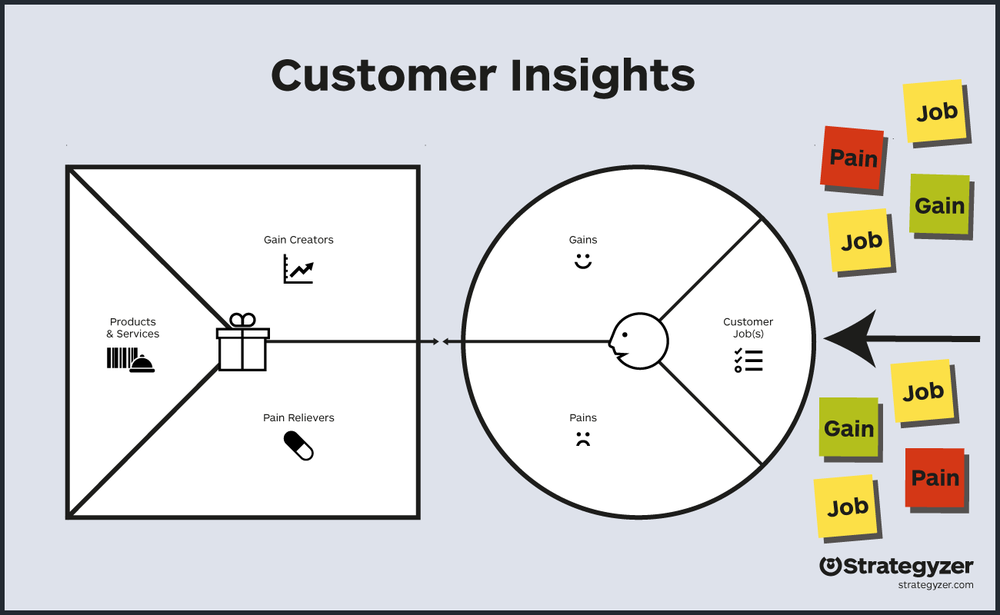
The insights that innovators need to get from this discovery process are:
-
What are the most critical jobs, pains and gains of customers.
-
And are any of these important enough that customers would be willing to pay for your product or service?
When teams start their innovation process with just a business idea, the customer is a pretty good starting point. In this case, we coach teams to work on the circle — the customer profile — and map the critical jobs, pains and gains.
2 – Making the most of what’s available
Many of the teams we coach in large organisations have much more than just good ideas. These organisations might have key resources such as patents, capabilities or access to technologies that innovation teams can use to prototype new value propositions and business models.
A classic example of reusing an existing capability to build a new business model is Amazon with Amazon Web Services (AWS). Amazon leveraged its IT expertise and infrastructure, which was initially built for its e-commerce business, to create AWS – a suite of cloud computing services sold to enterprise customers.

The innovation journey is long and hard enough: it would be careless not to use all the assets and opportunities available to you. When we work with teams in large organisations we often help them prototype many different product and services using available assets early in their innovation process. In this case, we start our innovation process with the square – the value map – and we ask them “what new value proposition could you design based on this key resource?â€� This piece of technology? Or this capability? Or this patent? And they describe how those available assets could contribute to a potential value proposition using the value map.
In both instances, whether you start with the customer to identify critical customer insights or start prototyping a new value proposition built on an existing key resource, you will soon need to go through a solid testing process to validate the fit between your value proposition and the customer segment.
That’s why we always remind innovation teams that we work with that you don’t always have to start with the customer, but if you want to achieve fit, you have to end with the customer.
Why not come and join us at one of our global Masterclasses to learn about more value proposition design best practices for you to apply to your own business?
* Please note that this post is only a small insight into the awesome work done by Greg Bernarda on Value Proposition Design best practices.
The orbital version of the SpaceX Starship is getting stacked in Texas. Pictures from Maria Pointer show that there seem to be improvements in how each of the ring sections are being constructed. The…
[[ This is a content summary only. Visit my website for full links, other content, and more! ]]


Turkey is home to hundreds of thousands of Uighurs. Many of them already live in limbo, unable to return to China and effectively stateless.
After three days of arduous negotiations, European Union leaders broke a deadlock Tuesday and nominated German Defense Minister Ursula von der Leyen to become the new president of the bloc’s powerful executive arm, the European Commission, one of two women named to top EU posts for the first time.
In a series of tweets, European Council President Donald Tusk said that Belgian Prime Minister Charles Michel would take over from him in the fall.
Frenchwoman Christine Lagarde was proposed as president of the European Central Bank, while Spanish Foreign Minister Josep Borrell was nominated to become EU foreign policy chief, meaning he would be charged with supervising the Iran nuclear deal, among other duties.
Only Michel can take up his post without other formalities. The others, notably von der Leyen — who will take over from Jean-Claude Juncker for the next five years — must be endorsed by the European Parliament. The assembly sits in Strasbourg, France on Wednesday to elect its own new president, and early signs suggest that lawmakers could contest the nominations.
“It is important that we were able to decide with great unity today, and that is important because it’s about our future ability to work.” German Chancellor Angela Merkel told reporters after the nominations — decided away from the cameras and media in a long series of meetings — were made public.
Several lawmakers have already objected to the leaders’ package of nominations, and it remains to be seen whether the parliament will flex new found muscles following the massive turnout for EU-wide elections in May. Party leaders have said the vote has brought the assembly — the EU’s only elected institution — even more democratic legitimacy.
“This backroom stich-up after days of talks is grotesque,” said Greens group leader Ska Keller, describing the nomination process as “party power games.”
“After such a high turnout in the European elections and a real mandate for change, this is not what European citizens deserve,” said Keller, who is in the running to become parliament president on Wednesday.
Juncker, who steps down on Oct. 31 as head of the commission, which proposes and enforces EU laws, conceded that “it won’t be easy in parliament.”
Tusk said “it was worth waiting for such an outcome” and that he would do his best to explain to what could well be a tetchy parliament on Thursday how the nominations were made and what thought processes went into the move.
“It’s always a huge question mark. This is why we have parliaments,” Tusk said, with a wry smile.
Von der Leyen would be the first woman in the commission job, and Merkel said this is “a good sign.”
So would Lagarde—currently chair of the International Monetary Fund—and she would serve for up to eight years if her nomination is endorsed.
“That’s a very important statement that Europe leads on gender equality,” Irish Prime Minister Leo Varadkar said.
“It might have taken three days, but it’s a good outcome overall,” he told reporters.
The nominations came after one of the longest summits in recent years, outstripping even all-night negotiations during the Greek debt crisis.
Already plagued by crises like Brexit and deep divisions among nations over how best to manage migration, the leaders had been keen to show that they could take quick decisions and that the European project remains important to its citizens.
But they struggled to establish a delicate balance between population size and geography — an even mix of countries from the north and south, east and west, and ensure that at least two women were nominated. Tusk he said he hoped that someone from a central or eastern European member state would be voted in as president of the European Parliament.
Despite deep tensions, some tantrums by leaders behind the scenes and even public criticism of his handling of the summit, Tusk said: “Five years ago we needed three months to decide, and still some leaders were against. This year it was three days and nobody was against.”
The Belgian prime minister said that he understands the challenges that lie ahead.
“The next five years will be very important for the future of the European project and I am convinced that it will be very important to protect and to promote our unity, our diversity and especially also our solidarity,” Michel told reporters, after one of the most acrimonious summits in recent memory.
More must-read stories from Fortune:
—Switzerland’s stock-trading standoff with the EU provides a glimpse of life after Brexit
—The Bahrain Conference: What the experts and the media missed
—Ford’s new plan for Europe: Fewer jobs, more SUVs
—The British Royal Family’s costs are skyrocketing. Here’s why
—Listen to our new audio briefing, Fortune 500 DailyCatch up with Data Sheet, Fortune‘s daily digest on the business of tech.
The New #Starlink Modem Device from #SpaceX and The Starlink Satellite Constellation Development Project are set for Pre-Order. Actual release date is due by 4th Quarter of 2019. Global satellite…
[[ This is a content summary only. Visit my website for full links, other content, and more! ]]


‘Apollo: MIssions to the Moon’ and ‘Chasing the Moon’ offer video versions of the race into space, but only one truly soars.
This is the 37th in an exclusive series of 50 articles, one published each day until July 20, exploring the 50th anniversary of the first-ever Moon landing. You can check out 50 Days to the Moon here every day.


