


Did you know an Instagram post with at least one hashtag averages 12.6% more engagement than a post with no hashtags?
Hashtags are powerful. They can help your posts reach a target audience, attract followers in your niche, increase engagement, and develop a more positive and recognizable brand image.
Here’s the thing, though: with great power comes great responsibility (#spiderman).
Hashtags can skyrocket your business to new heights, but if used too frequently or without a clear strategy in mind, they become pointless and inefficient, e.g.: #happy #superhappy #ecstatic #jumpingforjoy #whatsanothersynonym.
We want your business’s Instagram posts to receive optimal engagement, so we’ve put together an ultimate guide for using Instagram hashtags in 2018. With this guide, you won’t just attract followers — you’ll attract the right followers.
Why are hashtags important?
Hashtags are essentially Instagram’s sorting process. With around 95 million photos posted on Instagram every day, it’s difficult for Instagram to efficiently deliver the right content to the right people. Hashtags help your post get discovered by viewers most interested in seeing it.
Krystal Gillespie, HubSpot’s Social Media Community Manager, explains the importance of hashtags this way: “Hashtags are like a funnel. For instance, #marketing is incredibly broad and attracts all types of posts. We’ve found #digitalmarketing or #marketingmotivation gives us a more specific, targeted reach. The audience searching for these hashtags are also trying to narrow their search to what we offer related to Marketing, so we’re actually reaching more of the right people.”
Essentially, hashtags are a better way to categorize your posts. They help you reach a target audience, and more importantly, they help your target audience find you. These users are more likely to engage with your post because your post is exactly what they wanted.
Top Instagram Hashtags 2018
- #love
- #instagood
- #style
- #dogstagram
- #me
- #fashion
- #cute
- #tbt
- #foodporn
- #photooftheday
- #instamood
- #follow
- #iphonesia
- #food
- #motivation
- #Instagramhub
Adding one of the most popular Instagram hashtags to your post doesn’t necessarily mean you’ll see more interaction. Since the hashtags above are so popular, they are being used by millions of people, so your post will most likely be obscured by the competition. Narrowing your hashtag topic is important, but we’ll get to that next.
Here are some of the top Instagram hashtags of 2018.
1. #love
Instagram users build their photo galleries on good feelings. For this reason, the #love hashtag is ever present next to the pics of friends, family, vacations, and beautiful scenery.
2. #instagood
Occurrences of this hashtag are inspired by the @instagood Instagram account, which scours the Instagram community for excellent photos and videos that are just too #instagood not to share. Add this hashtag to your content for a chance to be reposted.
3. #style
This hashtag has more than 400 million posts associated with it, making it one of the top tags in 2019. It’s used for beautifully edited photos of outfits, vacations, luxury products, and anything aesthetically stunning. Tag #style on a gorgeous outfit inspiration or new product, and Instagram users looking to add a little glamour to their lives will find you.
4. #dogstagram
We all know that the internet loves cute puppies, so it shouldn’t be surprising when a hashtag for our beloved doggos trends on Instagram. It’s always a good idea to include man’s best friend in an Instagram post — your followers will love it and you’re almost guaranteed dozens of heart emojis in your comments.
 Source: Instagram
5. #me
This is the quintessential selfie hashtag, indicating to the Instagram community that the photo it’s captioning is a picture of you.
6. #fashion
People often turn to Instagram to see what styles are “in”, looking at posts ranging from fashion week to everyday outfit inspirations. This means that a significant portion of the content on Instagram revolves around fashion — in fact, there are more than 700 million #fashion posts on Instagram today. You will find celebrities, luxury brands, clothes, makeup, and other aspirational images tagged with #fashion.
http://instagram.com/p/B0OfdykBv80
7. #cute
#Cute puts your content in a pool of Instagram photos and videos that elicit “awes” from all over the Instaverse. If you think your puppy is the cutest puppy that ever lived, it deserves a photo with this esteemed hashtag.
8. #tbt
#Tbt stands for “Throwback Thursday,” and encourages Instagram users to post an old photo of themselves or an event they’re reminiscing over. Everyone likes content from the good old days — here’s your hashtag for enjoying the nostalgia.
9. #foodporn
I hope you’re hungry! The #foodporn tag is brimming with mouthwatering posts of desserts, pizza, recipe videos, and so much more. This hashtag is for the best of the best when it comes to delectable treats on Instagram — find the most original, delicious, and tantalizing food pictures on the internet under this hashtag.
http://instagram.com/p/B0OXDjWgizB
10. #photooftheday
Managing a business account? This hashtag is a surefire way to attract more followers and repeat visitors. If you plan to post daily content, all around a common theme, add the #photooftheday hashtag to increase your exposure.
11. #instamood
#Instamood is all about the vibe or emotion a photo or video elicits. Pretty scenery, a day at the beach, or a night out with good people were all prominent under the #instamood hashtag in 2018. Landscapes are a popular starting point when figuring out what to post on Instagram, according to Jumper Media, and they fit into this hashtag perfectly.
12. #follow
This hashtag — currently tagged on half a billion posts — is a tactic used by public accounts looking to gain more followers. It’s a ubiquitous tag, non-specific to any one type of content creator, so you’ll see #follow on fashion accounts, travel blogs, makeup tutorials, celebrity fan pages, and much more. The idea is that if a user comes across content that they like on your explore page, they might be motivated to follow the account for more of that content.
13. #iphonesia
#Iphonesia is dedicated to the burgeoning community of Instagrammers in Indonesia.
14. #food
Meal pics are the bread and butter (no pun intended) of a people-oriented Instagram account — and 2018 was no exception. Use the #food hashtag to caption your next delicious Instagram photo.
15. #motivation
On Twitter, #MondayMotivation encourages inspiring quotes and messages to help people start the week off on the right foot. On Instagram, the #motivation hashtag has come to caption anything from a photo of a user after a big gym session, to a computer screen right before he or she gets to work.
The above 10 hashtags might have helped define Instagram over the last year, but there are still plenty more that end up trending every year. The following hashtags can help inspire photos and videos that Instagram users always seem to find captivating — and are sure to in 2019.
16. #Instagramhub
This hashtag isn’t specific to one type of post — #instagramhub is a place for active Instagram users to demonstrate their presence on the platform and reach larger audiences. By including this popular hashtag, influencers on Instagram are able to connect with as many users as possible.
Top Trending Instagram Hashtags
- #life
- #beautiful
- #travel
- #fitness
- #happy
- #repost
- #igers
- #photography
- #instadaily
- #bestoftheday
- #followforfollow
- #likeforlike
- #tweegram
- #summer
- #nofilter
- #ootd
- #instafood
- #fun
1. #life
This one goes out to all the photos and videos that encompass the essence of your life.
2. #beautiful
Instagram is the place to go to put your best foot forward — whether it be your amazing getaway, a new hairstyle, or a breath-taking sunset, #beautiful photos encompass the best of what the platform has to offer.
 Source: Instagram
3. #travel
Away for the weekend? Show your followers where you are, using this hashtag to indicate you’re traveling somewhere new.
4. #fitness
Get in on a trending community of workout warriors with photos and videos from your best exercise sessions, using the #fitness hashtag to share the moment.
5. #happy
Sometimes the best part of feeling good is sharing that sunshine with others. The #happy group of posts is full of radiant people and lighthearted content that brings us joy. Tag a photo of a cute kitten or one of yourself after getting a promotion with #happy.
6. #repost
Reposting is a common function on Instagram that allows you to share content from other users, with credit back to the original user. Use the hashtag, #repost, to tell others on Instagram that you were inspired by this photo or video.
7. #igers
#Igers is short for “Instagram users.” If you’ve got a photo or video that encompasses the Instagram community, show your solidarity with this colloquial hashtag.
8. #photography
At its core, Instagram is a photo sharing media, so it makes sense that there are some stunning and artistic images shared in #photography. Instagram is unique in that a user could be scrolling through the #photography posts and see National Geographic and professional photos next to amateur photographers.
http://instagram.com/p/B0OdNt_AZsu
9. #instadaily
This hashtag is similar to #photooftheday — one of the most popular hashtags of 2018 above this list — and is perfect for Instagrammers who post every day.
10. #bestoftheday
The #bestoftheday tag offers a glimpse into the massive amount of varied content that is posted to Instagram every day. Here, you’ll find some of the most noteworthy images on the platform — images of beautiful spots around the world, award-winning photos, yummy recipes, adorable animals, and so much more.
11. #followforfollow
Interested in building a fast list of followers on Instagram? #Followforfollow tells everyone who browses this hashtag that you’ll follow users who choose to follow you. This hashtag is always trending highly.
12. #likeforlike
#Likeforlike is similar to the #followforfollow hashtag explained above. Use this hashtag if you want to increase engagement on your Instagram account, telling users that you’ll like their photo or video if they like yours.
13. #tweegram
There is plenty of multi-platform sharing across social media sites, and in #tweegram, you’ll find images taken from Twitter, Pinterest, and more. #Tweegram is best known for quotes, screenshots of Tweets, and memes.
14. #summer
The summertime is the best season to enjoy fun vacations, fruity drinks, and time by the pool. This tag is full of Instagram users enjoying the long summertime hours on the beach or showing off the breezy outfits keeping them cool under the hot #summer sun.
http://instagram.com/p/B0Osoc1AGcE
15. #nofilter
Instagram offers so many different filters to help enhance photos, it’s practically assumed that any picture on Instagram has been edited. But if you’re posting a pic that was beautiful all by itself, let the world know that this gem didn’t need a filter to look so nice.
16. #ootd
#Ootd stands for “Outfit of the Day,” a hashtag dedicated to Instagram users who love showing off new clothing and styles on a regular basis.
17. #instafood
This popular tag is different from other food hashtags because it accompanies food pictures that are gorgeous, creative, and, most importantly, worthy of Instagram. Instagram posts are known for being aesthetically appealing, and #instafood is no different. Use this tag if you’re posting a photo of a colorful, unique, and sumptuous dish!
18. #fun
If it’s not fun, it’s not Instagram-worthy. Make it known to millions of Instagram users that you had a blast in your latest photo or video with this popular hashtag.
How to Use Hashtags on Instagram for Business
- Keep your hashtags organized.
- Figure out your magic number.
- Narrow your hashtags.
- Research what other people are hashtagging.
- Test out related hashtags.
- Follow your own hashtag.
- Create a brand campaign hashtag.
1. Keep your hashtags organized.
To create an efficient hashtag system, you can use Excel or an Instagram analytics tool. If you choose an excel sheet, you’ll need to manually keep track of which hashtags you use, how often, and which ones correlate to your most popular posts. Over time, you’ll see relationships between certain hashtags and your most popular posts, and this can help you decide which hashtags work best for your brand.
If you have a more advanced social media team, you might want to consider a tool like Iconosquare, which automatically stores top hashtags and provides reports on which hashtags reach the most people.
For smaller businesses with limited budgets, Krystal Gillespie says that, “an excel sheet is the best way to start. Once you get more advanced I would highly recommend using a tool to track the data. A manual system can get overwhelming when you’re posting three times a day and using about 20 hashtags per post.”
2. Figure out your magic number.
Most top brands — 91% of them, to be exact — use seven or fewer hashtags per post, so it’s easy to assume that’s the magic number for everyone … right? Krystal explains that this isn’t always the case: She told me HubSpot has been more successful with hashtags ranging in the low 20s.
The point is, you can’t know how many hashtags work best for you until you test it. For HubSpot, it took the team several months to find a number that worked best, and during our trial period, we ranged from seven to 30. Give yourself the same flexibility for trial and error.
3. Narrow your hashtags.
There are two big reasons more specific, smaller-volume hashtags are better for your brand: first, you can compete in a smaller pool. HubSpot, for example, doesn’t typically use the hashtag #marketing because it’s too broad. If you search #marketing, you’ll find pictures of restaurants, inspirational quotes, before-and-after hair style pictures, and memes.
The randomness of #marketing leads me to the second reason specific hashtags are a good idea: as a user, I’m more likely to find what I need if I search for something specific, and when your business comes up for my specific search request, I’m more likely to be happy with what I found.
Krystal explains: “Keeping a hashtag close to the interests of your brand really helps. We try to use hashtags tailored for a specific topic and then narrow it down further — for instance, we’d use #SEOTips if our marketing post was mostly about SEO.”
Think of it this way: #dogs is more popular, but it has a wide demographic. If I search #goldenretrieverpuppies and I find your post, I’m more likely to engage with it because it’s exactly what I wanted.
4. Research what other people are hashtagging.
An easy way to generate hashtag ideas is to make a list of your followers or competitors and research what they’re hashtagging on their own photos. It can also be particularly helpful to research what influencers in your industry are hashtagging — by definition, influencers are people with a large social media following, so they must be doing something right.
5. Test out related hashtags.
When you type a hashtag into Instagram’s search bar, Instagram shows you related hashtags in the scroll-down menu. Instagram also delivers related hashtags on the next page after you click on a hashtag. This is a simple way to create a longer list of hashtags to try out.
6. Follow your own hashtag.
Another way to use Instagram hashtags for your marketing purposes is to follow your own hashtag. Krystal explains, “On Instagram I actually follow the hashtag #hubspot so I can find anyone who talks about us and connect with them. As long as your account isn’t private, people will be able to find you via the hashtag.”
Following your own hashtag is an effective way to engage with other people talking about your brand and develop better relationships with them.
7. Create a brand campaign hashtag.
This is the trickiest item on the list, but if done successfully, it can pay off big time. Some businesses have successfully attracted followers by creating their own campaign hashtag. A campaign hashtag needs to be funny, clever, or at least memorable in order to work.
Campaign hashtags are particularly useful for promoting a new product or upcoming event, or even just inspiring people. Red Bull, for example, encouraged followers to post Red Bull pictures with a #putacanonit hashtag (see what I mean about clever?). LuLuLemon, rather than running a more traditional ad campaign, developed a positive connotation for their brand by asking followers to post real, active pictures of themselves with a #sweatlife hashtag.
Now that we’ve covered the importance of using Instagram hashtags for your business, you might be wondering how to search for Instagram hashtags within the app, or how to use the search function to find related ideas. If you’re unsure of the technical process for hashtag searching, here’s how:
How to Search Hashtags on Instagram
To search hashtags on Instagram, tap the magnifying glass at the bottom of your screen, then tap the search bar at the top. Selecting the “Tags” option will enable you to search hashtags and related hashtags based on the popularity of each one.
1. Open Instagram and tap the search icon.
Instagram wants you to use hashtags, and has made it extremely easy to find the perfect ones for your post. To start, open the Instagram app on your mobile device and tap the magnifying glass at the bottom of your screen.
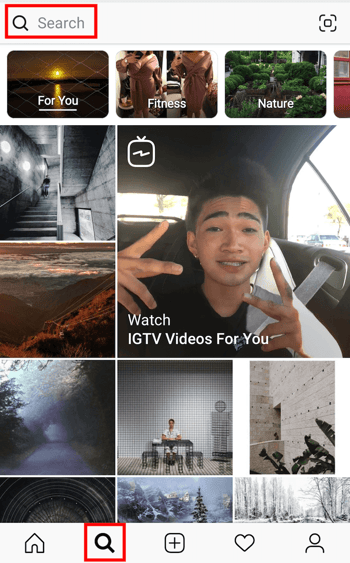
2. Tap the search bar at the top of your screen.
The search screen on your Instagram might first send you to a newsfeed-style page with suggested content based on topics you’ve demonstrated an interest in on social media. To switch to a hashtag search, tap the search bar at the top of this page, as shown in the screenshot above.
3. Tap “Tags.”
Once you’ve tapped the search bar at the top of your screen, Instagram will give you four options with which to filter your search. Instagram refers to hashtags as simply “Tags,” as shown in the screenshot below. Tap this “Tags” option, then tap the search bar above it, and begin searching topics for which you want to find a trending hashtag.
You don’t have to include the pound sign (#) in your search — your results will be the same with or without it — but you will need to use this pound sign in the caption of your photo once you choose a hashtag.
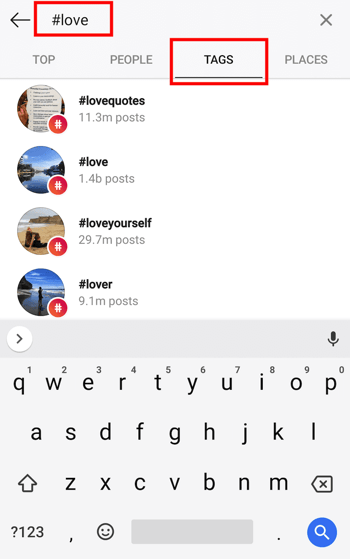
4. Browse hashtags based on post count and current content.
Voila! You should see multiple options for hashtags based on your search. Browse around at each related hashtag that Instagram suggests for you — you might find that a hashtag with slightly fewer posts includes photos or videos that are more in line with the content you’re posting.
Happy hashtagging!

One of the reasons why so many crowdsourced innovation programs struggle is because it is difficult for innovators to gather, process, select and implement ideas on a continuous basis.
The post Use This Template as a Calendar for Innovation appeared first on Innovation Management.
When you set up a system, it helps to keep in mind what will happen if it doesn’t work. Depending on the costs of ‘not working’, you can build more resilience into the system.
In most cases, ‘not working’ isn’t catastrophic. If your toaster doesn’t work, it’s not that big a deal. You can make toast in a few days and live with limp bread in the meantime. On the other hand, if you’re on a mission to Mars, you’ll probably be glad you packed a few extra oxygen tanks, even if the cost of bringing them is quite high.
We make two mistakes when we organize a system:
- We get overly optimistic about the reliability of the system, and combine that with a narrative that minimizes the cost of living without it. I’d put the current state of our internet infrastructure in that camp.
- We get overly pessimistic about the likelihood and cost of failure. This leads us to over-engineer things, or to pay far more for redundancy than we should. Putting life jackets on airplanes is a great example of this. So is the avoidance of the last typo. It’s also one reason our medical costs are so high… the last .01% is the most expensive part.
A useful skill in executive decision making is the ability to describe resiliency and the cost of failure in non-emotional ways. Especially when it’s difficult do precisely that.
How can the disaster-relief world change people’s perceptions to increase donations?
Over the last two years, the United States has experienced 30 natural disasters that have each caused at least a billion dollars worth of damage. In many cases, the damage toll was far higher: The 2017 trifecta of Hurricanes Harvey, Maria, and Irma combined for a total of $265 billion in losses.
In 2018, research conducted by the Leichtman Research Group found that 78% of households still watch traditional satellite or cable TV.
Looking at that statistic, you wouldn’t think that TV viewing is on the decline — but it is, and with it, TV ad spend.
For instance, considering research from the same group in 2018, you’ll see 69% of homes in 2018 were subscribed to a video streaming service — which is up from 52%, just two years prior.
On top of all that, internet usage itself has risen to over four billion users since last year. That number encompasses over half of the global population, with China, India and the United States ranking ahead of all other countries in terms of internet users.
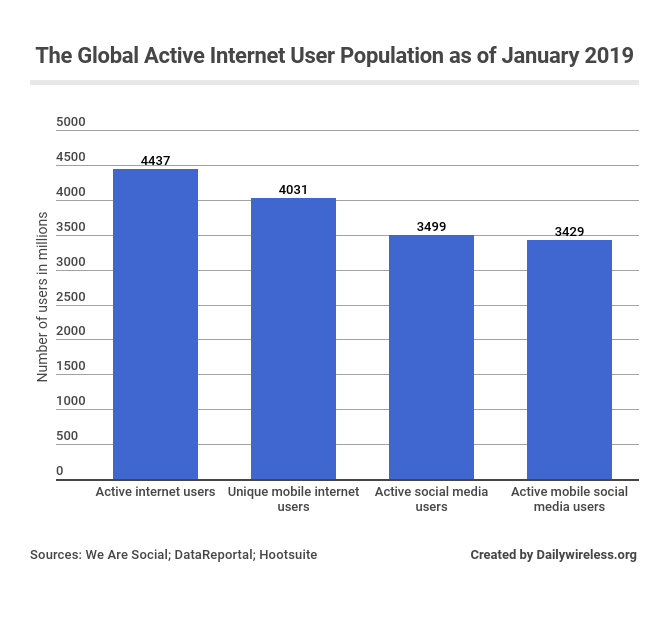
Traditional TV viewing has dropped dramatically since 2012, particularly among 18-24 year olds. In the next few years, we’re going to continue to see a decline of TV viewing — and with it, a steep drop-off of traditional TV advertising in favor of using digital media as the preferred advertising platform.
Here, I’m going to explain why.
The Decline of TV Advertising
TV advertising spend actually climbed 16% from 2010 to 2017, according to analysis by ARK Investment Management. And yet, conversely, TV viewing decreased in that time by 20%.
In years past, TV was the only form of media you could use to reach a massive market during prime hours — but now, people aren’t watching as much.
The way we see it, there are a few components to this shift.
First, a study by Omnicom Media Group’s Hearts & Science agency found that nearly half of Millennials and Gen Xers are no longer viewing video content on traditional TV.
Instead, they are choosing to view content on newer streaming platforms — Netflix, Hulu, Amazon Prime, and YouTube TV, which have been taking over the viewing space.
In fact, on average, they’re consuming 30 hours of video content on streaming platforms per week. This makes these generations “unreachable” through traditional advertising methods, particularly since most streaming platforms, like Netflix, don’t allow brands to advertise on the site.
Additionally, when these audiences do watch regular TV, they aren’t solely engaged in the show — for instance, on commercial breaks they’re likely to pull out their phones or other devices, so they might not remember or watch TV commercials at all.
If these losses continue as projected, by 2023 viewing hours could be less than half what they were in 2010, and cut in half again by the year 2028.
ARK’s research suggests that if marketers begin to take these dropping viewing hours into account and continue to shift their budgets toward digital methods, the United States’ TV ad revenue could plummet to less than half its current levels over the next 10 years.
The Rise of Digital Advertising
In contrast, online streaming platforms have been experiencing massive growth. For example, YouTube TV increased its viewership by more than 10X between 2010 and 2017.
Even social networks like Facebook and Twitter are creating their own versions of video streaming.
In addition, in 2019, digital ad spending will surpass TV ad spend, and traditional ad spend, for the first time ever. It’s also projected that by 2023, digital will exceed two-thirds of total media spending.
But why exactly is this happening? Why the shift? Let’s dive into that further. Here, I’ll outline five reasons digital ad spending is surpassing traditional.
1. Digital media is cheaper.
The cost difference between TV advertising and digital marketing methods is tremendous. A 30-second TV ad — which may or may not reach your ideal audience — will cost you over one-third of a million dollars … plus setup costs.
In contrast, while you need to hire employees to conduct SEO and potentially invest in SEO products, SEO itself is free, and can help you organically reach your target audience over the long-term. PPC and email marketing have cheap set-ups, and could cost anywhere from a few cents per click to a few dollars.
Frankly, that sort of disparity — while it makes sense logistically — is fairly ludicrous.
2. Digital marketing allows for better segmentation.
Traditional TV advertising lets you broadcast to anyone who turns on the channel. To reach a specific audience to whom your product will appeal, you need to guess what sort of TV programming could appeal to your ideal demographic — it’s difficult to apply or collect any audience-specific analytics.
With TV advertising, the closest you can get to understanding a TV channel’s audience is through ratings like Nielsen ratings or the Gross Ratings Point. These ratings are used to estimate the percentage of the desired demographic on a particular channel through statistically relevant sampling.
The downside to TV ratings like Nielsen is that, 1) these are estimates, not exact numbers; and 2) as an advertiser, you still need to pay to broadcast to anyone who views that channel, not just your intended demographic. It’s a wide-net strategy.
Digital media methods, however, are able to mine personal data on a more individual level, allowing for dramatically greater personalization. You’re searching for a “green Columbia jacket?” Well, my company has that jacket, and we’ve applied the right filter to catch your search term on Google instantly.
If you don’t buy the jacket today, that’s okay — we can use retargeting to show you an ad on your social networks about our green Columbia jacket, and remind you of your interest in the future.
Plus, we can create different ads for different segments — hikers looking for sturdy Columbia jackets in the summertime, versus skiers who need athletic cold-weather jackets.
TV can’t say the same — it’s estimates and wide-nets all around.
3. Digital marketing is more agile.
Leading off the last point, digital media advertising methods allow you to track, measure, and make adjustments necessary to optimize your ads — in real time. Everything from adjusting a few words, a color, or a filter can be done quickly, and cheaply.
Every change you make to your digital marketing campaigns or content can be made quantifiable by tracking CTRs and conversion rates to identify exactly where something needs to be tweaked, and how — and, again, you’ll see quickly if you made the right choice.
TV ads, in contrast, need time to see if they’ll pan out, and they can’t be adjusted easily … or affordably. You can make multiple versions upfront of the same advertisement to air in different regions, but beyond that, it’s clumsy and expensive to make tweaks and adjustments.
4. Video ads are online now, too.
TV used to be the king of storytelling — in a short span of time, you’d get a scene, a protagonist, a problem, and a solution. Internet initially just used banner ads, which, while annoying, were effective — but only in the short-term.
Eventually, digital advertisers had to figure something else out. Slowly, they started to determine more versatile methods — images, images in slide decks, and video.
Users are already increasingly shifting toward the internet and internet content as their preferred method of entertainment. Online video ads are a powerful threat to TV because it’s ultimately a familiar type of storytelling, and on the platform preferred by consumers.
5. Advertising follows attention.
As mentioned earlier, viewing has shifted from traditional media to digital. And ultimately, where attention shifts, advertising should follow. In 2019, brands will need to consider digital methods if they want to reach their target audience, many of whom are using online streaming services more than they’re using their cable box.
Why TV Is Still Around
I’m going to play contrarian for a moment, here.
Digital media seems to be killing TV advertising, but maybe it’s not — or, at least not entirely. Research by WARC suggests that consumers actually pay more attention to ads on TV than they do on YouTube or Facebook. In fact, TV held more than twice the active viewing than YouTube, and 15 times more than Facebook.
Ultimately, TV still works for advertising. It’s often effective to diversify the channels on which you promote your products or services — and TV is one of those channels. So, while digital media may be killing TV advertising’s spot as the #1 channel, it likely won’t go entirely by the wayside.
However, we’re going to say it again — where attention shifts, advertising follows. Despite research suggesting things aren’t as dire for TV ads as you might think, the numbers are still pretty clear on at least one front: more consumers are shifting toward viewing content online.
This means, as marketers, you need to be devoting more of your budget to where your audience is. TV doesn’t have to be cut entirely — and probably shouldn’t be — but finding the right mix of digital and TV is critical for finding success in this new age of online-first viewing.

Since the first story was carved on a rock, media pundits have explained that they have simply given people what they want, reporting the best they can on what’s happening.
Cause (the culture, human activity, people’s desires) leads to effect (front page news).
In fact, it’s becoming ever more clear that the attention-seeking, profit-driven media industrial complex drives our culture even more than it reports on it.
Thoughtful people regularly bemoan our loss of civility, the rise of trolling and bullying and most of all, divisive behavior designed to rip people apart instead of moving us productively forward.
And at the very same time, reality TV gets ever better ratings. So much so that the news has become the longest-running, cheapest to produce and most corrosive TV show in history. Increase that exponentially by adding in the peer-to-peer reality show that is social media, and you can see what’s happening.
Imagine two classrooms, each filled with second graders.
In the first classroom, the teacher shines a spotlight on the bullies, the troublemakers and the fighters, going so far as to arrange all the chairs so that the students are watching them and cheering them on all day.
In the second classroom, the teacher establishes standards, acts as a damper on selfish outliers and celebrates the generous and productive kids in the classroom…
How will the classrooms diverge? Which one would you rather have your child enrolled in?
We’re not in elementary school anymore, and the media isn’t our teacher or our nanny. But the attention we pay to the electronic channels we click on consumes more of our day than we ever spent with Miss Binder in second grade. And that attention is corrosive. To us and to those around us.
The producers of reality TV know this. And they seek out more of it. When they can’t find it easily, they search harder. Because that’s their job.
It’s their job to amp up the reality show that is our culture.
But it’s not our job to buy into it. More than anything, profit-driven media needs our active participation in order to pay their bills.
It’s an asymmetrical game, with tons of behavioral research working against each of us–the uncoordinated but disaffected masses. Perhaps we can find the resolve to seek out the others, to connect and to organize in a direction that actually works.
The first step is to stop taking the bait. The second step is to say, “follow me.”
Design incentives for both financial and nonfinancial goals.
Jon Gordon shares his thoughts on the value of positivity for professional sports teams and Fortune 500 companies.
Deborah Ancona and Kate Isaacs, researchers at MIT Sloan School of Management, say many companies struggle to be nimble with a command-and-control leadership culture. They studied Xerox’s R&D outfit PARC and the materials science company W.L. Gore & Associates and found these highly innovative organizations have three kinds of leaders: entrepreneurial, enabling, and architecting ones. These roles work together to give direction and avoid creative chaos. Ancona and Isaacs are coauthors of the HBR article “Nimble Leadership.”


