


I grew up as what many refer to euphemistically as “working class.” My mom was a single mother who didn’t receive child support and worked low-wage jobs to put herself through nursing school. My brother and I were well loved and…
As the Great Attrition marches on, leaders are eyeing the door themselves. But is quitting the solution to the problem? Over the past year, intent for male leaders to stay has dropped 9 points; for female leaders, intent to stay has dropped a wh…
Even before the pandemic ushered in phrases like the Great Resignation and quiet quitting, burnout among the most dedicated employees was an issue. But in the last few years, employees across industries suffered a remarkable decline in morale, and are quitting, retiring, changing jobs or scaling back. Often the normal attempts to address dissatisfaction with bonuses or allow employees extra time off aren’t making a difference. So what’s really behind this crisis and how can both managers and employees address job satisfaction in a more meaningful way?
To help answer those questions, I spoke to Ludmila Praslova and Phoebe Gavin last week at the 8th annual Fast Company Innovation Festival in New York. Praslova is a professor of organizational psychology at Vanguard University of Southern California with extensive experience in talent systems, inclusion, and wellbeing. (She is also frequent contributor to Fast Company.) Gavin is a career and leadership coach specializing in career strategy, negotiation, and self-advocacy. She’s also the executive director of talent and development at Vox.com.
What is burnout?
Both made the distinction between real burnout and just being tired of doing something. “Chronic depletion is a very good way to think about [burnout],” says Praslova. “It’s really a matter of human sustainability. You cut more trees than you replenish. You’re going to lose the forest. You take more energy out of the human than you are allowed.”
Gavin points out that it’s a matter of determining where you or your employee falls on the spectrum: Are they disengaged from their work, on the way to burning out, or already burnt out? The solutions to each problem are different—and trying to solve the wrong issue will backfire.
Gavin calls burnout an “occupational safety issue” that should be addressed immediately by leaders in the same way other safety hazards would be. But dissatisfaction, she says, is up to the employee to bring up. “When it’s about disengagement with the work, you need to use your individual agency [as an employee] to advocate for yourself to your supervisors to say, ‘This is the work that I’m excited about doing; this is the work I’m less excited about doing. Is there something that we can do to adjust the demands of my job so that it’s more in line with the things that I’m really excited [about] and where I really want to send my energy?’”
Often companies seek to solve problems of burnout and disengagement with either more time off or flexible hours, which on the surface may seem like good solutions, but are often implemented without deeper thought. As Praslova explained, “Flexible hours go only so far. If your choice is which 70 or 80 hours you’re going to work, that’s not the real deal. The real deal is manageable workloads.”
Disengagement vs. Conflict
Many people may confuse disengagement and “quiet quitting” with burnout, but Praslova and Gavin also pointed out a third issue: moral injury, which flies under the radar of many leaders, but is just a dangerous. “Burnout is fundamentally a matter of energy,” says Praslova. “Moral injury [is the idea] you’re doing something against your moral values and against your conscience. The basic idea is ‘I got into this job to help people, but I end up doing something that goes against my values.’ That can be very damaging. … Sometimes you can have moral injury, but no burnout. Sometimes you can have both.”
Gavin pointed out that there is a difference between being disconnected from your work—often what people are talking about with “quiet quitting”—and being in conflict with your work (aka moral injury). “If you’re disconnected from your values, you have a few options,” she says. “You can find a different job that is more connected to your purpose, or you can take that purpose into your personal life. It’s a very different situation when the job is forcing you to behave in a way that is in conflict with your values. And that is a situation that can only be resolved by changing the job.”
Listen to the full episode to learn how anxiety and self-doubt play into disengagement and burnout, as well as the three types of employees Gavin says exist in every workplace.
You can listen and subscribe to The New Way We Work on Apple Podcasts, Google Podcasts, Stitcher, Spotify, RadioPublic, or wherever you get your podcasts.
A few years ago, not long after she took the helm of Amazon Studios, Jennifer Salke pitched an idea that she thought could set Amazon apart as a streaming destination. Salke envisioned an ambitious flagship series that could spawn local spinoffs and satellite shows to draw in a global audience across countries like India and Italy. But she needed to recruit show creators who could take that format and run with it—which led her to the Russo brothers, who had directed multiple wildly successful Marvel movies.
“My brother Joe and I have had an amazing relationship with Jen Salke for many years now,” Anthony Russo said during a panel at the Fast Company Innovation Festival on Thursday. “She called us one day and said, ‘Hey, I have this idea that I want for a show.’ And she goes, I don’t know what it’s about—but this would be the concept.’”

The result is Citadel, a sci-fi espionage series created by the Russo brothers and starring Priyanka Chopra Jonas, who also appeared on the panel. The series—which is reportedly one of the most expensive television productions of all time, second only to Amazon’s recently released Lord of the Rings prequel—is set in the near future and centers on a global spy organization called Citadel that Russo describes as “a defender of humanity.” (Chopra Jonas plays one of the top agents at Citadel, alongside Richard Madden of Game of Thrones fame.) “This agency ends up coming in conflict with a new rival agency that has been developed by the world’s elite to sort of protect their self-interests,” he added. “So it’s a global struggle between these two competing points of view about what humanity should be.”

The project is an extension of the “universe storytelling” that Russo and his brother are already doing through their production company AGBO, which grew out of their experience with interconnected narratives in the Marvel Cinematic Universe. For Amazon, however, Citadel is a big bet—and an opportunity to gain significant market share as the largest streamer in the country after Netflix. Amazon already has more than 200 million Prime subscribers across the world (though about 150 million of them are reportedly American users). According to a 2021 report by analytics firm Digital-i, Netflix and Amazon have both seen an uptick in users consuming non-English language content.

Chopra Jonas, who has a first-look TV deal with Amazon Studios and a storied career in Bollywood, was the first name Salke thought of when it came time for casting. Beyond her background in Hindi films, Chopra Jonas is also investing in small budget, regional films through her production company, Purple Pebble Pictures. “When she brought up Priyanka, it was like a light bulb went off,” Russo said. “It was so intelligent and so smart because Priyanka represents the essence of what we’re trying to do with the show. The fact that she’s done such amazing work in India [and] internationally. She has this sort of dual identity—a foot in both worlds.”
It was an obvious decision for Chopra Jonas, who was immediately drawn to the show’s global ambitions. “You don’t have to watch the American show to understand; [the local language series] stands alone,” she said. “But if you watch all the other shows, they’re all connected—and that’s never been done in television. It’s such an interesting experiment, especially for a streamer like Amazon that caters to audiences across the world. To be able to offer a show which cross-pollinates audiences and languages is just so exciting to me. So it was innovative, and that’s what I loved about it.”
While a paycheck is important, a lot of people are questioning the exchange of their time for money. According to survey by McKinsey, 70% of U.S.-based employees say their work defines their sense of purpose and nearly half are reconsidering the kind of work they do because of a shift in priorities during the pandemic.
Instead of leaving your current employer to find a job that is more fulfilling, though, it’s possible to find a greater sense of purpose where you are, says Soon Yu, author of Friction: Adding Value by Making People Work for It.
One of the biggest benefits of work is that there is meaning attached to effort. It can be learning something, teaching something, or getting better at something and being able to demonstrate mastery. A lot of the reward of a hard day’s work is knowing who you helped, how you moved the business forward, or what you proved to yourself today. Often, these times are predicated on periods where you faced adversity and overcame it.
While companies are realizing that they have to provide opportunities for professional development, mentorship, and career progression, employees can and should start asking for it. How you approach your request, however, will likely impact your success.
How to Frame the Ask
Don’t plop the request in their lap, says Ken Coleman, author of From Paycheck to Purpose: The Clear Path to Doing Work You Love. “You could create a little bit of unnecessary tension, even if you are ultimately helping your boss,” he says. “Instead, you can be like a lawyer in a courtroom and lead them along the path to what you’re actually asking.”
Do this by casting a vision. Coleman recommends showing hunger that is wrapped in humility. For example, “I’m grateful for this company and the job that I have. I want to grow professionally, and I’ve been looking around in my heart and examining my talents, what I love to do, and what results matter to me.”
“I call this talent, passion, and mission,” says Coleman. “Talent is what I’m good at. Passion is what I love to do. And my mission speaks to the values and results that I want my work to create.”
Next, ask for what you need to get there, such as additional training, new assignments, or added responsibilities. Be sure to connect the effort to the anticipated results, showing your boss what they can expect from you in the future.
“Paint a picture for your boss of what it will look like when you’re using the specific talents,” says Coleman. “You want to add more value to the company. That kind of specificity and vision casting will bring them in as a participant and help get their buy-in.”
For example, you could say, “do you think there’s an opportunity to make a slight adjustment in my current job? I’m spending half my day doing work I love, and I’d like to bump that up to 80%. I believe the additional time I spend on that type of work will generate [this benefit].”
Yu agrees that it’s important that your request demonstrates the added value you will bring to the company. Another good way to frame the ask is to say, “I would like to get better at what I’m doing, but I need help. I’m willing to put in the extra time and effort if you’re willing to help me. I would really like to take a course, which connects to this project I’m working on. I am happy to share what I learn with the team.”
“Your boss would have to be an asshole to say ‘no’ to that, especially if you come in with some concrete things that would help your mastery and your autonomy,” says Yu. “If it’s in their authority, the boss is likely going to give you a trial.”
But don’t ask if you’re not willing to put in extra time and effort. “If you fall flat on your face, the likelihood of you getting the second favor may not be as great,” says Yu.
Meaningful Work is Meaningful to Your Boss, too
Managing employees who excel at their roles and add value to the company will reflects well on bosses. “Now you’re their protégé,” says Yu. “If it’s within their authority or if they can advocate for it or be a champion for it, they’ll try to get you an opportunity to [put] meaningful work into practice.”
“There’s humility [in] saying, ‘I want to bring more to the table,’” adds Coleman. “That’s usually very attractive. What’s happening with that type of posture is that you’re bringing your leader into the equation, and you’re not just saying, ‘hey, I want this.’”
As consumers increasingly research the background of the products they love—including who founded the brand—retailers like Ulta, Sephora, and even Target have curated their inventories in response. Now their stores spotlight minority-owne…
Trust in various institutions has shifted over the past several years, said PR giant Edelman’s CEO Richard Edelman. While NGOs were the most trusted institution for almost two decades, Edelman’s yearly Trust Barometer survey shows that re…
In 2020, when protests against racial violence and police brutality erupted across the country, corporate America responded with a wave of unparalleled financial donations and diversity, equity, and inclusion commitments. Nearly every industry was forced to reckon with its diversity issues; and for the first time, it seemed like business leaders were prepared to go beyond lip service and take steps toward lasting change.
Two years later, however, some of those efforts have faded or proven more complicated than business leaders might have hoped. “People wish there were a quick fix to this,” Orion Pictures president Alana Mayo said during a panel at the Fast Company Innovation Festival on Tuesday. “They wish there were a DEI hire plus a couple of trainings and a seminar—and yay, we solved [systemic racism],” Mayo said. “And as I hope everybody in this room knows, that is not the case.”
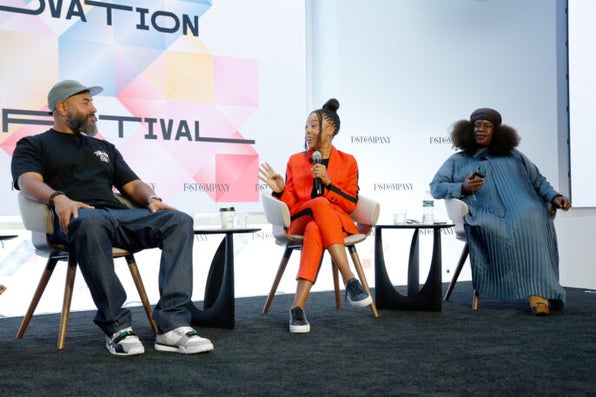
In Hollywood, she says, the racial uprising after George Floyd’s murder did raise awareness, particularly with respect to how the industry has shaped public perception of policing and violence against Black people through onscreen portrayals. There was a greater investment in diverse filmmakers and even decision makers: Mayo herself was recruited to helm Orion Pictures, a division of MGM that the studio relaunched in 2020, to focus on underrepresented voices and stories. “The level of representation, and the amount of people who are given dollars—which is really the most significant lever—who were not [getting funded] 16 years ago, when I first moved to L.A., is also staggering,” she said.
But there are no easy solutions when it comes to revamping industries that have a long history of homogeneity. And some of the actions companies and executives took in 2020 were, in hindsight, short-term solutions to more pervasive, systemic problems.
The publishing industry, for example, sought to diversify its ranks by recruiting new people into the field, which some people believe wasn’t the right approach to cultivating a pipeline of talent.

“On the editorial side, [publishing is] an apprenticeship program,” said Little, Brown and Company executive editor and VP Tracy Sherrod, who appeared on the panel alongside Mayo and Apple Music’s Ebro Darden. “That’s how it works because you need the skills to be able to convince someone to give you a million bucks. You need skills to know how to put a book into production. You need skills to know how to edit a book.”
At the same time, many white editors were tasked with editing more books from underrepresented authors, some of whom received outsize advances that they wouldn’t be able to earn out—which could, in turn, hurt their chances of getting another book deal. Sherrod said white editors tended to overestimate how well those books would sell, and whether white readers would pick up the book.
That optimism may have come from a lack of understanding of the audience for books by underrepresented authors. “My publishing friends whose homes I’ve been to—I don’t see Black books on their shelves, even the ones that they published,” Sherrod said. “I think their perspective is one of optimism, and we have to pay the price for that.”
Darden echoed the idea that DEI efforts in the workplace didn’t exist in a vacuum. “We have to be honest about our coworkers, and that they go home to very homogenous communities,” he said. “But then we expect them to come to the workplace and flip a switch and become this aware, inclusive person.”
On the other hand, he noted, addressing diversity issues at work could also impact how people move through the rest of their lives. “You’re learning about different holidays that they don’t even teach at your kid’s school, [but] you haven’t gone to the PTA meeting to ask, ‘Hey, I was learning about Juneteenth this year at my workplace, but we don’t do that at school. How come?’” Darden said.
“You come to the workplace and put on the charade because you kind of have to, because inclusion and diversity is en vogue,” he added. “But if we really want solutions, aren’t we going to do this at home?”
In any issue of diversity, identity, or inclusion, language is one of the most fundamental markers of difference and constructive definition.
I’ve seen this in the historical development of words like colored or minority. We’ve all s…
There’s something Silicon Valley’s most indispensable CEO coach must get off his chest. “At times,” says Matt Mochary, “I realize that I’m a fraud.”
In the last decade, Mochary has built a career on guiding a good percentage of the tech industry’s youngest and most prominent CEOs toward being better managers, feeling more comfortable in the role, and even achieving professional joy. He’s not only the guy who teaches young CEOs how to do the job while they’re doing it; what sets him apart is his recognition of the psychological distress his clients are under, and the emphasis he places on off-loading the drudgery and releasing the pressure. His past and present client list is a who’s who of leaders from the go-go 2010s, including Vlad Tenev of Robinhood, which had a market cap that peaked at almost $60 billion; Sam Altman of OpenAI, which has raised more than $1 billion; and Brian Armstrong of crypto exchange Coinbase, which had its market cap exceed $76 billion last year. Even though Mochary, 53, moved to Hawaii two years ago and works exclusively via Zoom with his “coachees,” as he calls them, he continues to exert more influence in Silicon Valley management culture than any other coaching professional.
And he still feels he’s faking it? “That doesn’t make me not a fraud,” Mochary says. “Because when I’m coaching, my goal is to show people how to build massively successful companies—companies that are worth $100 billion or more. I haven’t built a company that’s worth $100 billion or more. So again, I’m a fraud.”
Mochary did once cofound a startup, at the height of the late-’90s dot-com boom: Totality, which provided server maintenance and repair for online retailers. He even sold some shares at the company’s zenith, when it was valued at $500 million, before it took a dive when the bubble burst. The venture survived, ultimately becoming Verizon Business, but Mochary persists.
He describes his time at Totality as one big ball of misery. “I gained lots of weight, and I looked terrible,” he says, wearing a striped polo shirt and shapeless shorts from Costco, where the entirety of his wardrobe is sourced (except for his underwear, which he says he buys from Amazon). “Not that I look great now, but I feel good now. I didn’t feel good then.” He’s positively bubbly today on the patio of his oceanfront Kauai home, gazing out across his vast emerald lawn toward the swimming pool and the surf beyond.
Two years ago, though, Mochary launched another startup. Mochary Method, named after his approach to coaching CEOs, is seeking to translate his lessons—currently available for free in a series of Google Docs and videos—into software to spread them interactively across an organization.
Mochary began coaching in 2012, and for the first eight years, he worked pro bono. Then he began letting his clients know that if they would like to give him a slice of equity in their companies, he’d kindly accept. That arrangement lasted two years. Now he charges his clients, but only, he says, to fund software development, and his users—all coaching clients—pay $150,000 annually for access. “The things that I love in life are free. More money wouldn’t do anything for me,” says Mochary, who earlier this year also started a VC firm, Fortius Ventures, to invest in startups whose CEOs he coaches. “And, yes, it seems disingenuous, living in this house, but”—here he pauses for a quick giggle—”it was my wife who bought the house.”
Mochary’s ideas—and the force of his outsized personality—steered young tech founders through more than a decade of boom times. But in this moment of economic uncertainty, valuations are being slashed, layoffs are rampant, and public companies such as Coinbase and Robinhood are down 75% from their highs. In Silicon Valley, Mochary’s clients may be more in need of him than ever.
His answer is beyond obvious, but why not just ask the question: Does Mochary really believe he’s a fraud? “No,” the coach says, throwing his head back, his hazel eyes twinkling and double chin deepening, as he lets loose a belly laugh louder than Seth Rogen’s.
Mochary’s impostor syndrome may be wholly disingenuous, but in early 2019, Brex co-CEO Henrique Dubugras was feeling the pangs of genuine insecurity. As a teenager in São Paulo, Dubugras and his fellow coder and close friend Pedro Franceschi had launched Pagar.me, a programmable online payment system that they sold within a few years for tens of millions of dollars. Dubugras relocated to Silicon Valley, reteaming with Franceschi to launch Brex, a corporate credit card for startups, in 2017. Dubugras was in charge of Brex’s fundraising, and by any measure he’d overachieved. By November 2018, he’d raised more than $180 million, valuing the company at $1.1 billion. The New York Times ran a feature to mark the milestone. Dubugras was still shy of his 23rd birthday.
Despite these triumphs, Dubugras was carrying this awful secret. “I don’t like to read and write that much, honestly,” Dubugras tells me, citing ADHD. “I can’t tell this to anyone,” he remembers thinking, “because all the good CEOs, they’re reading something like 30 books a year. They’re writing beautiful shareholder letters like Bezos does. I’m just not like that. And I don’t want to get caught.” He was convinced that if word got out, it could seriously damage him in the eyes of everyone he depended upon for further success.
He was still dragging all that inside him when he showed up for his first executive coaching session with Mochary. Dubugras, a Y Combinator alum, had scored the recommendation from the firm’s former president Sam Altman. As soon as they got settled, Mochary asked Dubugras to flip his laptop open. He was going to shoot him a file—actually, he was going to be sending him a lot of them during the next 90 minutes—and he was going to wait patiently as Dubugras read. Only after Dubugras had digested the information fully would they start talking about the precepts and techniques contained in a given document.
Just a few minutes in, and quite by accident, Mochary had uncovered Dubugras’s professional dilemma. (Mochary does not discuss the details of what he says with his CEOs, but CEOs are free to share their experiences.) The coach called an audible, sweeping aside all his introductory materials.
There were to be no mitigation strategies such as streaming audiobooks, no salient tips on how to make writing less of an ordeal. Instead, Mochary advised Dubugras to find someone who actually adores writing persuasive letters to investors and inspiring prefaces to annual reports—and shift the burden to them.
“Matt said, ‘you be you. You have things that are special to you,’” Dubugras remembers. “‘We need to leverage your zone of genius.’ For the young leader, this was an epiphany, and he zealously embraced Mochary’s techniques.
Dubugras had initially been skeptical about Mochary’s refusal to bill for his services, but in the end, he did compensate his coach with an equity stake in Brex. “Not because Matt asked,” Dubugras says, “but because he generated so much value that we just said, ‘okay.’”
In June 2019, six months after Dubugras began his coaching sessions with Mochary, he completed a fresh round of funding that valued Brex at $2.6 billion. By January of this year, the company’s valuation had skyrocketed to $12.3 billion. Beats a five-figure monthly rate. “Oh yeah,” Dubugras says. “I’m sure he made millions of dollars on that.”
Mochary’s circuitous route to CEO coaching started with his own early strivings in Silicon Valley. After getting his MBA from Kellogg, the New Jersey native scored a partnership at a tech investment firm. The position was “like a guaranteed money train,” he says. But he jumped off for Totality and the dot-com gold rush. “So if my company failed, I’m just an idiot. I couldn’t allow that.” He helped the company get through the worst of the crash and left in early 2001.
Mochary wandered away from the tech industry with no destination. For two years, he traveled the world, surfing. Then he became a filmmaker, financing and codirecting Favela Rising, a documentary about a former drug trafficker turned social activist who galvanized the youth of São Paulo’s worst slum through Afro-Reggae music. Mochary met his future wife, Tatiana Dorow, an architect, during postproduction. The film won 36 international film festival awards. He made one more documentary, and he was done.
Settling in Manhattan with Dorow, Mochary aspired to do some social good, but he insisted on doing it on an almost operatic scale. He started the Mochary Foundation in 2007 to take convicted felons under his wing, teach them interview and self-presentation skills, and find them jobs in a market that routinely rejected them. One area of focus became making licensed big-rig drivers out of the formerly incarcerated. (Today, on Kauai, he also sponsors rehabilitation and training for a recovering meth addict and has launched a tiny-home construction program enabling native Hawaiians to claim 99-year residential leases on their ancestral lands for a dollar.)
Mochary has an undeniably massive savior complex, which he suspects he inherited from his grandfather, who worked alongside Swedish architect Raoul Wallenberg to save tens of thousands of Hungarian Jews from Hitler’s gas chambers. Impossible to live up to, but that doesn’t mean Mochary isn’t sensitive about it. Toward the end of our time together, he tells me what he thinks I’ve concluded but haven’t said: that he spends too much of his time on the CEOs (90%) and not enough on good works. (I hadn’t made any such judgment.)
In the spring of 2011, Mochary returned to Silicon Valley, where he continued his work with convicted felons. One day, Dorow was in their kitchen when her husband came in and announced that a recent inmate of Rikers Island he’d worked with in New York was having difficulty with the written section of his trucker’s exam, because he wasn’t entirely literate. Mochary announced that he was going to send him a plane ticket, and he’d be staying in their spare bedroom for a few weeks while he shored up his reading. Dorow had her concerns about inviting an ex-con to stay under the same roof with the couple and their 6-month-old son, but kept them mostly to herself. “At the time, I was living in a phase where I would put up with stuff because I wanted peace more than I wanted what I wanted,” Dorow says. “So I rolled my eyes, but I was like, ‘All right, fine. There he goes again.’”
“That was Josh Vasquez,” Mochary says, tears welling in the corners of his eyes as he recalls his protégé’s name, one of more than a half-dozen times during our several days together that he gets visibly emotional about people he’s helped. “Yeah, he was the guy who held our firstborn.”
While his friends were happy he was back, he couldn’t persuade any of them to join him in this kind of work. “Really, they thought, ‘you’re gonna get killed one day by one of these guys,’” Mochary recalls. “That’s so not true.”
In fact, Mochary was seeing precious little of his friends, because they worked so much. “I could get little snippets in the evening with them,” he says. “But if I wanted to spend time with them during the day, I’d have to go into their industry.” At the time, he didn’t want to start another tech company; why make a return visit to the circles of hell? “I thought, ‘well, what if I can take just the fun parts without stress?’” he says. “The fun part is strategizing. Well, great, what if I just do that?”
An impromptu friendship with a Stanford computer science student looking for a couch to crash on in the summer of 2013 led to introductions to other Stanford students who’d recently launched startups. Mochary persuaded them to try him out as their coach. He soon set his sights beyond the Stanford student body, swimming vigorously upstream through Silicon Valley, even seeking out Mark Zuckerberg and Elon Musk, he says, though he didn’t land them. He did get AngelList cofounder Naval Ravikant, who recommended Mochary to Coinbase’s Armstrong, who recommended him to Altman. Before long, Mochary was also coaching the leaders of preeminent VCs such as Benchmark, Sequoia Capital, and Y Combinator, who began referring him to the founders they were backing.
“I can’t point to anything that I do that is truly, honestly my own creation,” Mochary says. “Everything that I recommend has been generated somewhere else by someone else at some time.” His imperative to help CEOs leave their zones of competence and settle into their zones of genius? That concept was set forth in a 2009 self-help book called The Big Leap, by psychologist and motivational author Gay Hendricks. In Mochary’s 2019 book, The Great CEO Within, he credits Jeff Bezos with inspiring his approach to meeting preparation. “I’m simply picking the ideas that I think are good,” he says, “and trying to describe them in a way to make them as easy and fast to understand and as easy and fast to implement as possible.”
Five years ago, Mochary began encouraging his founders to take on a chief of staff and confer them with the kind of plenary power only White House chiefs of staff are usually afforded. Today, he won’t take on a new CEO unless they commit to hiring one. “The key is to give them full access to your email, and let them sit in on every meeting you have, including coaching with me, because that way, you don’t have to spend any time training them.”
The goal is not merely to understand the CEO’s process but to inhabit the boss’s professional consciousness after weeks and weeks of witnessing every workday inhalation and exhalation—aside from bathroom breaks. “Over the course of one to three months, they’ll start to grok how you think, because they’ll see the information coming into you,” Mochary says. “They’ll see the decisions you make, and they’ll connect the dots. Then, after three months, you’ve got a mind meld with somebody. Now they can start taking over and doing tasks for you that you don’t want.”
The closest I got to hearing any leader steeped in the Mochary Method critique it was when OpenAI’s Altman bemoaned the ubiquity of the chief of staff position across tech startups. “It’s almost become a status symbol,” he tells me. “You see these 30-person companies where the CEO has a chief of staff and also 15 direct reports, and it’s like, ‘all right, come on.’”
Although Mochary says that he’s designed his coaching process to be effective in as little as three sessions over two months, he and his subject “usually develop deep trust and friendship. The CEO wants to continue, and so do I.” He currently has 30 clients, a number that he says is well above his usual cap and isn’t sustainable.

“I don’t know how much of it is Matt created a system and then embodies that system? Or that Matt is the system?” AngelList’s Ravikant posits, going on to compare Mochary to both Pablo Picasso and Salvador Dalí, artists who invented a style. “Well, did they really? . . . Or did they just express themselves?” With Mochary, he says, “it’s impossible to separate the creative from the creation.”
Mochary is seeking to remedy this conundrum in two ways. First, there’s the software. Instead of offering a vast menu of alternative approaches and techniques, his management package serves up the equivalent of a prix fixe meal. “My software is highly opinionated, like, here’s how you do it, step one, step two, step three,” Mochary says. “For a first-time manager, they’re like, ‘I have no idea. I want someone to just tell me how the hell to do it.’”
At this stage of its development, the software is available only to companies whose founders are current clients. According to a document available from the bare-bones Mochary Method homepage, the coach claims that his startup is profitable, with 20 customers including Coinbase, Reddit, and Brex, and “$3 million of annualized recurring revenue and only $1.2 million of expenses. So, we are already at a 60% profit margin. And we are growing revenue at over 100% per year.”
To someone who does not run a startup valued in the billions, or fund those companies, the Mochary Method software in its current incarnation may appear rather inelegant. Mochary says he’s following the lead of Slack, which spent three years perfecting its software with a tiny group of users before rolling it out to the public. “Once they thought, ‘you know, I don’t see how this can get any better,’” Mochary says, “that’s when they released it to the public and scaled massively. We’re taking the same approach.”
In a second initiative, he’s begun training acolytes in the Mochary Method to become great CEO coaches in their own right, allowing him to expand his client base. At the beginning of this year, he held a six-week training class for 12 potential protégés. He hired two of them, and they now serve as official Mochary Method “coaches in residence.” Their rate is $10,000 a month, compared with Mochary’s $12,500. (Mochary takes a cut.)
But surely there must be limits to the appeal of a Mochary Method coach who’s not Mochary himself. Allow Mochary to clear up this misperception. He describes the first session with a new client, during which he and coach-in-residence Alexis d’Amecourt—an Atlanta-based serial entrepreneur and investor in his forties—coached in tandem. In retrospect, Mochary could see that he was butting in too much. He allowed d’Amecourt to coach the subsequent two sessions on his own, then Mochary gave the CEO the choice of working with himself or d’Amecourt. The client chose d’Amecourt. “I gotta tell you something,” Mochary says, his voice again turning brittle with emotion. “You can see, it made me so proud—frankly not just of Alexis, but also of me.”
“Not only am I replicable,” he continues, “but I’m eminently replicable.”
In the first half of 2022, as tech stocks led the Nasdaq’s 5,000-point plunge, Mochary’s CEOs began paring down their workforces, firing their least lucrative clients, and otherwise reacting to the kind of adversity they’d never experienced in their careers. When I ask him how he pulls his more callow clients out of panic mode, he says, “I simply put the founders who’ve never gone through this process in touch with the founders who have.” The veterans reassure the young CEOs that in tough times like these, “companies come out the other end stronger.”
Remarkably, though, only half of Mochary’s current clients sought his counsel before taking extreme measures amid this year’s tech collapse. Dubugras, for one, did not consult with him before Brex sent out an awkward email in June informing tens of thousands of small-business customers that their lender was abandoning them. Pun-loving headline writers had a field day, launching zingers like Brex-It and Brex-istential Crisis. “We felt that our team had a good handle on it,” Dubugras tells me seven weeks after the contretemps, “and it’s not traditionally the type of thing we usually talk to Matt about.” But the decision not to consult with Mochary does seem puzzling, given Dubugras’s written communication challenges.
This past summer, Coinbase CEO Armstrong emerged as arguably the most vilified tech leader of the market downturn, with his every move inviting outrage. Late last year, he closed on a $133 million Bel Air mansion. Come June, with the cryptocurrency market losing more than $2.2 trillion in value from the previous year’s high, Armstrong laid off 18% of his workforce and rescinded nearly 600 job offers. When a petition began circulating at the company urging a no-confidence vote for two of Armstrong’s top executives, he unleashed a tantrum of a tweetstorm, calling the petition “dumb on so many levels,” and advising Coinbase malcontents to leave the company.
Certainly, Armstrong may have benefited from heeding Mochary’s admonition never to act out of fear or anger if one can possibly help it, or from adhering to the coach’s best practice for receiving negative feedback, one of the pillars of his program. In fact, Mochary specifically cites Armstrong in his curriculum for his skill in eliciting unfettered criticism, writing, “he LOVES hard feedback. Never ever gets angry. And really acts on the feedback.”
The coach says that he didn’t know the details of Armstrong’s austerity measures before his client launched them. (Mochary forwarded Fast Company‘s request to Armstrong asking if he would cooperate with this story; he declined.)
Mochary tries to explain why Armstrong didn’t first talk things out with him before going forward. “It happened in between coaching sessions,” Mochary says, noting that he coached Coinbase through the March 2020 meltdown. “And so . . . I don’t know why. It just didn’t have time to come up.”
Another day on Mochary’s oceanfront deck, during the lunch hour, Dorow has joined her husband at the table. Slender and elegant and sporting a baseball cap that reads “Lihue Vuitton,” she’s been observing him with a gaze that shifts between warmth and bemusement.
“Truly, the home is a laboratory for me,” Mochary says, “because I do take my stuff, and I use it at home. Sometimes it works. Sometimes it doesn’t work. Then Tati’s like, ‘no, that doesn’t work here.’ And she’ll tell me why it doesn’t work. I’m like, ‘wow, that’s true.’ Then I get to think of another way to make it work better. So she helps me make the system more effective.”
The benefits of Mochary’s at-home beta testing don’t necessarily flow in both directions. “Many of the things that apply on a company level—when you’re speaking to a group or managing a company—feel rigid to me in a relationship,” Dorow says. “So yes, he does do it. And it’s too much.”
Asked about any changes she may have noticed during her husband’s years of coaching, Dorow takes a moment to ponder.
“Matt, he’s always had a big mind,” she says. “And he’s always been a visionary in so many ways. Always super loving and super generous—to everybody in his life.”
Oh, yes, she’s got it now. There is this one big difference. “I would say he’s happier,” Dorow says, “because now he can tell people what to do.”
With that, the coach’s king-size belly laugh roars out to sea.


