


From reporting bad behavior to allowing more flexibility, these advancements help everyone.
The resignation might be a sign that not all is well in the wake of the Constellation deal.
The proposed duties are in retaliation for EU subsidies to aircraft-manufacturer Airbus.
Here’s your week in review, in haiku.
1.
They take to the streets,
united yet divided.
Hong Kong protesters
2.
Europe was a boy’s
club until this week: Let
women lead the way
3.
Son of immigrants, father
of Chrysler, at rest.
4.
FIFA is a boy’s
club. It’s time to pay women
5.
Tanks on the Fourth? Yes!
Making parades great again,
or patriot games?
RaceAhead will back on Monday, July 8. We wish you a happy and independent holiday! We appreciate all of you.
The first step in any successful project is drawing up a game plan with a clear objective. That’s why marketers love creative briefs. But if you’re just starting out in a creative role, or are taking on your first gig as a designer or consultant, you might not know how to write one effectively.
The idea of a creative brief sounds simple, but it can be hard to wrap a bunch of important details into just a few pages.
Whether you’re a consultant pitching a creative brief to a client, or a project manager presenting a brief to your team, it can be helpful to start by speaking with project stakeholders. These discussions will help you drill down on the company mission, project goals, and challenges your team faces. Then you’ll be able to write a compelling brief that focuses on what’s really important to your company or client.
Once you’re fully informed and ready to write, use these seven helpful steps to draft a solid brief in a short amount of time. If you’re still having trouble organizing your thoughts, I’ve included a fill-in-the-blank template to help you in the sixth step.
1. Write about the brand and the project’s background.
This area is meant to set the tone of your entire brief. It allows you to show your team or your client that you understand their mission and project motivations. It also provides a list of company goals that you can keep in mind while aiming to develop an on-brand project.
Set the scene with one or two sentences that sum up the brand’s mission. Follow this with a few sentences that give background on the brand and what led to the development of the project.
While some creatives have put this information all together in a quick paragraph, others separate it with headers like “Brand Statement� and “Background.�
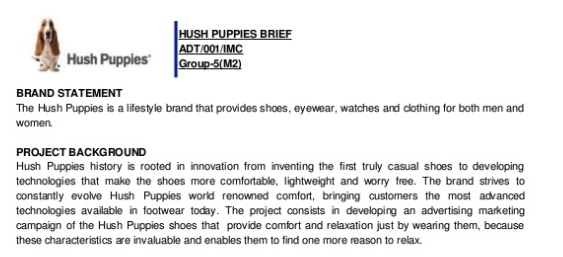
Here’s an example of how the brand statement and background was discussed in a fictional creative brief for Hush Puppies:
2. Highlight challenges and objectives.
Next, write a short paragraph about the brand challenge(s) that your project aims to solve for. Then give more detail on how the project will offer a solution.
This section will be helpful in emphasizing why the project needs to happen. The goal aspects will help you and your team align on the project’s expectations.
If the company or client hasn’t identified any major challenges, you can focus this section on goals and objectives. Explain what a successful project looks like and how it will benefit the company.
If there are a lot of objectives and challenges, you can split these up into two subsections with headers like “Challenge� and “Objective.
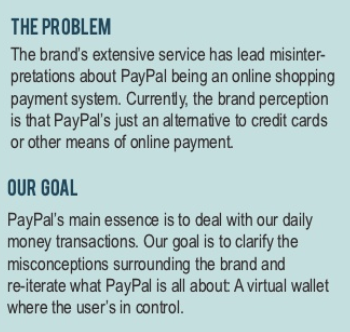
Here’s an example of a sample creative brief for PayPal that offers separate sections for “The Problem� and “The Goal�:
And here’s an example of a sample brief for RedBull which just focuses on the objective:

3. Describe the target audience.
To know what type of content will engage your audience, you and your team need to know your audience. This section requires you to drill down on a specific type of audience and describe what’s important to them.
Along with basic demographics like age, gender, and geography, you should also include factors like customer pain points and motivations in this section of the brief. If you or your client has developed a detailed buyer persona already, this would be a great place to include some of this character’s information.
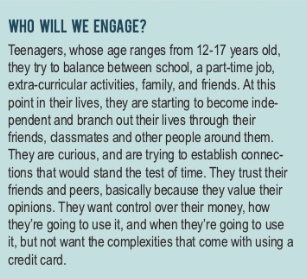
Here’s how the sample brief for PayPal noted above thoughtfully explains a new product’s target audience:
4. Walk through the competitive landscape.
Knowing what your competitors are doing is advantageous for the whole team. You can use competitive data to come up with ideas that they haven’t tried yet, learn from their failed projects, or build a project that improves on a strategy they’ve used in the past.
Include a quick list of competitors with similar product or service offerings. Briefly list a few things your company has in common with them, how your brand has differentiated itself already, and a few areas where this project can help you get ahead.
5. Offer a brief distribution plan.
When the project is done, you’ll need to make sure your audience actually sees it. List a few channels or platforms that you plan to announce the launch on, as well as any promotional content you plan to create.
When drafting this section, think about your target audience. Don’t waste time on a promotional strategy that they won’t see. For example, if you’re promoting a project to Gen-Z, you’ll want to invest in social media rather than billboards or newspaper ads.
Along with listing distribution points, you should also include messages or captions that will go along with promotion.
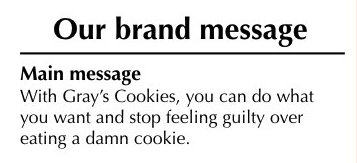
Here’s a sample brief where a specific promotional message is directly stated:
In this section of the brief, you should also note the appropriate voice for your audience. While some audiences, like those in the business world, might prefer more formal language, others might engage more with a casual, relatable tone.To acknowledge the best brand voice, you could write something like, “Our brand voice is a casual and care-free tone because it speaks to younger Gen-Z audiences.�
6. Organize with a template.
Having trouble with the flow and organization of your brief? Here’s a simple template that could help. Copy and paste it into a document and fill in the blanks. You can also add to it or adjust it as needed for your project.
[Inset Company or Client Logo at top]
COMPANY BACKGROUND:
For ___ years, ______ [Brand Name] has been serving customers in the ____________ [group/job field/geographical area] with ____________________ [product or service].
[Brand Name] has made achievements including __________,__________, and ___________. We have also launched marketing campaigns that have touched on ____________,________, and ____________. With the launch of _________ [project name] they hope to ___________.
CHALLENGE/OBJECTIVE:
With this project, the company aims to solve problems related to ____________________, while also expanding on ___________ and improving on _____________.
TARGET AUDIENCE:
Our target audience is ____ [gender], in the age range of _ and _, and live areas like ____, _____, and ______. They enjoy _____, dislike ______, and might work in fields like _____, _____, and _____. They want more of ________ and their daily pain points include ________.
Their favorite products might include _______ and ______. They learn about these products through channels including ________, _________, and _______.
COMPETITION:
Our three biggest competitors [are/will be] ________, ________, and _______. These competitors offer _____, ______, and ______. We are ahead of them in _____ and ______, but we are behind when it comes to product offerings like __________ and _________.
DISTRIBUTION:
We will promote the launch on platforms and channels that our demographic regularly engages with. These will include ________, ________, and _______.
We will also release content including _______, _______, and ________ to gain attention from our audience and inform them of the project.
Below are a few messages we will use:
- _________________________________________________.
- _________________________________________________.
- _________________________________________________.
7. Share the brief.
Once you’ve drafted a creative brief, share it with the team you’ll be working with. You’ll also want to circulate it around the company via Slack, email, or presentations. If you’re a consultant working outside of a client’s company, encourage your clients to share the brief internally.
As you or your clients spread awareness, you should be open to answering questions or taking feedback from colleagues in case they have any great ideas. This strategy will improve team alignment, increase support of the project, and insure that all of your colleagues are on the same page.

I’ve recently been advising a range of leaders in how to start successful innovation programs. A couple are relaunches of efforts that were abandoned in the past, and others are starting from scratch in organizations (and sectors) that are more comfortable with the status quo.
The post A Strategic Approach to Starting a Successful Innovation Program appeared first on Innovation Management.
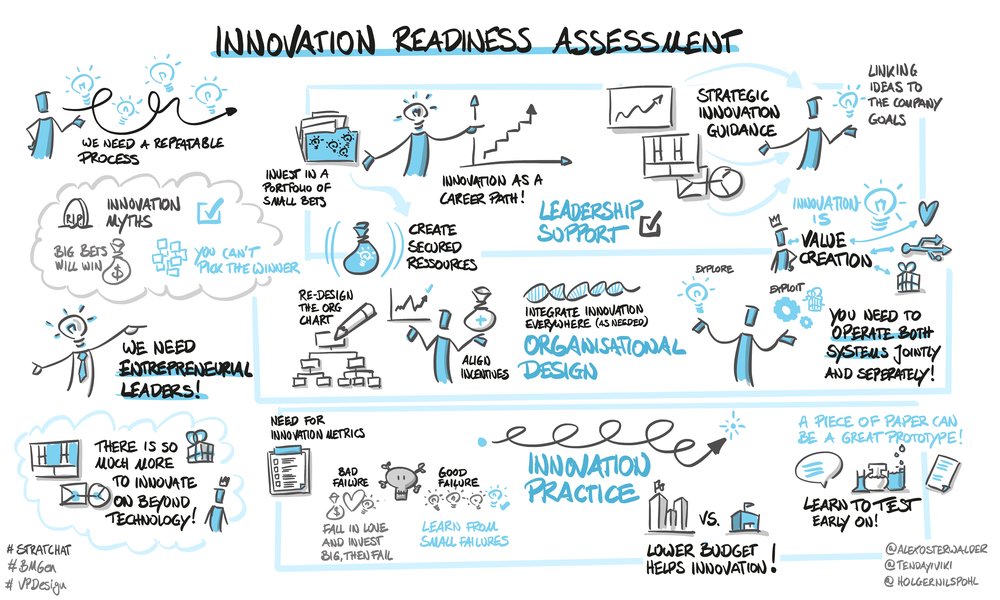
Visual live-drawn by Holger Nils Pohl
As the pace of change in our world has increased, competitive advantages have become temporary. Companies now need to be able to support and nurture innovation – not as one-off projects, but as a repeatable process. Innovation proficiency is no longer optional.
The questions for leaders and intrapreneurs are:
-
How ready is your company to nurture and support innovation?
-
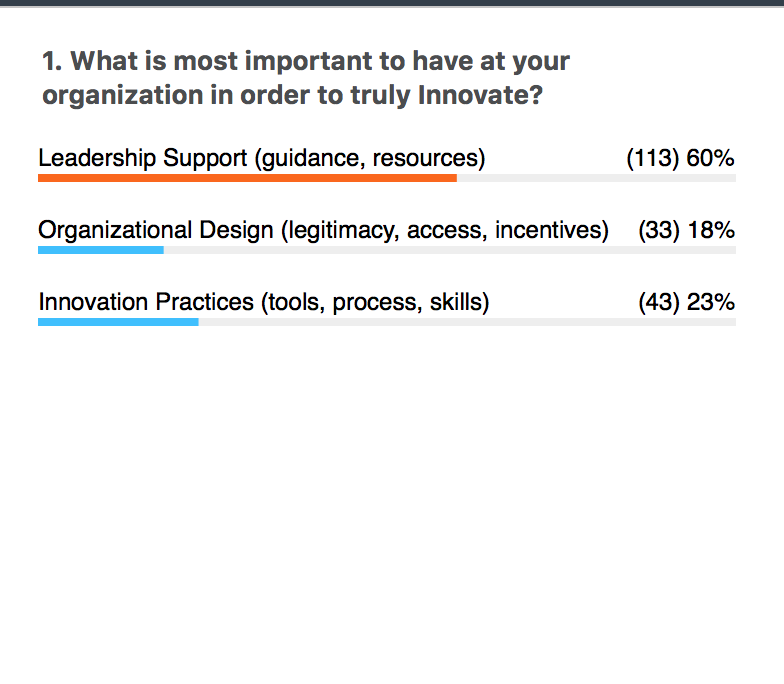
Do you have the right leadership support, organizational design and innovation practice?
In this session, Tendayi Viki, Associate Partner at Strategyzer, Thinkers50 2018 Radar Thinker and the author of The Corporate Startup, joins Alexander Osterwalder in an insightful discussion around how companies can assess their levels of innovation readiness using some of our latest insights from the field.
Enjoy the replay!
Webinar Survey Results:

Some projects suffer from a lack of awareness. If only more people knew about what you were offering, you’d be fine.
But most projects don’t have that problem, not really.
The problem is that the people who are already aware of it don’t take action.
They don’t sign up.
They don’t engage.
They don’t spread the word.
More focus on action and less on awareness usually pays dividends. It’s more difficult of course, because you need to focus on what you make, how you make it and the change you seek to create.
Visual live-drawn by Holger Nils Pohl
As the pace of change in our world has increased, competitive advantages have become temporary. Companies now need to be able to support and nurture innovation – not as one-off projects, but as a repeatable process. Innovation proficiency is no longer optional.
The questions for leaders and intrapreneurs are:
-
How ready is your company to nurture and support innovation?
-
Do you have the right leadership support, organizational design and innovation practice?
In this session, Tendayi Viki, Associate Partner at Strategyzer, Thinkers50 2018 Radar Thinker and the author of The Corporate Startup, joins Alexander Osterwalder in an insightful discussion around how companies can assess their levels of innovation readiness using some of our latest insights from the field.
Enjoy the replay!
Webinar Survey Results:
Adam Dell, founder and CEO of Clarity Money, outlines how his app caught the attention of Marcus by Goldman Sachs.


