


If you want to advance your career, you need to be comfortable speaking up and voicing your opinions. Speaking up not only makes a positive impression, but also conveys your value and confidence. Successful professional knows that preparation is key to…
From forgetting to get a flu shot to failing to enroll in your 401k plan at work, most of us don’t follow through on things we know are important. While overlooking some of these actions may seem harmless in the moment, they can have serious long-term consequences.
“Our intentions are only loosely predictive of our behavior,” says Katy Milkman, author of How to Change: The Science of Getting from Where You Are to Where You Want to Be and professor of operations, information and decision at The Wharton School. “Forgetting may sound like a flimsy excuse for not getting around to something, but even people who have strong intentions can flake out.”
A good example is voting. Milkman’s colleague Todd Rogers, a professor at the Harvard Kennedy School of Government, researched voter turnout and learned that 54% of registered voters who told pollsters they intended to vote in the 2008 U.S. presidential primary failed to show up.
“The most common reason people didn’t vote was because they forgot,” says Milkman. “Whether you intend to vote, get a flu shot, or meditate, there is an action/attention gap that’s as wide as the Grand Canyon. And it’s so solvable.”
Think through the details
After deciding you want to do something, you can increase your chances of actually doing it by planning the implementation in detail, says Milkman. For example, if you want to go to the gym, you’ll be more likely to do it if you think about when you’re going to go, how you’ll get there, and what you will be doing right before you go.
“You can say to yourself, ‘On Thursday at 4 p.m., I will go to gym for 30 minutes. I will drive there after work, and this is what I will do when I get there,’” says Milkman. “Thinking through the details will significantly boost the likeliness you’ll follow through.”
Working through the logistics also helps you anticipate potential pitfalls. “If you say you want to go get your COVID vaccine on Tuesday at 2 p.m., you will be more likely to think about the obstacles that could happen and you’ll be more realistic about your ability to take action,” says Milkman. “You’re more likely to follow through once you make a commitment. It feels uncomfortable to go back on it when something is concrete versus a vague intention. If you commit, you’ll be backing out on yourself.”
To increase the number of people getting to the polls, Rogers not only asked people if they were going to vote; he asked when they would vote and how they were going to get there. The simple prompt increased voter turnout by 9%.
You can also set up cues that prompt you to take action. For example, when this happens, I’ll do this. Cues could be anything that triggers your memory, such as an event or a location. For example, getting a raise could be a cue to increase your monthly retirement contribution.
Planning also helps you break down a goal into bite-size chunks, which can help you take the next action. It acts like a pledge to yourself, increasing your commitment to your goal, says Milkman, adding that you need to be choosy.
“If you form too many cue-based plans at once, you may be discouraged and your commitment may dwindle,” she says.
Set up simple reminders
Another way to stop forgetting to do something is to set up reminders. However, your reminder needs to be well timed. In a 2004 study conducted by John Austin, a psychology professor at Western Michigan University, at a casino, valet staff tested how reminders would impact the number of patrons who buckled their seatbelts. The first group got a reminder to buckle up when they handed their ticket to claim their car. The second group was reminded to “buckle up right away” as the valet pulled up and delivered the car to the customer. And the third group didn’t receive any reminder.
There was virtually no difference between the first and third group. About 55% of drivers buckled up. However, 80% of patrons in the second group fastened their seat belt.
“Reminders work far better when we can act on them immediately,” says Milkman. “They can’t bridge time unless they’re delivered in the moment. Technology can help you remember, but only if the reminders are delivered when you need to do the action right now. Reminders that aren’t timely have far smaller benefits.”
The good news is that when it comes to failing to meet the goals you set for yourself, forgetting may be the easiest obstacles to overcome, says Milkman.
“It’s common to make plans and forget to execute on them,” she says. “Pernicious things can have long-term consequences. Timely reminders and cue-based plans can help combat forgetfulness.”
For Fast Company’s Shape of Tomorrow series, we’re asking business leaders to share their inside perspective on how the COVID-19 era is transforming their industries. Here’s what’s been lost—and what could b…
I’m not editing my emails anymore.
I’ll fix the typos and adjust for clarity. Then I’m hitting send. No more combing the email for one too many exclamation points, no more hovering over “just” a little too long, and n…
You are a couple of weeks into your new job and you have quickly learned there is either no onboarding process or an ineffective one. Your boss was thrilled to see you start on the first day, but you have had very little interaction since. It is unclea…
When we talk about the LGBTQ experience at work, often all the letters get lumped together, and while there is certainly a lot of unity and intersection within the queer community, the experience of being trans, especially at work, brings some u…
Between the #MeToo and Black Lives Matter movements, the Harvey Weinstein and Derek Chauvin trials, and the millions of stories and videos being shared on social media, America has had its eyes opened more than ever to what systemic sexism and racism l…
It’s hard to notice oddities in your culture—they just feel “normal.” But there’s nothing universal about what you consider common sense. It’s all shaped by the world you grew up in.
The book American Ways by G…
A 2015 study by the American College of Occupational and Environmental Medicine found that “a healthy and safe workplace correlates with a company’s performance and its ability to provide positive returns to shareholders.”…
Many women are raised and conditioned to build consensus. Many men, on the other hand, aren’t. Even when they lack expertise, men are encouraged to speak authoritatively—which also extends into their online behavior. Australian feminist and author Dale Spender calls the often-patronizing ways in which men try to “explain” something to women (who may actually know more about the subject than they do) “digital mansplaining.” Many men are simply accustomed to grabbing more airtime in conversations, and if a woman is present, either they’ll interrupt her or talk right over her.
In a digital workplace, this behavior only gets amplified. In a viral Quartz article by Leah Fessler called “Your Company’s Slack Is Probably Sexist,” she noted that men are more likely to declare their opinions as facts and send along a link to an article without comment or sometimes even context. Women by contrast typically explain why they are passing along a link—”per our previous conversation about climate change”—or another way to explain why it might be of interest to the recipient. Says one female Slack user about the comments of her male coworkers, “They just toss [a link] in because their interest in it was enough to warrant sharing it—they’re assuming you’ll receive their gift with graciousness, then they walk away.”
I belong to a Facebook group of peers in the professional speaking industry. It’s evenly divided between men and women who come together every so often to share advice. One guy in our group, whom I’ll call Dan, never responds to questions. He’s not there, it seems, to engage or help. He simply wants an appreciative audience. We all know to avoid him and ignore his behavior. From Dan and others, I’ve observed that digital mansplaining isn’t just about interrupting people, it’s also about a person (usually male) conveying an unassailable entitlement in tone and style.
According to researcher and linguist Susan Herring, the male tendency to mansplain is timeless—and could be seen at the dawn of the internet age. In the early 1990s, for example, Herring joined a listserv comprising more than 1,000 other linguists. “Many were claiming that online, gender and other social differences would be invisible; you wouldn’t be able to tell who was who, or judge anyone based on their identity,” she recalls. That wasn’t the case, though. The online discussions that Herring at least followed tended to be divisive. One especially caught her eye, as the topic in question had broad appeal across the entire linguistic community and historically prompted numerous, valid opinions from both genders. “However, it was almost entirely men engaging,” Herring remembers.
Wondering why the women in the group were holding back, Herring sent out a survey. When the results came in, nearly all the female respondents reported that they disliked the contentious style and tone of the digital discussion, and found participating in it to be unproductive. Herring finds this same dynamic on crowdsourced Wikipedia articles, concluding what a lot of people (especially women) know already, namely that “some contributors, anonymous and otherwise, use rude and haranguing language. Such environments are—if not outright intimidating—unappealing to many women.”
That said, is there such a thing as “womansplaining?” Does it go both ways?
In my case, at least, I admit it might. Every year, for example, my family plans a group vacation. A few years ago, during a particularly busy time in my career, my husband volunteered to take over my traditional duties as chief vacation officer. Reluctantly I agreed, assuming he would be terrible at it.
Over the next few weeks, in addition to juggling my work schedule, I insisted on reviewing every vacation option he came up with. Had he checked to see if the hotel offered free breakfast? Were there photos of the rooms he’d reserved? Hold on a second—was I mansplaining, no, wait, womansplaining? I was. I was interrupting and talking over his plans and ideas with my own plans and ideas, which I secretly suspected were superior. Even when he and I agreed on something, I insisted on saying it louder. Yeah, I can be a micromanager and a know-it-all, and aren’t those secondary characteristics of a man- or womansplainer?
Is there any way to shut a peoplesplainer down? Yes. Managers can stop digital interrupters from hijacking a phone or video call by being firm about who speaks, and for how long. “Follow good chairing protocols,” advises André Spicer, an expert in organizational behavior at Cass Business School in London. “At the beginning, say: ‘This is the purpose of the meeting, this is how long we’ve got, we’re going to spend this much time on each item, and here’s how we’d like you to share.’” Simply being more aware of who is “loudest” in messages, on phone calls, and in meetings will help you guide your team to collaborate confidently by making sure everyone gets sufficient airtime.
The digital workplace flattens many traditional gender biases we’ve known for years. Women can be more resolute, and men can realize there is new space to show warmth and affection. At the same time, certain traditional gender norms are amplified, such as women who still feel the need to be “liked” by peppering their digital communications with exclamation marks and modifiers. Perhaps the greatest advantage is that our digital body language provides an accurate visual mirror that reflects what has occurred for so long in spoken cross-gender communication. Maybe looking in that mirror, we can ask ourselves: how can I just be myself?
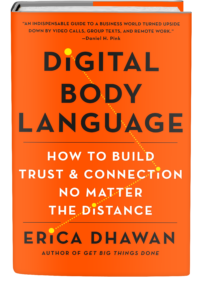
Modified excerpt from Digital Body Language: How to Build Trust and Connection, No Matter the Distance by Erica Dhawan. Copyright © 2021 by the author and reprinted by permission of St. Martin’s Publishing Group.
Erica Dhawan is a leading expert on 21st-century collaboration and innovation. She is an award-winning keynote speaker and the author of the new book Digital Body Language. Download her free guide to “End Digital Burnout.”


