


If you’re looking for a job and watching the coming COVID-19 holiday season loom, don’t despair: It could be your lucky break.
“My advice around the holiday season is to keep the search active,” says Sharon Patterson, chief …
At Fast Company we’ve been writing about how to beat distractions and find more focus at work for years—we’ve even covered the topics on this podcast before. But right now, all of the normal advice feels less practical. Between the…
We know that algorithms can outperform humans across an expanding range of settings, from medical diagnosis and image recognition to crime prediction. However, an ongoing concern is the potential for automated approaches to codify existing human biases…
Winter is coming. As it gets darker and colder, the desire to snuggle up on your couch in your well-worn yoga pants and sweatshirt is stronger than it was at the start of the pandemic.
This is where the pandemic blues merge with the winter blues and yo…
The majority of professionals who began working remotely in the spring as a result of the pandemic would like to keep working that way after it’s safe to return to the office. A recent FlexJobs survey of more than 4,000 people who’ve been…
Imagine some of the most of the frustrating interactions you have over the course of your workday. Your voice isn’t being heard during meetings; HR sends vague, confusing emails. You feel a rising sense of anxiety that your direct reports won&#x…
Kay Koplovitz and Alli McCartney are friends and advocates for female financial empowerment. Koplovitz is a media pioneer: she founded and served as CEO of USA Networks, now part of NBC Universal. She also is and cofounder and chairman of Springboard G…
Jingle Jangle: A Christmas Journey has all the familiar beats of a classic Christmas movie: There’s the gruff yet lovable guy who’s given up on believing in magic. There’s the plucky kid who turns his world around with her pollyannaish charm. And there’s a whole soundtrack of show stopping numbers.
However, what makes Jingle Jangle undeniably special is how writer and director David E. Talbert dresses that framework.
The world of Jingle Jangle centers an all-Black cast in a Victorian period setting that’s been richly draped in African culture. From the wardrobe, to the music, to the characters, there’s a vibrancy in Jingle Jangle‘s representation that feels singular, especially for a Christmas movie.
And all Talbert needed to capture it was his wife and son, free creative rein from Netflix—and 20 years.
“My son melted my heart.”
Jingle Jangle tells the story of Jeronicus Jangle (Forest Whitaker), a beloved toy maker who loses hope after a series of unfortunate events, including his trusted apprentice stealing his prized book of inventions. A few days before Christmas, Jeronicus’s estranged daughter Jessica (Anika Noni Rose) sends her own daughter and budding inventor Journey (Madalen Mills) to spend time with her grandfather. Over the course of a few days and misadventures, Journey fights past Jeronicus’s tough exterior and gets him to believe in magic—and himself—once again.
It’s an idea that Talbert, who is also an Award-winning playwright, initially conceived for the stage back in 1998 when he first began writing it. He wanted to create a musical with all the whimsy and wonder of the Christmas spirit as seen through the eyes of a child.
The problem was he wasn’t a child.
“I was 32 when I started writing it,” says Talbert who’s now 55. “I couldn’t quite access that POV authentically.”
It wasn’t until the birth of his son Elias, who’s now 7, that Talbert began to gain the perspective he needed—not to mention get feedback on some of the toy characters in the film.
“I started to look at the world through his eyes,” Talbert says. “I would say, ‘What do you think of the design of Buddy? What do you think of Don Juan?’ And he would let me know. That’s what gave me the courage this time to do it.”
Talbert also says that his son helped him lean into the film’s core relationship between Jeronicus and Journey.
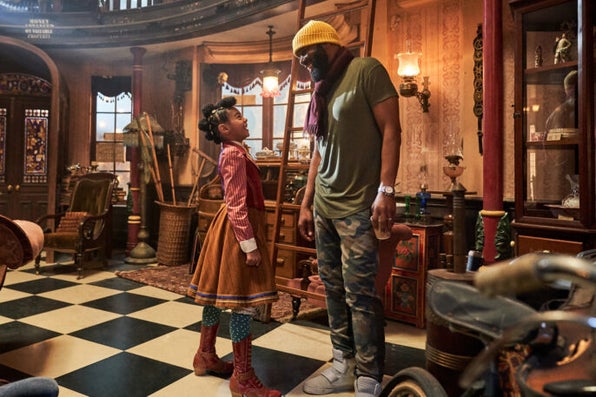
“My son melted my heart. It was like The Grinch,” Talbert says of his disposition working in Hollywood over the years, “with everything that was going on with the studios—you try to sell a movie or a movie doesn’t open up as big as you would hoped it would.”
“But when I would come home,” Talbert continues. “I’d turn the key and he would come to top of the stairs and say, ‘Daddy!’ He is pure optimism, pure fun, pure love. It’s that kind of joy that I was able to reconnect with and then infuse in this work.”
In a way, Jingle Jangle is as much family project as it is family film, with not only the inspiration Talbert’s son provided, but also the production insight his wife lent to the film as well.
“I’m the sizzle—she’s a steak.”
Throughout his 30-year career, Talbert’s wife Lyn Sisson-Talbert has produced all of his plays and films.
“She’s the brains of the operation,” Talbert says. “I’m the sizzle—she’s a steak.”
One of Sisson-Talbert’s key contributions to Jingle Jangle was her vision of creating that Afro-Victorian look and feel to the production, including the natural hair styles in the film.
“She’s a Leo, so aesthetics and fashion is her whole thing,” Talbert says. “She’s the secret sauce on why it looks the way it looks.”

That, Talbert adds, has been the case since day one of their professional relationship—and it’s also why he wanted to help put a stamp on her contributions to the film.
“She immediately came in with this freshness and this look, touch, and feel for my work,” Talbert says. “But the toughest thing for a wife of a director and a woman in the business is many times you’re perceived as a ‘must hire’ or a ‘vanity credit.’ She’d been holding down the fort for a long time, and what was most important with this film was to put her out front as a lead producer. So people could see her contributions independent of me. She shined, and I couldn’t be more proud of her.”
Watching Jingle Jangle, it’s clear that Sisson-Talbert has exquisite, albeit expensive, taste.
Enter Netflix.
“Write your imagination.”
Back when Talbert was still trying to make Jingle Jangle for the stage, he kept slamming into budgetary restrictions. Having made a film for Netflix in the past, 2017’s El Camino Christmas, Talbert decided to bring the idea to Scott Stuber, head of Netflix’s original film division.
“I told him about the holidays and how much they mean to my family. But when we sit down every year, there’s nothing we can watch with anybody that looks like us. If we’re feeling this way as a family, imagine how many families around the world are feeling the same way?” Talbert says. “And Scott said we need to do something about that.”
Talbert pitched his idea, and Netflix scooped it up with one key provision.
“Before I started writing [Stuber] said something that changed the course of my life as a creative: He said, ‘As you’re about to write this, I want you to write your imagination. We’ll figure out the budget later,’” Talbert says. “I couldn’t be hearing right, because I was used to people saying, ‘You got $2 dollars—and don’t let this go to $2.25, or that’s going to be your 25 cents.’”
“I would always have to write with a ceiling and a box that I was put in,” Talbert continues. “And I wasn’t mad at it, but I was just trained that you cannot go outside of this box. Therefore your imagination can’t go outside of this box.”
With that prompt from Netflix, Talbert says it took about three days for him to retrain his brain to think without a budget in mind.
“What is my imagination if I could do anything I wanted to? What would that look like? I had to summon that again,” he says. “I ended up doubling the budget that was originally set, but they were very conscious with what I was doing. They wanted to invest in wonder. They wanted to give me the tools that all the other big event movies have that we haven’t had.”
And, oh what foresight to invest in a movie rooted in Blackness and depicting unfiltered hope and love to bow at the end of such a cataclysmic year as 2020.
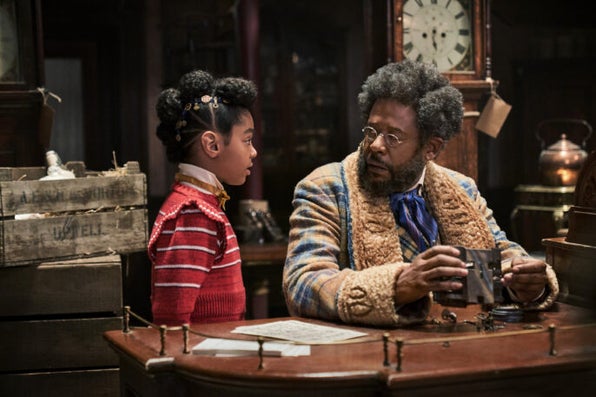
“The pandemic, the political shenanigans, the racial unrest, we’re right smack dab in the middle of all three. And if we ever needed something to remind us that there’s hope it’s this film,” Talbert says.
That said, Talbert is clear that while the film centers Black characters, the messages in the film are universal.
“We were unapologetic in the representation that we wanted, but it has nothing to do with any of that,” Talbert says. “It has everything to do with the humanity and the heart of these characters who happened to be Black—not Black characters who happened to have humanity.”
While on the subject of hope, Talbert is hopeful that 2020 has signaled a permanent shift in entertainment companies investing the money and creative freedom for creators of color to tell their stories.
“I feel differently than I’ve ever felt before that it isn’t just lip service, and it isn’t just for a press release this time,” Talbert says. “I feel there’s genuine desire to be inclusive in this town and nothing happens overnight.”
Having worked on a project like Jingle Jangle, Talbert says there’s no way he can go backwards from here.
“I won’t go back to making a $2 movie, and I won’t allow the art to be put in a box anymore, because I have experienced what it feels like having resources and support,” Talbert says. “It’s a new world for me, and I’m excited to keep pushing the boundaries.”
Jingle Jangle is streaming now on Netflix.
While teams have been using Slack for communication and collaboration since long before COVID-19, the platform became a good substitute for watercooler talk when working arrangements went remote. Quick conversations in the office can promote team bonding, and instant messaging can too. But the written word removes context, and always-on technology can feel intrusive. As a result, Slack can lead to misunderstandings. To get the most out of the tool, it helps to follow these rules of etiquette.
1. Establish expectations in your profile
To prevent constant Slack overflow into personal time, take a few minutes to set your profile with key information, suggests Sara Teare, cofounder of the password manager platform 1Password. “Things like their work schedule, time zone, department, focus at work, preferred pronouns, and contact information,” she says. “This is vital to set expectations around when a team member is available for a quick Slack DM, and when a less-likely-to-get-lost email is more appropriate.”
You can also update your status to alert members of your availability, adds Vicki Salemi, career expert for the job site Monster. “In turn, be respectful of colleagues’ status such as ‘working on a deadline—DND,’” she says.
2. Separate topics
“Too many conversations started unrelated to the goal of a channel means people start to tune out and ignore the channel, meaning important messages get missed,” says Teare. “Having a number of different channels with specific topics/focuses makes it easier to keep things relevant—and include channels for fun stuff, too. That way people can share cat pictures, weekend plans, and Baby Yoda memes in a place where everyone expects to see them.”
Remind employees to create clear channel descriptions, adds Salemi. “This can help reiterate the purpose of the channel in case conversations go off-track,” she says.
To boost morale, employers may encourage workers to create a #random or #bookclub channel to encourage teammates to share nonwork conversations. “This can also help steer work-related topics specifically for work as workers can turn to these nonwork channels to connect,” says Salemi.
3. Be cautious about divisive topics
Having nonwork channels helps employees bring their authentic selves to work, says Fernando Matzkin, chief business officer of North America for the software development company Globant. However, talking about politics or sports could present the opportunity to be divisive.
“Any company’s mission should be facilitating diverse spaces that allow both personal and work conversations,” he says. “To best mitigate uncomfortable or combative situations, including ones on chat, it’s crucial for organizations to take a stance on what they believe is the social norm for their organization. Some examples could be to remain respectful, act with kindness, and be inclusive. This way, everyone is equally committed to build a respectful and inclusive place, where everyone can participate and be the best version of themselves.”
4. Set norms
Once you establish the team norms, publish them and make sure they’re adopted by senior leaders, says Dan Pontefract, author of Lead. Care. Win. How to Become a Leader Who Matters.
“Many employees look up the hierarchy to model behaviors exhibited by senior leaders,” he says. “If they refrain from being civil, there is a next to zero chance employees will be civil.”
Pontefract recommends including Slack etiquette norms in onboarding or new hire orientation programs. And recognize those who demonstrate them.
Companies empower employees by leading by example, adds Salemi. “Leadership using Slack can set the bar in terms of tone and interaction as well as encouraging their employees to provide feedback to colleagues if they’re misusing it,” she says. “If inappropriate language is used, for instance, it should be addressed privately with the employee.”
5. Know when it’s not the right tool
Since Slack is easy, it’s also easy to be misused. “You wouldn’t walk into a room and yell when you just want to talk to one person, so why use Slack that way?” asks Teare. In many cases, direct messages or other tools could be more appropriate.
“Make sure that you are keeping the goal of your messages in line with how it’s being communicated,” says Teare. “Is it something everyone needs to instantly know? Slack is exactly what you need. Looking for advice on a sticky issue? Starting a thread in the right channel is the way to go. Wanting to update your address with HR? Nope, not Slack. Keep that one to email.”
I talk ad nauseum about the importance for companies, especially high-growth startups, to hire people who exhibit exceptional emotional intelligence. I’m not the first one who has come to this conclusion, but I think more people need to realize …


