


There’s a question I ask every guest on my podcast, Inspired with Alexa von Tobel. It comes near the end of every conversation, after we’ve gone deep on business models, hard pivots, and the relentless grind of building something from noth…
As artificial intelligence puts Americans out of work, there are programs available to help them land on their feet—but experts warn they’ll need to ramp up quickly to meet the demand.
One new pilot program sends a $1,000 monthly stipend to workers…
Women face discrimination on several different fronts at work. They are 14% less likely to be promoted than their male colleagues. They still face pay gaps. And they suffer professionally for being caregivers at home, facing higher levels of burnout a…
Compliments come in many forms, and handling them well is an important part of building strong relationships and projecting a positive image. Sometimes a simple “Thank you” will do. But in other cases, praise may have a negative undertone, which you w…
This week, Starbucks unveiled plans to open an office in Nashville, in a bid to establish a home base in the Southeast. The coffee giant is investing $100 million in this expansion and plans to staff the new office with thousands of workers within the…
The great jazz trumpeter Miles Davis once said, “Sometimes you have to play a long time to be able to play like yourself.” This is why the best artists are not only masterful at their craft but also distinctive in their voice; they’ve committed themselves to the process of being themselves. Subsequently, this means they committed themselves to the failure that comes along with it also. But that’s the part no one talks about—the work required to “become” who we are or, better yet, who we want to be. It’s as if we’re expected to go to the gym and walk out with a six-pack. That’s not how the gym works, nor is it how work works. And we know this. There’s a process to becoming, and that process inherently requires failure.
Be that as it may, there are no LinkedIn claps reserved for failing. There are no at-a-boys for coming up short, despite the reality that we’ve all experienced failure to get to where we are. But of course, failure is just a natural part of the process of becoming. So why do we omit this truth from our stories when we tell the tale of becoming ourselves? Why do we whitewash the parts that aren’t so flattering and “yada yada yada” our narratives to a flatten expression of self. I get the fact that no one wants to fail, let alone admit to it. However, I also realize that in order to get good at something, we have to work through being not so good first. So, maybe we should practice sharing the entire story more frequently to help folks more successfully navigate this process of becoming. That’s exactly why we invited Courtnee LeClaire onto the FOR THE CULTURE podcast. LeClaire’s career trajectory consists of a who’s-who of brands. She was the head of worldwide app marketing and corporate partnerships at Apple after launching the iPod and iPhone. She’s held executive marketing seats at Disney and Intel before serving as CMO of the Oakland Raiders. But these days, LeClaire boasts a different title. Today, she is a chief “becoming” officer, an executive coach that helps leaders become their best selves, who they truly are, to help them achieve what Paul Coelho’s The Alchemist would call their personal legend. Despite her long list of impressive accomplishments, in this new role LeClaire spends more time talking about her failures, but she makes a pointed distinction between “failure” and “failing” that unlocks many of the challenges we have with failure.
Failure, as LeClaire bifurcates, is a complete sentence. It’s done, and, therefore, it occupies real estate in our lives like a title—I failed, so I’m a failure. Failing, on the other hand, is an active sentence, meaning that there’s something that comes after it. And it’s the something that comes after it that enables us to do something about it. I’m failing, so I need to [fill the blank]. I was failing, so I [fill in a blank some action].
The reframing of failure to failing is what opens the door for success. Whether it’s something new or something new to us, there will be a point when we are failing relative to our ambition and taste. But when we perceive it as an active sentence, we give ourselves room to improve. Failure is something we experience, not who we are. It’s a moment in time, and because it’s something we’re merely experiencing, that means we can change it. This distinction is critical. One is a state of who we are (failure), and the other is a state of where we are (failing). When we reposition failure to failing (or I was failing), we acknowledge the reality of where we are relative to where we want to be and can now honor the fact that this is just a part of the process.
To hear this from LeClaire during our conversation on the pod had a profound impact on me personally because I worked with her during my time at Apple. She was much more senior than I was, and I “totemized” her as the consummate example of having it all together. She wasn’t in my reporting vertical, but I got to engage her from time to time, where she’d drop marketing wisdom and sage advice for how to navigate life on One Infinite Loop. To hear her reveal her moments of failing on her way to becoming, even in those moments when I held her on a pedestal, was like learning that Spiderman is really Peter Parker. That is to say, LeClaire, like all of us, had to play a lot to learn to play like herself. Fancy that.
Hearing this not only humanized LeClaire but also gave me permission to admit to my own failings and accept the fact that we’re all just buffering, even the best of us, as we become our best selves. Imagine how empowering that would be if we all started to share our own processes of becoming, moving from failure to failing; it might help us all navigate the process with a bit more grace—and perhaps even a bit more success.
Check out the full episode of our conversation with Courtnee LeClaire on the latest episode of the FOR THE CULTURE podcast on Spotify or wherever you get your podcast.
Human beings are obsessed with change. As large scale scientific studies show, most of us would like to change at least some aspects of our personality, defined as consistent patterns of behaviors or habits that make us who we are and different from others. For example, I’d love to be less impulsive, excitable, or cynical, which is why I have been working on not being myself for many years. Likewise, most individuals want to grow, to develop new adaptations that make them a better version of themselves, and organizations are equally interested in transforming, which typically depends on their people’s ability to grow and evolve.
At its core, change is not about becoming someone else. Rather, it is about becoming a less exaggerated or extreme version of yourself. Most of our strengths, when overused, become weaknesses. Confidence becomes arrogance, attention to detail turns into obsessional perfectionism, and resilience mutates into stubbornness or “false hopes” in the face of problems and challenges that undermine our potential. Real development is not reinvention but calibration. Think of it as the ability to regulate your natural tendencies so they fit the demands of the situation, or optimize your behavior to develop better adaptations and become a more versatile and effective version of yourself, keeping your limitations and flaws in check, especially in high-stakes or critical situations.
Sadly, left to our own devices, we rarely change.
Human behavior is remarkably stable. Personality traits show high levels of consistency over time, and even when people receive feedback, they tend to interpret it in ways that protect their self-image. We are biased toward seeing ourselves as better than we are, and we systematically underestimate the gap between how we see ourselves and how others see us.
This is where coaching comes in…
The evidence is clear: coaching works, but not always, and not equally for all. A landmark meta-analysis by Tim Theeboom and colleagues found that coaching has significant positive effects on performance, well-being, coping, and goal attainment, with effect sizes ranging from moderate to large. More recent meta-analyses confirm that workplace coaching consistently leads to positive organizational outcomes, particularly when it focuses on behavior change.
The key insight is that coaching is not a placebo. It is a scientifically validated intervention. But like most interventions, its effectiveness depends on how it is designed and delivered, who it’s delivered by, and of course who the recipient of coaching is.
Some coaching relationships are transformative. Others are pleasant but inconsequential, like chatting to a friend of hairdresser. The difference is rarely about whether coaching “works” in principle. It is about whether the right coach is matched to the right person, for the right goal, in the right way.
Four factors
Choosing a coach, therefore, should be treated as a high-stakes decision. Yet most people approach it casually, relying on reputation, referrals, or vague impressions of “chemistry.” That is not enough.
There are four factors that matter most.
1) First, personality chemistry and style fit. Coaching is fundamentally a relationship, and like any relationship, it depends on trust. But chemistry is not just about liking someone. It is about alignment between the coach’s style and the coachee’s needs. Some coaches are direct and confrontational, excelling at telling people what they need to hear, even when they really don’t want to hear it. They challenge assumptions, provide blunt feedback, and push for rapid change. Others are more facilitative and supportive, helping individuals reflect and arrive at their own conclusions. Neither approach is inherently superior. The question is which one works for you. If you are defensive, overconfident, or prone to dismiss feedback, you may need a coach who is willing to confront you. If you are already self-critical or risk-averse, a more supportive approach may be more effective. The goal is not comfort, but progress.
There is also a personality dimension. Research suggests that similarity can build rapport, but difference can drive growth. A coach who mirrors your worldview may feel comfortable but may not stretch you. A coach who is too different may create friction without insight. The optimal point is somewhere in between: enough overlap to build trust, enough difference to challenge your thinking.
2) Second, method fit to goal. Not all coaching is the same, and not all goals require the same approach. If your objective is to improve a specific skill, such as communication or decision-making, a structured, behavioral approach with clear feedback loops may be most effective. If your challenge is more psychological, such as managing derailers, improving self-awareness, or navigating interpersonal dynamics, a deeper, more reflective approach may be required.
Some coaches draw on cognitive-behavioral techniques. Others rely on psychodynamic frameworks, systems thinking, or data-driven assessments. Increasingly, coaching is also augmented by analytics and AI. None of these approaches is universally better. What matters is alignment with the outcome you seek.
Too often, organizations adopt a one-size-fits-all approach to coaching, offering the same intervention regardless of the problem. This is equivalent to prescribing the same medication for every illness. It is convenient, but ineffective.
3) Third, expertise and proficiency. The coaching industry is largely unregulated, which means quality varies significantly. Anyone can call themselves a coach. Not everyone should, and not everyone is qualified.
It is not enough for a coach to have a preferred method. They need to be good at it. This includes formal training, relevant experience, and, critically, a track record of impact. Have they worked with people at your level? Do they understand your context? Can they translate insight into action?
In an era where AI can generate generic advice instantly, the value of a coach lies not in providing information, but in interpreting it, contextualizing it, and applying it to your specific situation. As I have argued in I, Human, the differentiator in the AI age is not access to answers, but the quality of judgment applied to those answers. A good coach enhances your judgment. A mediocre one simply adds noise.
4) Fourth, and avoid stagnation through measurement and iteration. Coaching should not be an open-ended, indefinite process. It should be structured, with clear goals, regular checkpoints, and measurable outcomes. This is where many coaching engagements fall short. They focus on conversations rather than outcomes. They create insight, but not change.
Effective coaching requires experimentation. Try new behaviors, gather feedback, adjust, and repeat. It also requires measurement. Progress should be assessed not only through self-reports, but through observable indicators. These may include improvements in team engagement, changes in leadership behavior as captured by 360 feedback, enhanced performance metrics, or even hard business outcomes. Research suggests that coaching has its strongest impact on behavioral change, which is precisely what should be measured. Indeed, without measurement, coaching risks becoming what much of corporate life already is: well-intentioned but performative.
The AI role
In many ways, selecting a coach is similar to selecting a leader. You are making a bet on someone’s ability to influence behavior and drive outcomes. You would not make that decision lightly in a business context. You should not make it lightly here.
In the age of AI, the stakes are even higher. As machines take over more of the cognitive heavy lifting, the human edge will depend on adaptability, self-awareness, and the ability to evolve. Coaching, when done right, can enhance all three. The right coach will not change who you are. They will help you become a more effective version of yourself. They will challenge your assumptions, expose your blind spots, and help you build the adaptations you need to succeed so that the best version of yourself shows up more frequently, and the worst version is contained or silenced, at least during critical work interactions.
You can feel everything—the frustration, irritation, and fear—and still choose your response from a place of calm. That’s what the Stoics (thinkers from ancient Greece and Rome) have taught me. Stoicism is staying calm when life isn’t, focusing on wha…
Open almost any newspaper, scroll through LinkedIn, or listen to the latest business podcast, and you will encounter a familiar theme: the return of the strong leader. From “wartime CEOs” to hard-charging founders and authoritarian coaching styles in elite sports, and the virtues of “hands on” leaders, there is a growing narrative that command-and-control leadership is not only back, but necessary. The appeal is intuitive. When the world feels volatile and uncertain, decisiveness offers comfort, and centralized authority promises clarity.
But, is this resurgence real, or are we simply observing a handful of highly visible cases amplified by media and investor attention? More importantly, what does the evidence actually tell us about the effectiveness of top-down leadership compared with more participative approaches?
To answer these questions, it is useful to distinguish between perception and reality.
Ever present
First, we find that command-and-control leadership never really disappeared. In fact, it has always been present in certain contexts, particularly those characterized by time pressure, high risk, and tightly coupled systems. As former White House Chief of Staff Rahm Emanuel famously put it, one should “never let a good crisis go to waste,” a reminder that disruption often expands both the appetite and the tolerance for more directive leadership. In such environments, centralized authority can offer clear advantages. Why? Because it enables faster decision-making, reduces ambiguity, and clarifies accountability. In crises, when coordination matters more than deliberation, these qualities can be valuable.
There is also a psychological explanation for its appeal. Freud famously argued that groups have a natural tendency to idealize strong leaders, projecting onto them a sense of certainty, protection, and authority that reduces individual anxiety. In line, humans in groups regress psychologically and transfer their ego ideal onto a leader, whom they then idealize and obey. The key mechanism is identification with the leader and a reduced tolerance for ambiguity, which helps explain the attraction to strong, authoritative figures. The result is a recurring attraction to “alpha” leadership, not necessarily because it is more effective, but because it feels more reassuring.
Although most of Freud’s observations were the product of his own clinical intuition and creative imagination, they were often backed up by subsequent empirical science. Indeed, decades of behavioral research show that uncertainty increases our preference for, well, certainty. In other words, the more ambivalent or ambiguous things are, the more we crave clarity and closure. This is where romanticizing about strong leaders makes sense; they will (appear to) fill in that certainty gap by providing confident, simple, clear-cut, compelling explanations or interpretations of reality (brushing aside uncomfortable ambiguities) also matching them with a proneness to action and bold decision making. In this sense, command-and-control leadership often provides not just direction, but emotional reassurance. And in a complex and ambiguous world in which it is even difficult to judge leadership performance or the contribution individual leaders actually make to success, we are often prone to over-attribute success to these charismatic individuals and under-appreciate the collective systems that underpin performance.
However, stories are not the same as evidence. And when we move beyond anecdotes to large-scale empirical research, a different picture emerges.
Seeking diverse perspectives
Indeed, recent meta-analyses evidence suggests that authoritarian leadership tends to erode work climate, suppress initiative and innovation, and increase employees’ intention to leave, with any performance gains largely confined to specific, short-term, high-pressure situations. As one of us (Amy) has. extensively documented, cultures that discourage dissent and concentrate decision-making power tend to suppress information, limit experimentation, and increase the risk of strategic error. By contrast, environments characterized by psychological safety, leader humility, and distributed input are more likely to foster innovation, adaptability, and sustained performance.
One important nuance is often overlooked in these debates: the difference between who makes the decision and who contributes to it. Effective leaders do not necessarily decentralize authority, but they do decentralize input. They retain responsibility for final decisions while actively seeking diverse perspectives, data, and dissenting views. This distinction is critical. It allows organizations to benefit from both clarity and inclusiveness, avoiding the false trade-off between speed and participation.
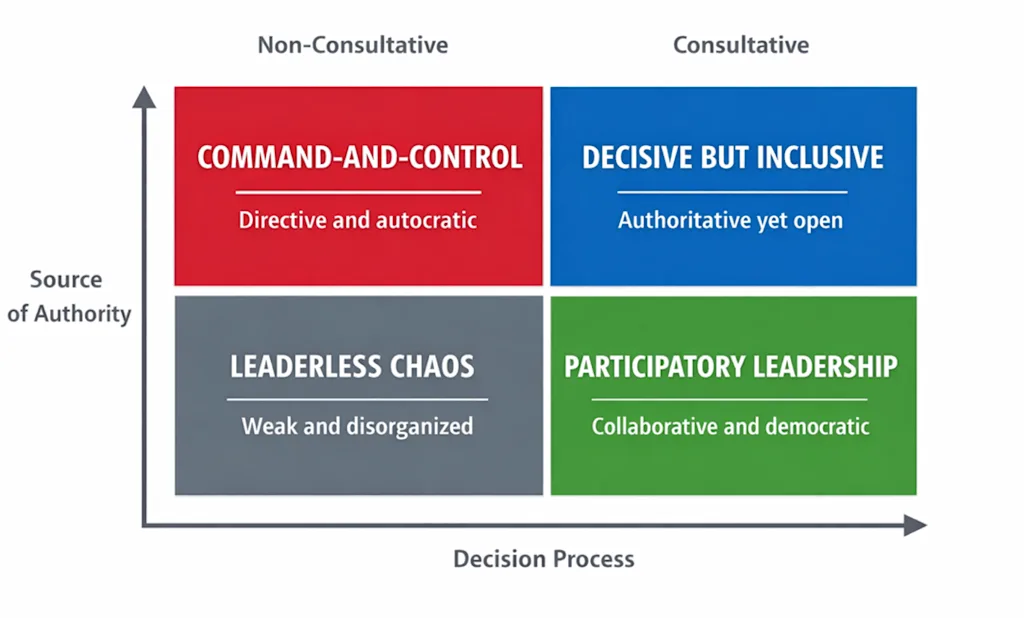
To make sense of the debate around command-and-control leadership, it is helpful to distinguish between two key dimensions: the decision process and ownership (ranging from non-consultative to consultative) and the source of authority and input (ranging from centralized to distributed). As the above 2 x 2 figure illustrates, these dimensions generate four distinct leadership modes:
In the top-left quadrant, where authority is centralized and the decision process is non-consultative, we find command-and-control leadership. This style is directive and autocratic, relying on unilateral decision-making with minimal input from others. It can deliver speed and clarity, particularly in crises, but it also risks suppressing dissent, overlooking critical information, and amplifying leader bias. The result, in the face of uncertainty and complexity, is too often failure.
In the top-right quadrant, where authority remains centralized but the decision process is consultative, we see decisive but inclusive leadership. This approach is authoritative yet open. Leaders retain control over final decisions while actively seeking input, expertise, and dissenting views. This model tends to produce higher-quality decisions in complex environments, as it combines accountability with access to broader intelligence. Although it may appear to be time-consuming, in reality it can be carried out efficiently and effectively.
In the bottom-left quadrant, where authority is distributed but the decision process remains non-consultative, we encounter leaderless chaos. This mode is weak and disorganized, characterized by unclear accountability and insufficient coordination. Decision-making is fragmented, and the absence of both strong leadership and meaningful consultation often leads to inconsistency and poor outcomes.
Finally, in the bottom-right quadrant, where authority is distributed and the decision process is consultative, we find participatory leadership. This style is collaborative and democratic, with shared decision-making and broad involvement. It can be highly effective in knowledge-intensive settings with skilled teams, though it may slow decisions and create coordination challenges if not carefully managed.
Balance is key
The key insight is that leadership effectiveness does not hinge on choosing one quadrant over another, but on understanding when each mode is appropriate (though, admittedly, this rarely applies to leaderless chaos, a state which by definition trends towards its own extinction). In practice, the most effective leaders gravitate toward being decisive and inclusive, combining clear authority with openness to input, while avoiding the pitfalls of both rigid command-and-control and unstructured participation.
In short, the limitations of command-and-control leadership become especially pronounced in complex, knowledge-intensive environments. No individual, regardless of experience or intelligence, possesses all the expertise or information required to navigate today’s challenges. Overconfidence at the top can therefore become a liability, leading to simplified thinking, blind spots, and costly mistakes. Concentrated power may deliver short-term alignment, but it often undermines long-term resilience.
The evidence instead points to a more balanced model of leadership. The most effective leaders combine direction with openness, authority with accountability, and decisiveness with learning. They create systems that encourage input without sacrificing clarity, and they recognize that their role is not to have all the answers, but to ensure that the right questions are asked.
As we have argued, this is particularly relevant in an era increasingly shaped by AI and data. As information becomes more abundant and accessible, leadership advantage shifts away from issuing directives toward designing systems that harness collective intelligence. The challenge is no longer to control information flows, but to integrate them effectively.
In that sense, the enduring lesson from decades of research is not that command-and-control leadership is obsolete, but that it is highly contextual and often overvalued. It may work in narrowly specific situations, especially in the short term, but it is rarely a reliable foundation for sustained performance. More broadly, leadership trends tend to oscillate. After years of emphasizing servant, humble, and coaching-oriented leadership, it is perhaps unsurprising that the pendulum swings back toward more directive styles. The real skill, however, is not to move from one extreme to another, but to remain versatile and flexibly moderate, which ought to include the ability to not “just be themselves”, calibrating one’s approach to the context. Effective leaders, in that sense, do not default to a single style; they adapt, drawing selectively from different modes to balance control and inclusion as circumstances require.
Whatever style or model leaders employ, though, it will always be easier for them to get things done and have a positive long-lasting impact if they are capable of bringing people along, motivating them to change their beliefs, and inspire rather than force them to action. As the brilliant political scientist Richard Neustadt observed, effective leadership in complex systems relies less on formal authority and more on influence. It requires persuasion rather than command, curiosity rather than certainty, and a disciplined focus on long-term consequences rather than short-term control. The real question, then, is not whether command-and-control leadership is back, but why we are so often tempted to believe that it works better than it does.
Oracle recently laid off thousands of employees by email. While headlines focused on the losses, another story is also unfolding quietly among those who remain, in offices, Slack channels, and video calls.
If you survived a layoff, you’re likely f…


