


In June, Sophia Amoruso stepped down as CEO of Girlboss, the media company she founded after her book (by the same name) sold half a million copies. It was an unexpected move both for the company, which had just been acquired by media investment firm Attention Capital, and for the Girlboss herself.
“We had big plans,” Amoruso told me. “It’s not like I got on Craigslist and sold something. It was: I’m finding a long-term partner to build this with me.” Girlboss had locked in a $10 million brand partnership deal that Amoruso claims would have put the company well over its financial goals for the year. Then the pandemic hit.

“Our ability to do events vanished overnight,” she says. “Our revenue went to zero. We tried to pivot; we continued pitching brands [but] brands really pulled their dollars for a while. We couldn’t sell conference tickets.” Girlboss kept on a five-person skeleton crew to oversee digital content, namely a weekly newsletter and social media. “I exited the business because I wouldn’t have been able to take a salary,” Amoruso says. “For me, it [was] like, ‘Oh, shit. Now what?’”
Just three months later, Amoruso is already on to her next project: an eight-week entrepreneurship course for would-be Girlbosses (and other founders) that she’s very literally calling “Business Class.” The course is broken up into seven modules—or “flights,” in Business Class parlance—each propelled by a heavy dose of aviation puns. (“We’ve reached cruising altitude!”) The first module encourages participants to name their Jet Fuel (“in other words, things we’re great at,” the course explains), while another helps participants pinpoint the Perfect Passenger (who their customer is, of course).
The course includes more than 200 pages of worksheets and exercises, supplemented with weekly Zoom calls with Amoruso and essential legal documents. (Also included: a prenup agreement, courtesy of her divorce attorney.) The course participants will be able to connect with each other directly through an accompanying app called The Lounge.
“It’s dense,” Amoruso says of the course, which costs $2,000. “It’s not fluffy [or] inspirational. I’m not going to insult your intelligence. I’m going to give you everything that I know, that I’ve learned from doing it right and also from doing it wrong.” (Amoruso says Business Class is comparable in price to other entrepreneurship courses, like Marie Forleo’s B-School and Amy Porterfield’s Digital Course Academy.)
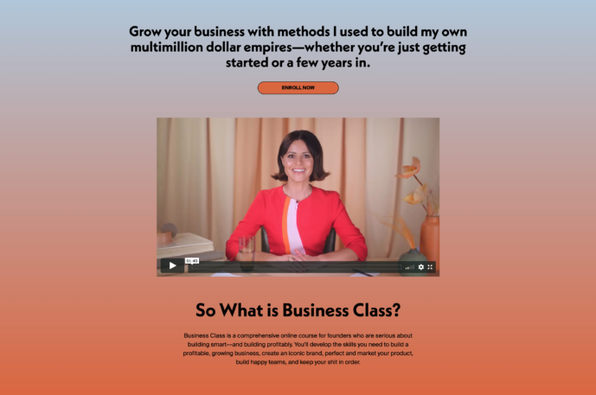
Since the course is tailored to founders who are bootstrapping, much like Amoruso did when she started Nasty Gal, the target audience is either someone who wants to build on an existing small business—a creative or Shopify store owner—or someone who wants to refine their idea before taking the leap.
“I didn’t do that the first time and I totally shot from the hip,” Amoruso says. “And I’ve learned the hard way that you really should have a plan. There are things that every founder should understand, especially for hiring people. Leadership and management is a big part of the course as well.” In addition to a section on team culture, Business Class includes a bonus module on unconscious bias and building an inclusive culture.
When I note the proliferation of business influencers and MasterClass courses available to entrepreneurs, Amoruso posits that she is uniquely positioned to lead this course because she has “been in trenches that not a lot of people have been in.” In the years since Amoruso wrote Girlboss, her name has become synonymous with the term—for better and for worse, as it has become shorthand in some circles for a particular brand of corporate feminism.
Her recent departure from Girlboss happened to follow a spate of resignations from prominent female CEOs, from The Wing’s Audrey Gelman to Tyler Haney of Outdoor Voices, largely driven by reports of a toxic work culture. Amoruso herself was the target of similar allegations while at the helm of Nasty Gal, and employees who were laid off sued the company over claims of pregnancy and disability discrimination. (Amoruso says the allegations brought against Nasty Gal “in terms of truth, really run the gamut.” Nasty Gal previously called the lawsuits “frivolous and without merit” and claimed the layoffs were part of a restructuring.)
From a business perspective, too, things took a turn. By 2012, Nasty Gal was an e-commerce darling with $100 million in revenue; the business was profitable, according to Amoruso, and drew multiple rounds of venture capital funding. Then, she resigned as CEO in 2015, and by the following year, Nasty Gal had filed for Chapter 11 bankruptcy. (Looking back, Amoruso believes Nasty Gal was never meant to be a venture-backed business, which is part of the reason she is focused on bootstrapping Business Class—and why she doesn’t intend to fundraise anytime soon.)
Amoruso says her experience with culture issues at Nasty Gal has proven instructive. “Even if what I’m being held accountable to isn’t completely true, it offers me an opportunity to examine myself and do better,” she says. “There’s no room in my life to think that anything that’s happened to me has been unfair because I signed up for it, and I put myself on the cover of a book.” With Girlboss, she says, she had a chance to do things over—to apply those lessons. “I’ve not just learned intellectually, how things work and don’t work,” she says. “I actually applied it with my second business. I’m incredibly proud of the culture I built at Girlboss.”
Amoruso sees Business Class as a more altruistic endeavor than her previous ventures. She’s pledging to offer 100 scholarships for Business Class, which will be awarded by the organizations Digital Undivided and Out Leadership. The idea is to both subsidize the course for people who might not be able to afford it and reach underrepresented founders—Black and Latinx women, as well as members of the LGBTQ community—who aren’t in Amoruso’s network.
“I’m doing this with a lot of integrity, probably more than anything that I’ve ever done, because I’m not doing it as an opportunist,” she says. “I’m doing it as someone who really believes that I’m going to help a lot of people with this.” She pauses, then quickly adds, “Also, I have a mortgage, and I’m unemployed. Forbes was wrong.”
It’s safe to assume that an overwhelming majority of the population has now participated in a videoconference. People who may not have even known how to start one six months ago now use them daily—and it’s all beginning to feel nor…
Something happened in the summer of 1993 that would have a profound impact on my life 18 years later. Ruth Bader Ginsburg was nominated and confirmed to the Supreme Court of the United States. Her legacy is not only one of social justice, it is one of …
I’ve recently been reflecting on challenges many founder CEOs face—myself included—in getting a company off the ground, and I keep coming back to the importance of the team. All startups have a vision and seeds of a product that ha…
Sentiments around “work-life balance” have always been divided. Some argue that the term itself implies a binary relationship (‘work” having a more negative or chore-like connotation, whereas “life” is positive…
Love them or hate them, your coworkers have a big influence over how much you like your job. While they may have less impact when you’re working at home, since you’re not necessarily affected by somebody fun or annoying sitting next to yo…
Small businesses are the backbone of the global economy. Think 90% of firms that account for more than 50% of employment, according to the World Bank. Those numbers were expected to keep growing, prior to the pandemic. Just look at how the ranks of wom…
Early in the COVID-19 crisis, when the number of Americans working remotely spiked to over 60%, many for the first time, we advocated for managers to recognize the unique challenges faced by their employees. We and others emphasized that remote work du…
You can’t have more than one top priority. You just can’t.
Deciding to prioritize one thing means, by definition, deciding not to prioritize something else. This is as self-evident as it is easy to ignore—which is why it’s i…
For many Western audiences, their first taste of K-pop’s impact came in 2012 when Psy’s video “Gangnam Style” went viral.
It seemed improbable at the time that a mostly non-English language track from South Korea would catch…


