


Stakeholders are integral to the operations and growth of an organization. Stakeholders are all those individuals or organizations that are impacted by the events and activities taking place at a business.
Stakeholders ensure that everything that’s undertaken or created by the organization is flawless. In return, the enterprise strives to make the stakeholders content. The association works for mutual benefit, and both entities get something in return.
Key stakeholder groups applicable to most organizations can be classified into 4 main categories:
- Clientele – include all those stakeholders that the organization serves.
- Employees – comprise people—barring the senior managers, board members, and directors—who serve the organization and consider themselves its representatives.
- Suppliers – encompass 3rd-party firms, subcontractors, and partners who provide raw material, equipment, technology, or supplies necessary to create product and service offerings.
- Stewards – entail the directors, senior managers, and board members of a business who are in charge of building the enterprise’s brand and achieving sustainable growth.
To gauge the performance of these stakeholders, measures of the main contributions and inducements for each stakeholder group are a must. This is exactly what a Stakeholder Scorecard does. The Stakeholder Scorecard documents all major stakeholders in a business, the efforts they put in, and the compensation they get in return. The Stakeholder Scorecard focuses on stakeholder satisfaction and enables that to leverage improved productivity, performance, and achievement of business objectives.
Contrary to the Balanced Scorecard, the Stakeholder Scorecard offers a stakeholder-centric method to gauge organizational Performance, by evaluating the extent to which a business strives to meet the demands of its stakeholders, motivate them to own it, and play their part in its growth.
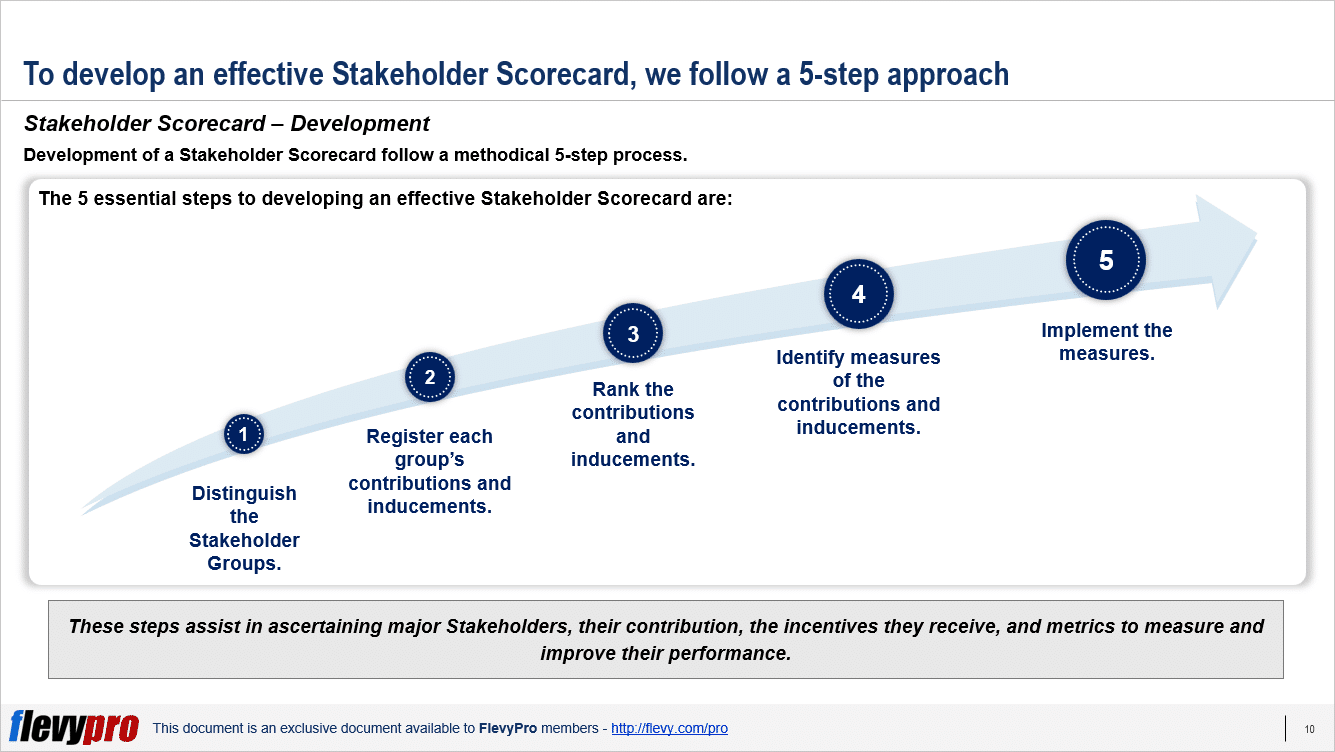
The creation of a Stakeholder Scorecard entails a methodical 5-step process.
- Distinguish the stakeholder groups.
- Register each group’s contributions and inducements.
- Rank the contributions and inducements.
- Identify the measures of the contributions and inducements.
- Implement the measures.
Let’s delve deeper into some of these steps.
Step 1. Distinguish the Stakeholder Groups
The first step in Stakeholder Scorecard development is to ascertain who the key stakeholder groups are. Key stakeholder groups comprise suppliers, clientele tended to, employees, and senior management. Society, regulatory bodies, creditors, and investors may also be included in this group. This should be in black and white, in the form of a list with names and groups.
Step 2. Register Each Group’s Contributions and Inducements
The next step is to populate a column-wise list encompassing the contributions made by and inducements offered to each stakeholder group. For instance, contributions by employees could be satisfactory completion of assigned jobs, continuous performance improvement, and/or trustworthiness. The inducements offered may include remuneration, rewards, steady income, and so on.
Step 3. Rank the Contributions and Inducements
After the identification of contributions and inducements, the next step is to rank the most significant contributions as well as inducements. Ranking contributions and inducements should be done with both entities (the organization and its stakeholders) in mind.
Documenting the stakeholders, their contributions, and inducements helps in knowing the impact of incentives on compelling the stakeholders to give their best.
Interested in learning more about the other steps of the Stakeholder Scorecard process? You can download an editable PowerPoint presentation on Stakeholder Scorecard here on the Flevy documents marketplace.
Do You Find Value in This Framework?
You can download in-depth presentations on this and hundreds of similar business frameworks from the FlevyPro Library. FlevyPro is trusted and utilized by 1000s of management consultants and corporate executives.
For even more best practices available on Flevy, have a look at our top 100 lists:


