



HR leaders excel at Workforce Planning at the business unit level, but face obstacles when it comes to effectively integrating their insights. By understanding the complexities of how business unit input is incorporated into the creation and implementation of workforce plans, HR leaders can gain the ability to steer a unified and effective organization-wide Workforce Planning Strategy.
To enable an efficient deployment of employees across business units while addressing urgent talent demand and supply mismatches with agility, we should follow the holistic organizational-wide workforce plans which can be achieved by incorporating 6-phase BU-driven Workforce Planning, as captured in the PowerPoint slide.
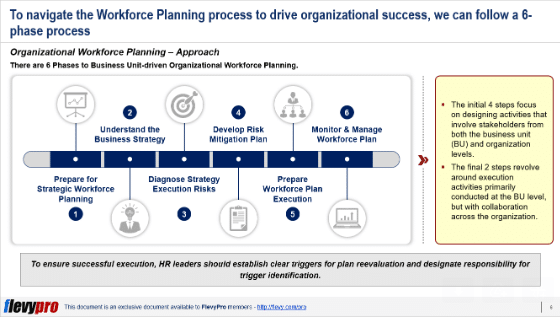
HR leaders should identify the necessary steps and activities at the business unit level and utilize this information to inform organization-level plans that this presentation will discuss in detail.
To better understand how an organization-level workforce plan can be conducted with inputs from BU-level Workforce Planning, a closer look at the activities involved in each step of the process is necessary.
Activities involved in Workforce Planning can be broadly categorized as:
- Design, where activities focus on the strategic aspects of planning the organization’s workforce. It involves activities that help determine the structure, composition, and capabilities of the workforce.
- Execution, which involves the operational activities required to implement the workforce strategies and plans developed during the design phase. These activities focus on managing the workforce on a day-to-day basis.
There are 6 phases to Business Unit-driven Organizational Workforce Planning:
- Prepare for Strategic Workforce Planning
- Understand the Business Strategy
- Diagnose Strategy Execution Risks
- Develop Risk Mitigation Plan
- Prepare Workforce Plan Execution
- Monitor & Manage Workforce Plan
The initial 4 steps focus on designing activities that involve stakeholders from both the business unit and organization levels. While the final 2 steps revolve around execution activities primarily conducted at the BU level, but with collaboration across the organization.
Let’s dive deeper into the first 2 phases of BU-driven Organizational Workforce Planning which includes gathering and analysis of data, conducting of assessments, and setting objectives to inform the development of workforce strategies and plans.
Prepare the Strategic Workforce Planning
Each BU’s workforce, future business demands, industry, and labor market data must be collected and analyzed. This phase requires strategic objectives to match organizational goals and priorities. Analyzing and developing goals prepares for long-term workforce strategies and plans.
Understand the Business Strategy
In phase two, HR must evaluate internal and external labor markets. HR must assess external and internal labor markets to understand talent supply and demand, coordinate workforce goals, and make recruitment, retention, and development decisions. Labor markets analysis can help to identify workforce strategy risks.
Interested in learning more about Workforce Planning? You can download an editable PowerPoint on BU-driven Organizational Workforce Planning here on the Flevy documents marketplace.
Do You Find Value in This Framework?
You can download in-depth presentations on this and hundreds of similar business frameworks from the FlevyPro Library. FlevyPro is trusted and utilized by 1000s of management consultants and corporate executives.
For even more best practices available on Flevy, have a look at our top 100 lists:


