


 It’s the Age of the Customer. In this day and age, becoming a Customer-centric Organization is no longer just a differentiator–it is a necessity.
Customers are now more demanding. Their expectations are higher. In fact, they expect companies to anticipate their needs.
To truly become a Customer-centric Organization, we must adopt a Customer-centric Culture. Research has shown that a Customer-centric Culture can drive superior financial results.
So, what characterizes a Customer-centric Culture? Let’s begin by taking a look at the Corporate Culture Framework.
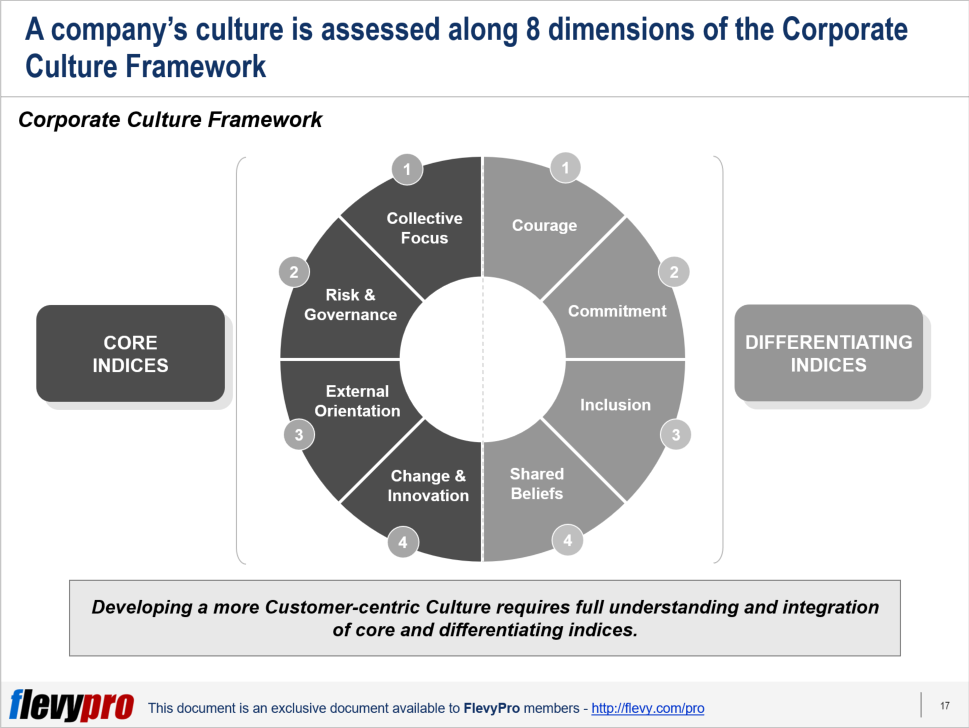
We see this Culture framework defines 4 core indices and 4 differentiating indices:
- Collective Focus – emphasis on collaboration, teaming, and cooperation in operations.
- Risk & Governance – focus on compliance, quality, and structure in operations.
- External Orientation – oriented towards customers and external environment.
- Change & Innovation – open to ambiguity, change, and risk to drive expansion and innovation.
- Courage – employees exhibit courage and resilience when confronting adversity, ethical dilemmas, failures, or opposition.
- Commitments – employees feel a sense of pride and ownership in the organization.
- Inclusion – accepts and promotes diversity, uniqueness, and authenticity.
- Shared beliefs – employees demonstrate commitment to organization-specific core values/beliefs.
Core indices are foundational to Organizational Culture, whereas differentiating indices drive differentiated performance. Developing a more Customer-centric Culture requires full understanding and integration of core and differentiating indices. However, there is an emphasis on just 4 of these dimensions:
- Collective Focus
- External Orientation
- Change & Innovation
- Shared Beliefs
Let’s dig a little deeper.
1. Collective Focus
Understandably, organizations that provide exceptional Customer Experience have strong collective focus. Collective focus means everyone in the organization is united in their understanding of their roles in delivering our Customer Value Proposition. Employees must internalize and appreciate this shared vision on what it means to deliver a great Customer Service.
To achieve this, significant resources must be devoted to communicating the Customer Value Proposition. Specifically, we must also conduct extensive employee training and coaching to ensure that company’s vision and value proposition are systematically represented in our service offerings and products.
Here are a several best practices related to enhancing our collective focus:
- Provide customer feedback in real time to all employees.
- Invest heavily in employee training and development to reinforce the company’s vision for serving customers.
- Listen to employee input to identify ways to improve the Customer Experience.
- Link employee and customer feedback systems so that employees can add important context.
2. External Orientation
Customer-centric companies that have strong external orientation are squarely focused on customers, competitors, and results. Employees must take an outside-in perspective, seeing themselves as customers see them.
3. Change and Innovation
Customer-centric companies place a premium on Change and Innovation.
By the way, we have Streams dedicated to each of these 2 areas:
We also have 2 Streams related to this central themes of this article:
Streams represent our most comprehensive offerings. Each Stream represents a bundle of best practice frameworks related to a specific management topic. We currently only have 14 Streams available.
An organization with a Customer-centric Culture has corporate belief system in place that values failing fast and learning quickly. The notion that mistakes are learning opportunities is embedded in the organization.
Customer needs and expectations are changing rapidly. Thus, we must innovate continuously to respond to these changes.
4. Shared Beliefs
In a Customer-centric Culture, employees find fulfillment in sharing the belief that servicing customers well is the priority.
Processes are created to reinforce customer-centric values and make them relevant to new employees.
Interested in gaining a better understanding of these cultural dimensions that drive customer-centricity? Take a look at our framework on Customer-centric Culture.


