


Burnout continues to be on the rise in 2021. As a sociologist, I’ve heard from people in all industries, and it’s rare I don’t hear about a person fighting malaise. In fact, it’s natural to feel exhausted or dragged out sinc…
I started my career in academia, where mentoring bright young minds is commonplace. Years later, mentoring and coaching others was one of the best parts of my job as a vice president of engineering at Google, and I tried to spend as much time on this p…
You have an idea. A great idea. A brilliant idea. A potentially business- or life-changing idea. But then, by the time you get the chance to write it down, you’ve forgotten it.
Even though it’s unlikely that something you can’…
There was a time when outlining your duties and key responsibilities on your résumé was enough. But in today’s competitive and tech-driven employment landscape, crafting a powerful résumé requires a little more finesse. Emplo…
Episode 1 of HBR’s video series “The New World of Work”: an interview with the CEO of Microsoft.
There is an elephant in your conference room. It’s quite comfortable there—it’s been living with us for decades, even centuries. But the longer organizations go without acknowledging its existence, the harder it is for people to do…
Listen to the latest episode of Fast Company’s Creative Conversation podcast on Apple Podcasts, Spotify, RadioPublic, Google Podcasts, or Stitcher.
If you’ve never wondered about the web of legalities and sociopolitical land mines that Seth Green tumbles through to make you laugh at his stop-motion darling Robot Chicken, then he considers his job complete.
“That’s the privilege of being the magicians, is that you get to quorum with the magicians backstage and figure out how you’re going to pull off this trick. And then you get out onstage and you say, ‘Abracadabra!’ and the audience says, ‘Wow,’” Green says in the latest episode of Fast Company’s podcast Creative Conversation.
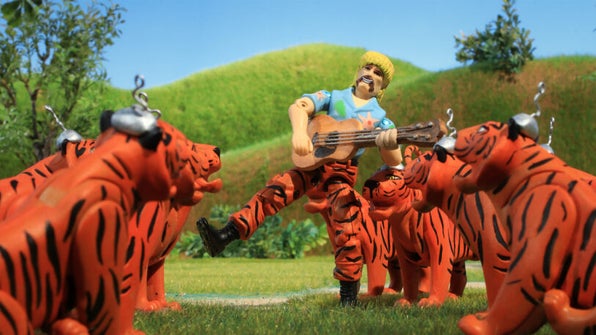
Since premiering in 2005, Robot Chicken has won six Emmys and a die-hard following that’s kept the irreverent pop culture digest around for 11 seasons. At the core of the show are those rapid-fire references to the things we all know and (sometimes) love. But creating jokes around popular characters from video games, comic books, films, TV, and beyond adds a legal filter to which jokes can and can’t be told. On top of that, as the social and political landscapes have become increasingly thorny, Green is actively thinking about what role a show like Robot Chicken plays in reflecting the world back at itself.
Check out highlights from Green’s episode of Creative Conversation below.
The serious side of funny
Seth Green: When writers come to us for the first time, the first week is just learning what will or won’t bear on the show. And that’s even hard to explain. But a lot of it is tied up in where the actual parody law is. So you get usage allowance under fair use under whatever is considered actual First Amendment free speech. Then that’s qualified against all these other markers of commerce, because this is a manufactured product for sale. So it gets really gray. But at this point, I feel confident to go to court and defend any of these points that we’ve made, because I feel like I’ve at least got a comprehensive understanding of the law to know where our barriers to successful performance are.
Fast Company: Oh my God, if that ever happens, please turn life into art and make a Robot Chicken sketch.
Green: That’s actually very funny! That’s not a bad idea. Like me, as the counsel, representing myself in a court. We’ll see! If we do a 12th season, that’ll be the opener.
Woke Chicken
“[Robot Chicken cocreator] Matt [Senreich] and I were very conscious about having to consistently bring in younger and younger writers and then just sort of teach them how we tell those jokes on behalf of this kind of show. That’s the thing that we have to discern every single year: What is the show? We get new writers in, and they’re always pitching us stuff. And sometimes, especially during this last summer when everybody’s so politically charged and radically polarized and also individually hypersensitive to ‘What am I putting out? Who am I giving a voice to? What kind of messages are we communicating?’
“We had to balance what everybody is very passionate about telling and what is Robot Chicken. Where is the place where we are going to weigh in on this? There are jokes that George Carlin could make, that Chris Rock can make, that [Dave] Chappelle can make, that Robot can’t make.”

Green’s greatest creative challenge
“Frankly, it’s governing my own temperament [because] realistically, you get so many things hurled at you that are out of your control. And remaining Zen about the job that has to get done and the unemotional reality of facts. When I can stay in that place, everything works great, whatever it is. Whenever I am triggered or emotionally engaged in a way that is distracting, that’s the biggest challenge.”
A core personal and professional mantra of mine is “never let a relationship drop to zero.” Now, in a time when most of us are still working virtually with limited travel, it takes more effort than ever to stay in touch with people. Wheth…
Advanced technologies are critical to stopping climate change—and the drive to develop and scale them is accelerating. Here are five themes that could attract $2 trillion of annual investment by 2025.
Blas Maquivar, president of global emerging markets at Mars Wrigley, discusses consumers’ evolving snacking behaviors, the company’s digital and purpose-driven ambitions, and his new travel schedule amid the pandemic.


