


CEO Jack Dorsey said Twitter was unlikely to open its offices before September
James McLeod on the rise of Shopify in the wake of the pandemic
Ethical leadership is as important as ever. Read More
Whether you’re quarantining solo or holed up with a partner, this pandemic has had a massive effect on peoples’ sex lives. In a study called “Sex and Relationships in the Time of COVID-19”, the Kinsey Institute found that half of the 1,200 participants are having less sex since the pandemic began. Similarly, sex-wellness app Coral, which uses coaching, stories, and guided exercises to improve intimacy, conducted a survey last month that found that 38% of responders are having sex less frequently than in their pre-pandemic days—but 66 percent of them say that intimacy and connection feel more important than ever. Long story long, it’s a confusing time.
“It’s proven that many species of wild animals don’t mate in captivity,” says Alexandra Fine, founder of the sex-toy brand Dame Products. “I think that’s how a lot of us are feeling right now. We’re having a lot of anxiety and not feeling sexy. I’m actually having less sex with my partner now. But it’s been so important in my journey to figure out that it’s not about quantity—it’s quality.”
And while it’s impossible to speak to everyone’s circumstances, Fine assures anyone who isn’t feeling sexy that it’s all okay: Everyone has their ebbs and flows. “It’s time to be adaptable,” she says. “These times prove that we can dramatically change quickly—and that means we can dramatically change for the better.”
To Fine, finding intimacy amid a pandemic is about readjusting and recalibrating what feels good. Here are the sex-tech guru’s tips for rediscovering intimacy and, as she puts it, “feeling sexy in these weird times.”
Widen your horizons
When we constantly share every meal, have to go into closets to make phone calls, and spend every moment under the same roof as our partner, a lot of magic can be lost. Cue that line about animals not mating in captivity again. “When we feel really close and don’t have individual space, the curiosity you naturally have when you go about your day outside of your home isn’t there anymore,” Fine says. “You know what your partner is doing and where they are, and the mystery is gone—so you have to really intentionally cultivate more space and variety for yourself, because otherwise it isn’t there.” Lately, Fine is seeing a lot of her peers hopping on FaceTime or Zoom for double dates, and she has friends who attend virtual concerts and events without their significant other. “We can still go to parties—the digital party scene is fun,” she says. “There are dance parties and live streams and movie clubs and even webinars, if that is more your thing. Finding those outlets help you feel outside of your home and create spaces to shine. And people are attracted to other people when they see them shine.”
Explore different types of intimacy
Fine recommends branching out of what you would normally define as “intimate” and trying something new, especially if you’re living alone right now. “There is so much more out there than you might realize,” she explains. “Phone sex is happening a lot, there is virtual sex—people are feeling more sexually explorative and doing it digitally. It’s pretty amazing that we get to have a moment of asking ourselves, ‘How do you want to engage with the world sexually?’”
Finding new ways to connect doesn’t have to be virtual if you share the same space with your partner. And it doesn’t have to involve sex, either. Fine says that sometimes she and her husband will practice eye gazing at home—where they sit facing each other and look into each other’s eyes with love for several minutes. “It fosters deep connection and intimacy,” she says. “And that’s important.”
Talk about what you want
If you want to find intimacy with a partner at home, Fine suggests taking a little time to sit together and talk about your relationship and what cultivating intimacy looks like to you. It may not be the easiest thing to do, but it’s better than expecting someone to magically know when and how to turn you on during these times. “When we understand what makes us feel sexy, it’s so powerful—but people struggle to articulate it out loud because we want it to happen naturally, and it makes us upset when it doesn’t just happen,” Fine says. “That’s a weird, normal, and human thing we all do. To counteract it, we have to spend time talking about it outside of sex and plan it.”
After talking to get on the same page, Fine suggests putting it all into action. That means giving the massages, lighting the candles, intentionally setting the mood (whatever that looks like for you). “Figure out what makes you feel sexy and aroused, then do what it takes to get there,” she says. “For me, there is an element of performance. I like to get dressed up for my husband—because heels get him excited, and then I’m excited because he’s excited. It’s intentional and it’s definitely planned to put on fancy clothes and heels right now when there’s no excuse to leave the house.”
Invest in tools and treats
As Fine said in our last FC interview: “It’s amazing to see a cultural shift begin and see the acceptance that sex is a part of our wellness. Sex toys don’t have to be this old-school porn stuff that feels cheap and isn’t good for your body or objectifies women.” By making sex toys that are research-based and easy to use, Dame has undoubtedly played a significant role in the cultural shift that Fine mentions. She notes that now, even if we aren’t having as much sex, people are masturbating more: “That makes a lot of sense for the situation. Masturbation is a different activity from sex that has a distinctly different input and output. People need that space.”

Currently, Fine’s favorite two products from Dame are the Pom handheld vibrator (“I use it all the time”) and the Arc internal vibrator, which Fine says is perfect for more exploratory play. “The Arc allows me to be more intentional and take my time and enjoy the experience,” she says. “Since I have more time lately, I’ve been using Arc more.”

But Fine notes that we can also experience pleasure simply from lighting a favorite candle. “It’s important to just love the experience of what you’re doing and experiencing,” she says. “I love candles—I love smells.” Currently she’s digging the Maison Louis Marie 04 Bois de Balincourt luxury candle. “It smells good and clean, and it’s relaxing. It’s hard to trust the internet when you’re looking for good smells, but this candle is amazing.”
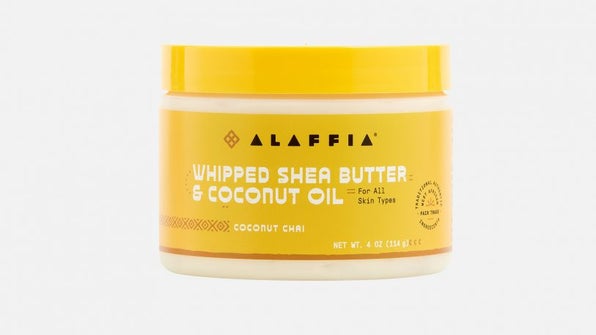
And whether you’re using lotion for a couple’s massage or you just want a luscious product to moisturize your skin, Fine swears by her whipped shea butter lotion. “It’s so airy and light that I want to eat it,” she laughs. “And it’s so moisturizing. Altogether, I love the experience of rubbing lotion on, and I appreciate that it feels really nice.” We recommend checking out this Moroccan rose body butter from Follain Organic, which has a light floral scent and an equally light, whipped texture. Or, if you’re into more richly scented lotion, you can’t go wrong with this Alaffia Whipped Shea Butter & Coconut Oil Lotion, which comes in a spicy coconut chai scent.
Looking for more recommendations? Check out our other handpicked suggestions.
- Theragun just rolled out a quiet, affordable mini massager
- This face mask made by an MIT-founded fashion brand is the best we’ve found yet
- Yale’s most popular online course ever is now available to take for free
- Editor’s Pick: Allbirds’ new running shoes are sustainable, fashionable, and unbelievably comfortable
- Why Thrive Market is a better alternative to Amazon for grocery delivery
- Shop these 30 brands to support COVID-19 relief
Fast Company may receive revenue for some links to products on our site.
Even during a crisis, developing a “future-back” mindset can spur innovation and growth.
Optimize efficiency by rightsizing your teams.
Shopify introducing its tap-and-chip payment terminal, which will let retailers accept debit and credit card transactions
What traits do we look for in our leaders? Ask someone what distinguishes a forceful leader, in business or politics, and they’re likely to mention self-confidence and charisma. Great leaders, we say, are bold and strong-willed. They have a vision for creating something new or remaking a company or a country. They challenge conventional wisdom and are slowed by neither self-doubt nor criticism.
These are the individuals whom corporate boards tend to select as CEOs, especially in times of upheaval, when the status quo is failing. They’re adept at self-promotion and shine in job interviews. Then, once they’re in power, we find out who they really are.
Sometimes they’re as good as their promise. But many turn out to be not just confident but arrogant and entitled. Instead of being bold, they’re merely impulsive. They lack empathy and exploit others without compunction. They ignore expert advice and treat those who differ with contempt and hostility. Above all, they demand personal loyalty. They are, in short, raging narcissists.
Charles A. O’Reilly, the Frank E. Buck Professor of Management at Stanford Graduate School of Business, studies how the personalities of leaders shape the culture of organizations and the behavior of those who work in them. In a paper with Jennifer Chatman of the University of California, Berkeley, he reviews the literature on narcissistic leaders, encompassing more than 150 studies, and draws some somber and urgent conclusions.
“There are leaders who may be abusive jerks but aren’t really narcissists,” O’Reilly says. “The distinction is what motivates them. Are they driven to achieve some larger purpose? Do they really want to make the company or the country better, or accomplish some crazy goal like making electric cars mainstream and maybe colonizing Mars along the way? Or is it really all about their own aggrandizement?”
When their self-admiration has some basis in reality, narcissistic leaders can achieve great things; that was certainly the case with Steve Jobs at Apple. But over the past decade, researchers have grown increasingly concerned by the destructive effects of narcissists on organizations. Cautionary tales abound, from Enron to Uber to Theranos.
True narcissists, O’Reilly says, are self-serving and lack integrity. “They believe they’re superior and thus not subject to the same rules and norms. Studies show they’re more likely to act dishonestly to achieve their ends. They know they’re lying, and it doesn’t bother them. They don’t feel shame.” They are also often reckless in the pursuit of glory—sometimes successfully, but often with dire consequences.
But even worse, narcissists change the companies or countries they lead, much like bad money drives out good, and those changes can outlast their own tenure, O’Reilly says. Divergent voices are silenced, flattery and servility are rewarded, and cynicism and apathy corrode any sense of shared purpose in a culture where everyone’s out for themselves. In the extreme, they can destroy the institution itself.
Why do we empower them?
Anyone who was bullied as a kid is familiar with the consoling notion that bullies don’t really believe they’re better than us—they’re “just compensating” for low self-esteem. They present as confident and assertive to mask some inner pain, and we take solace in their secret suffering, maybe feigning pity for their brokenness.
Unfortunately, that generous assessment is not always true.
“That’s the classic case of vulnerable narcissism recognized in psychiatry,” O’Reilly says. “But in the last decade or so, there’s been an outpouring of research on what’s called grandiose narcissism. These individuals have high self-esteem. They are much more agentic, more extroverted, and really more dangerous. And evidence shows that they’re achieving high positions in organizations, getting promoted, and making more money than normal people.”
Relatd: How other countries see Donald Trump
Such individuals seek positions of power where they can be admired and can demonstrate their superiority. And they tend to gain those posts because they look like prototypical leaders. “There must be 20 or 30 studies that demonstrate this,” O’Reilly says. “If you gather a group of strangers and give them a task, those who are more narcissistic are much more likely to be selected as leaders.”
O’Reilly thinks we may especially tend to choose narcissistic leaders in times of turmoil. “In the last few decades, big companies like automakers and banks have been threatened by technological disruption. So you could imagine that in anxious times people are looking for a hero, a confident person who says, ‘I have a solution.’” They may be the only ones who are confident in such times.
“By the way,” he adds, “I haven’t researched this, but I think venture capitalists love these people. For their business model, which is to invest in 10 companies hoping that 1 pays off big, it makes sense. If I’m a VC and I see one startup that’s headed by an introverted engineer and another that’s led by someone who says, ‘Yeah, I’m going to change the world, and if you don’t get it, then you’re a bozo’—I’m going to go for the visionary spiel.” In a way, it’s an investment model predicated on grandiosity.
Tallying the damage
Because narcissists are fundamentally driven by their own self-interest, lack empathy, and are less constrained by ethical standards, they can cause tremendous harm once in power and can even put the organizations they lead at risk, O’Reilly says.
Field studies have shown that narcissistic CEOs are more likely to engage in fraud and other types of white-collar crime, manipulate earnings, and pursue aggressive tax avoidance. And a 2013 study of U.S. presidents found that those who scored higher on the narcissism scale were more likely to abuse their authority (not to mention, on a personal level, their marriage vows).
Along with Bernadette Doerr of UC Berkeley, O’Reilly recently published the results of three experiments showing that narcissistic people in general have lower levels of integrity—meaning their words and deeds do not align—and that they are more likely to lie, cheat, and steal in order to prove their special status.
Ascending to a position of power only reinforces these tendencies, O’Reilly says. “Being elected or appointed to office validates their sense of entitlement. At the same time, even without narcissism, power disinhibits—it encourages people to indulge their worst instincts—so now you’ve got the two working together.”
And when narcissists do achieve some success, it reinforces their belief that they know better than others, so that they feel even more justified in ignoring the advice of experts and relying on their own instincts. “Success chips away at their hold on reality,” O’Reilly writes in his review.
Not surprisingly, studies also show that narcissists’ belief in their superiority is based on scant evidence, validated neither by objective measures of intelligence or competence nor by performance reviews from peers or subordinates. One recent paper on corporate decision-making found that grandiosity in leaders was associated with greater risk-taking but not better financial returns.
As a result, narcissists often feel they don’t receive the admiration and credit they deserve, and they can seem pathologically consumed with resentment. That can take the form of petulance, aggression, unhinged public rants, and abuse of underlings. Narcissistic CEOs often involve their firms in costly litigation. In the narcissist’s worldview, other human beings must be either acolytes or enemies.
But the gravest danger posed by such leaders is that their malignant influence guides the behavior and expectations of others—and ultimately shapes the culture of the organization or polity in their own image. Studies of businesses show that self-serving, unethical behavior at the top cascades through the organization and becomes legitimized, or at least normalized.
“Once they’re in power, narcissists consolidate their position by firing everyone who challenges them,” O’Reilly says. In their place rises a plague of toadies, opportunists, and enablers equally guided by self-interest and short on scruples. “So you end up with these individualistic cultures with no teamwork and low integrity. We’ve documented this in a bunch of Silicon Valley tech firms.”
When you join a new company, you figure out how you need to behave to fit in, he says. “If you see that the path upward requires you to scheme, suck up, and withhold information, then you have a choice: You can either do the same or not, in which case you’re going to be excluded and probably eliminated.”
He points to the struggles of Uber CEO Dara Khosrowshahi to turn the company around after its founding CEO, Travis Kalanick, was forced out. “Once you create these cultures, it’s very hard to change them. There are long-term consequences.”
Follow the trail
O’Reilly’s hope is that by pulling together the lessons from what is now a large body of research on narcissistic leadership, we can learn to better distinguish between real transformational leaders and the self-dealing look-alikes who exploit our hopes and fears to gain power.
If you’re evaluating candidates for high office, you really need to look beyond the self-presentation, he says. “Too often, when boards select CEOs, especially outside CEOs, they do it through interviews. But interviews play to the strength of a narcissist. And you can’t just look at performance, because they can fake performance”—blithely taking credit for others’ work and even falsifying results.
“What would really be far more illuminating would be to go talk to the people who’ve worked for them and with them in the past. You have to get data from people who have seen that person operating. But that typically isn’t what happens.”
It’s up to the hiring teams and voters who select leaders, O’Reilly says, to do the proper background checks: “We’re not helpless. The information is out there.”
And as research shows, the stakes are high—because, as O’Reilly says, “These people aren’t going to change.”
This piece was originally published by the Stanford University Graduate School of Business.
As the world has come to a complete standstill, the novel coronavirus has placed a major strain on the healthcare community, prompting a rapid evolution of medical practice.
This has lead to droughts of personal protective equipment, loss of loved ones…


