


Your team is struggling … Get involved and learn to provide clarity and fuel to help everyone.
As an executive at Xerox, Bernard Kinsey helped launch the National Black Employees Caucus, believed to be the first-ever employee resource group. He went on to serve as chief operating officer and cochairman of Rebuild Los Angeles and now serves as pr…
At 77 years old, Bernard W. Kinsey doesn’t mince words. “The thing that concerns me today is that we continue to try and be citizens of a country that clearly does not see our citizenship at the same level it sees white citizenship,ȁ…
The fun of unwrapping a flaxen slab of good cheese is inversely proportional to how frustrating it is to wrap in the first place. At least when you don’t know what the hell you’re doing.
I certainly did not, so when I first had to do a professional-grade wrap-job, I floundered. It was as tricky a task as folding cable-knit sweaters back into hospital-corners immaculacy after trying them on at Zara. The wax paper bunched up around the cheese like goblin-origami, making neatness impossible.
Working at a cheese shop would be harder than I’d anticipated, wouldn’t it?
After months of researching the lives of cheese mongers as part of my new book, American Cheese: An Indulgent Odyssey Through the Artisan Cheese World, I wanted to dive deeper into this subculture than just eating a galaxy of gorgonzola and mingling with mongers. If I was going to demystify cheese, and truly separate the whey of assumptions from the curds of knowledge, I would have to get down in the trenches and work as a monger myself.
I would have to mong.
On my first day working undercover behind the counter at BKLYN Larder in Park Slope, Brooklyn, I did not feel confident about my ability to sell cheese. I figured I’d instead just shadow the mongers to see how it’s done, and help out as needed—hence the wrapping. For the first few hours of my first shift, I mainly just stood around, drooling over the inventory: buttery cheddars, almondy alpines; some with rinds covered in a gorgeous honeycomb pattern, others with the powdery look of the lunar surface. I felt honored just to be around them, let alone to see them from a view I’d never gotten before: behind the counter.
It turns out that all the little customer-facing placards noting the style and price of each cheese had the same info on the back, along with descriptive words about the cheese. I’d talked to countless mongers over the past several months, who had waxed poetic, philosophical, and damn near sexual about so many cheeses—they hadn’t seemed to need any help describing them. But those people hadn’t started out knowing all that they do now, and would likely have benefitted from a cheat sheet telling them that Noce del Piave is a “cow’s milk” cheese that’s “aged three months” in “walnut leaves” and tastes “intensely nutty and sweet.”
The cards would obviously be helpful for me when I was ready to attempt to sell cheese, but at first, I made myself scarce. When customers approached the counter and none of my “colleagues” were around, I scurried away so as to not accidentally say the wrong thing and put them off all cheese forever.
A monger named Nicole with short chestnut hair thought I was joking when I mentioned I’d been doing this, until she actually saw me do it. “You know, you can just say, ‘Hang on, I’ll get somebody to come help you,’” she offered, with a pained look on her face. “Otherwise, they’ll think you’re running from them.”
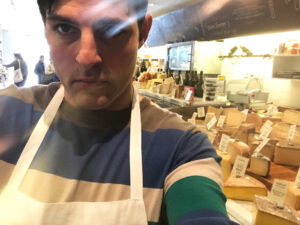
The next time someone came by while no mongers were near, I stood strong. I was getting ready to let the elderly customer know that while I was personally useless, someone who wasn’t would be right along, when she held up a free-standing hunk of ivory cheese with a classically Cheeto-colored rind and asked if I could tell her about it.
This was happening.
“Tres Bonne?” I said, reading from the card where the cheese once sat, scanning it for further data I could deploy. “It comes from Eleven Brothers, which is, uh, a goat farm, up in Vermont. It’s fresh, it’s got kind of a little mineral-ness, like blue cheese, but it’s more creamy.”
Her face was inscrutable. She didn’t look un-intrigued, per se. Then she asked if she could taste the cheese. Of course, she could.
I sampled out a slice for her—cutting one for myself too, as many mongers had said they do every time—and passed her the thin strip on a sheet of wax paper, which I then threw into a small trash can bearing a sign that read ‘fromage garbage,’ which I briefly mistook to be another type of cheese.
“It doesn’t even taste like goat!” the woman said, gingerly. “I’ll take a half-pound.”
I’d done it: Closed my first sale, on my first attempt. Sure, the cheese did a lot of the heavy lifting, with the user-friendliness of the card picking up the slack, but I had been involved.
By the end of that shift, I realized all I had to say when someone was interested in Tres Bonne is that Eleven Brothers has that name because the family that makes it actually consists of eleven brothers, and somehow that story hooked people in. People love a cheese story. Or, at least, some do. Knowing which customers need a little extra enticement and which ones are all business is just one of the many things mongers can intuit.
Throughout my shifts at the shop, a bell above the main door constantly clanged as people breezed in and out. Sweaty single dads stopping by after a Saturday workout. Park Slope moms popping in, prodding their kids to be polite to me. Hipster trios who seemed amused by something I would never know. A young married couple in argyle cardigans patronizing the story every Sunday, like cheese church. They all craved fermented milk and they all had questions about it.
“Does this gouda go with a red wine?”
“I couldn’t say for sure, but probably!”
“Do you know the difference between real buttermilk and not-real buttermilk?”
“I do not but I know someone who might!”
“Is this cheese un-pasteurized?”
“Ummm…”
“It’s written on the back of this card you’re staring at, isn’t it?”
During the many times in my few shifts at the cheese shop where I didn’t know quite what to say, I would just as often do what I did in any conversation that made me nervous—steer it in the direction of something I could definitely talk about without sounding dumb.
One woman asked me about a cheddar called Barnburner that had a smoky flavor. I didn’t know much about the cheese, but I did know about the vast spectrum of cheddar flavors, which had impressed me to no end over the past several months. Before diving into this subculture, I was sure cheddar came in one of three degrees of sharpness and at least two colors and that was it. Now I knew better. I knew that some tasted like caramel and others tasted like horseradish, while others still had more of a muted umami flavor. Some came from cows, and some came from goats; some were best served young and supple, while others flourished more with time and the development of tyrosine crystals. This one happened to have a smoky flavor, and wasn’t it nice that such variety exists just within one of the countless styles of cheese?
“Wow, you really sold me on that!” the woman said when I finished my cheesy soliloquy.
I looked around to see if anyone else had heard her say it—who would even believe me if I told them later?—and sure enough, Nicole flashed me a quick thumbs-up while wrapping an enormous piece of Raclette.
The more cheese I sold, the more I learned how much fun it could be to taste cheese with customers. They would ask about the Manchego 1605, prompting me to sneak a peek at the card and learn that it is sweet and milky, with a hint of nutmeg + cinnamon.
OMG. Let’s try it together!
There is a lot more to being a monger, though, than just reading info off of a card and eating cheese with new pals. You have to know exactly how the cheese is supposed to taste, so you can determine whether the batch this customer might be buying is consistent with the standard. You have to be able to walk people through a Choose Your Own Adventure-style decision tree; asking whether someone prefers cow, goat, or sheep. Mild or wild. Sweet, sour, or bitter. How far out of their comfort zone they seemed willing to be pushed.
After a few shifts, I knew enough to know that I couldn’t yet cut it as a monger. But I had a much clearer idea of what cutting it actually entailed. I had gained a fuller appreciation for all that mongers do by walking a mile in their shoes—and going home with cheese pebbles in my sock.
It’s 1:36 a.m. and I’ve just gotten my daughter back to sleep after she threw up violently. She has no fever, no cough, no shortness of breath, but what if . . . I think it’s food poisoning and not COVID-19, but I can’t know…
American women have made strides in the workplace over the past half-century in terms of earnings, employment, and careers–in no small part thanks to the efforts of the late Justice Ruth Bader Ginsburg.
The COVID-19 pandemic risks undoing many o…
With so much in flux and many employees working from home, now is the time to leverage the moment and make virtual learning more effective. Here’s how.
2020 has been a challenging year for so many, with Americans reporting elevated levels of mental illness, substance use, and suicidal ideation, according to a recent report by the CDC.
“Feeling lonely, down, or anxious right now makes sense,” said Dr. Connie Chen, chief medical officer at Lyra Health, a startup that partners with companies (like Facebook and Starbucks) to provide mental health benefits. She, and journalist author Dan Harris, spoke with senior writer Ainsley Harris (no relation) during the last day of Fast Company’s Innovation Festival. The duo shared their thoughts on meditation, isolation and how companies can help support their employees during these challenging times.
Harris first got interested in mental health and meditation after having a panic attack on Good Morning America. Today, he’s the author of the best-selling book 10% Happier, and has an app and a podcast (by the same name) focused on teaching meditation techniques, coping skills and stress relief. He says he’s seen an increase in demand among users looking for basics of how to incorporate various practices like meditation into their daily lives.
“[This year] has become a good opportunity for millions of people to take stock, step back, and say, ‘how can I work on my mind?’” he said. “We spend so much time working on our stock portfolios, our interior design, our résumé, our Instagram page, but so little time working on the one filter through which we experience everything.”
The loneliness epidemic dates back far before the start of COVID-19, says Harris. “Even going into the pandemic, we were seeing a huge issue with loneliness, which—to use a loaded phrase—we’ve put on steroids with social distancing,” said Harris. “We’re designed to be part of a tribe and we’ve dismantled the tribe to our detriment in massive, massive ways.”
Chen says that many employers are starting to see the importance of helping employees access mental health resources—especially as many of their workers are more isolated than ever before. “What’s been particularly hard about this year is for a lot of people in the workforce, with the disintegration of broader social networks, maybe their remaining tribe was their coworkers, and now with work from home, that’s being pulled [out] from under them.”
Mental health affects the bottom line of companies across industries, says Chen. “Self-insured employers spend something like $38 billion a year on mental health through their [employee assistance plans] or their health plan. In addition to that there’s probably about $140 billion in indirect costs that employers incur through things like disability, absenteeism, presenteeism,” says Chen. “Especially this year—whether or not your employees are talking about it, they’re struggling.”
Both Harris and Chen emphasized the importance of equipping individuals with the skills necessary to weather this anxiety-filled time. “Part of what we want to do is to help people develop the skills to cope better—because the challenges we face are very real and hard to change,” said Chen.
Sponsor content from Siemens.
In April, Françoise Brougher was fired from her post as the chief operating officer at Pinterest. The news was delivered to her during a 10-minute video call, and, as Brougher later recounted in a Medium post, the only explanation Pinterest offere…


