


No one ever tells you what you should know about money when you’re young. There isn’t a class in high school, or even college, where a professor sits you down and says, “Now listen up: mastering money is no different than learning …
Are you a judgmental person?
Whether you are known as the resident Judge Judy or consider yourself to be a tolerant person, being judgmental is a behavior that we have all engaged in at some point or another. But there’s a difference between bei…
From 2008 to 2010, Antoine Deltour was an employee at PricewaterhouseCoopers (PwC), based out of the professional services firm’s Luxembourg offices. During his time there, Deltour discovered PwC was helping large corporations sidestep large tax…
Vacations can help you reduce the stress of work, but that feeling of bliss doesn’t last long. A survey from the American Psychological Association found that the benefits of time away dissipate within a few days. Maybe it’s facing the re…
We use the value proposition canvas to help innovation teams design products and services customers actually want. Although one question we get all the time (especially from new users of the value proposition canvas) is: Do you always start with the customer?
The last couple of decades have seen an overwhelming focus on customers. I have yet to advise a company whose vision or strategy doesn’t include an acute customer focus. And this plethora of customer-driven organisations rely more and more on methodologies such as Design Thinking which starts with an empathetic and exploratory approach toward the customer. But a good idea doesn’t have to become a dogma.
In this post we explain why you don’t always have to start with the customer, but you always have to end with the customer — especially the validation of fit between the customer (as mapped in your customer profile) and your product/service (as designed in your value map).
1 – Fishing for customer insights
The innovation journey of many teams starts with a customer discovery process and a large number of customer interviews. In many corporate innovation programmes, it has become a design principle that teams cannot advance to the next stage of the programme and access more funding before having completed a large number of customer interviews, sometimes as high as 100 interviews in a 6-12 week window.
Why this focus on customer interviews?
There are many benefits to doing many customer interviews early in the innovation process:
-
Consistent customer feedback helps innovators to not fall in love with their initial ideas, and thus avoid one of the most dangerous pitfalls facing entrepreneurs.
-
Customer interviews are the simplest form of testing innovators can do. When done properly, these interviews can provide early evidence on the most critical assumptions.
-
After a while, these interviews will lead to a deeper customer understanding and to critical insights for designing a product or service that customers want.
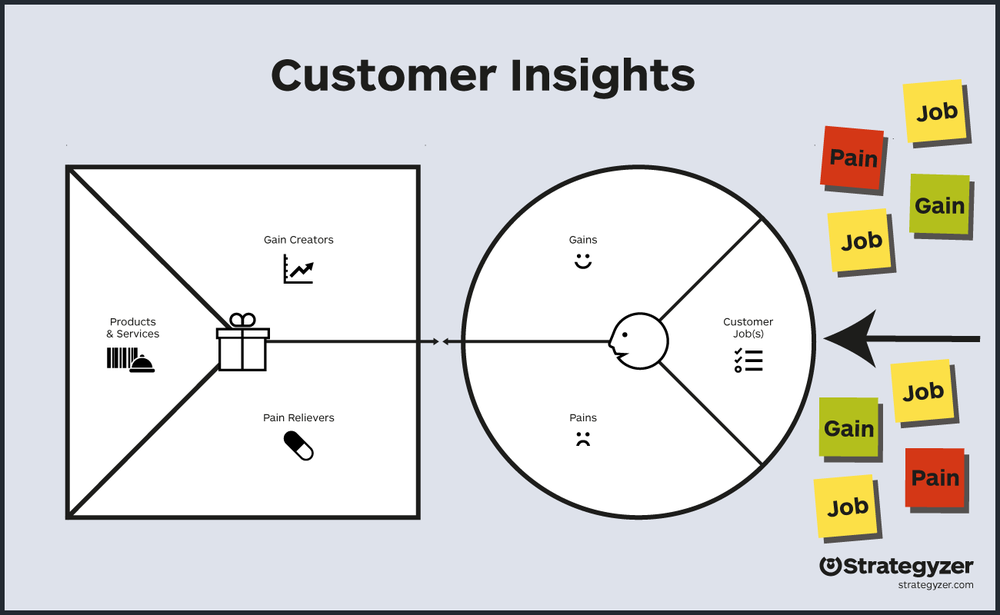
The insights that innovators need to get from this discovery process are:
-
What are the most critical jobs, pains and gains of customers.
-
And are any of these important enough that customers would be willing to pay for your product or service?
When teams start their innovation process with just a business idea, the customer is a pretty good starting point. In this case, we coach teams to work on the circle — the customer profile — and map the critical jobs, pains and gains.
2 – Making the most of what’s available
Many of the teams we coach in large organisations have much more than just good ideas. These organisations might have key resources such as patents, capabilities or access to technologies that innovation teams can use to prototype new value propositions and business models.
A classic example of reusing an existing capability to build a new business model is Amazon with Amazon Web Services (AWS). Amazon leveraged its IT expertise and infrastructure, which was initially built for its e-commerce business, to create AWS – a suite of cloud computing services sold to enterprise customers.

The innovation journey is long and hard enough: it would be careless not to use all the assets and opportunities available to you. When we work with teams in large organisations we often help them prototype many different product and services using available assets early in their innovation process. In this case, we start our innovation process with the square – the value map – and we ask them “what new value proposition could you design based on this key resource?â€� This piece of technology? Or this capability? Or this patent? And they describe how those available assets could contribute to a potential value proposition using the value map.
In both instances, whether you start with the customer to identify critical customer insights or start prototyping a new value proposition built on an existing key resource, you will soon need to go through a solid testing process to validate the fit between your value proposition and the customer segment.
That’s why we always remind innovation teams that we work with that you don’t always have to start with the customer, but if you want to achieve fit, you have to end with the customer.
Why not come and join us at one of our global Masterclasses to learn about more value proposition design best practices for you to apply to your own business?
* Please note that this post is only a small insight into the awesome work done by Greg Bernarda on Value Proposition Design best practices.
Touch carries unspoken authority “that goes right to the emotional centers of the brain and for that time period where touch is on it makes that person feel a little submissive.”
The orbital version of the SpaceX Starship is getting stacked in Texas. Pictures from Maria Pointer show that there seem to be improvements in how each of the ring sections are being constructed. The…
[[ This is a content summary only. Visit my website for full links, other content, and more! ]]


Turkey is home to hundreds of thousands of Uighurs. Many of them already live in limbo, unable to return to China and effectively stateless.
After three days of arduous negotiations, European Union leaders broke a deadlock Tuesday and nominated German Defense Minister Ursula von der Leyen to become the new president of the bloc’s powerful executive arm, the European Commission, one of two women named to top EU posts for the first time.
In a series of tweets, European Council President Donald Tusk said that Belgian Prime Minister Charles Michel would take over from him in the fall.
Frenchwoman Christine Lagarde was proposed as president of the European Central Bank, while Spanish Foreign Minister Josep Borrell was nominated to become EU foreign policy chief, meaning he would be charged with supervising the Iran nuclear deal, among other duties.
Only Michel can take up his post without other formalities. The others, notably von der Leyen — who will take over from Jean-Claude Juncker for the next five years — must be endorsed by the European Parliament. The assembly sits in Strasbourg, France on Wednesday to elect its own new president, and early signs suggest that lawmakers could contest the nominations.
“It is important that we were able to decide with great unity today, and that is important because it’s about our future ability to work.” German Chancellor Angela Merkel told reporters after the nominations — decided away from the cameras and media in a long series of meetings — were made public.
Several lawmakers have already objected to the leaders’ package of nominations, and it remains to be seen whether the parliament will flex new found muscles following the massive turnout for EU-wide elections in May. Party leaders have said the vote has brought the assembly — the EU’s only elected institution — even more democratic legitimacy.
“This backroom stich-up after days of talks is grotesque,” said Greens group leader Ska Keller, describing the nomination process as “party power games.”
“After such a high turnout in the European elections and a real mandate for change, this is not what European citizens deserve,” said Keller, who is in the running to become parliament president on Wednesday.
Juncker, who steps down on Oct. 31 as head of the commission, which proposes and enforces EU laws, conceded that “it won’t be easy in parliament.”
Tusk said “it was worth waiting for such an outcome” and that he would do his best to explain to what could well be a tetchy parliament on Thursday how the nominations were made and what thought processes went into the move.
“It’s always a huge question mark. This is why we have parliaments,” Tusk said, with a wry smile.
Von der Leyen would be the first woman in the commission job, and Merkel said this is “a good sign.”
So would Lagarde—currently chair of the International Monetary Fund—and she would serve for up to eight years if her nomination is endorsed.
“That’s a very important statement that Europe leads on gender equality,” Irish Prime Minister Leo Varadkar said.
“It might have taken three days, but it’s a good outcome overall,” he told reporters.
The nominations came after one of the longest summits in recent years, outstripping even all-night negotiations during the Greek debt crisis.
Already plagued by crises like Brexit and deep divisions among nations over how best to manage migration, the leaders had been keen to show that they could take quick decisions and that the European project remains important to its citizens.
But they struggled to establish a delicate balance between population size and geography — an even mix of countries from the north and south, east and west, and ensure that at least two women were nominated. Tusk he said he hoped that someone from a central or eastern European member state would be voted in as president of the European Parliament.
Despite deep tensions, some tantrums by leaders behind the scenes and even public criticism of his handling of the summit, Tusk said: “Five years ago we needed three months to decide, and still some leaders were against. This year it was three days and nobody was against.”
The Belgian prime minister said that he understands the challenges that lie ahead.
“The next five years will be very important for the future of the European project and I am convinced that it will be very important to protect and to promote our unity, our diversity and especially also our solidarity,” Michel told reporters, after one of the most acrimonious summits in recent memory.
More must-read stories from Fortune:
—Switzerland’s stock-trading standoff with the EU provides a glimpse of life after Brexit
—The Bahrain Conference: What the experts and the media missed
—Ford’s new plan for Europe: Fewer jobs, more SUVs
—The British Royal Family’s costs are skyrocketing. Here’s why
—Listen to our new audio briefing, Fortune 500 DailyCatch up with Data Sheet, Fortune‘s daily digest on the business of tech.
The New #Starlink Modem Device from #SpaceX and The Starlink Satellite Constellation Development Project are set for Pre-Order. Actual release date is due by 4th Quarter of 2019. Global satellite…
[[ This is a content summary only. Visit my website for full links, other content, and more! ]]


