


Annoying peers are hard enough to deal with. Things get even more complicated when the annoying person is your boss. As with peers, there are several ways that a boss can be annoying. Unfortunately, you have to tread lightly with many (though not…
During college, a friend convinced me to take an improv comedy class. An introvert by nature, I was way out of my depth. On the first day, I was so nervous I thought I might faint. But I ended up loving it—and learning a lot. In addition to silly warm…
Game design holds important lessons for education, said Lee Schuneman, the chief product officer at edtech firm Efekta Education Group.
Private sector engagement could help unlock digital health benefits in resource-constrained healthcare systems, but its success will depend on strategies tailored to fit each country.
‘Tis the season of holiday celebrations with friends, family and, yes—coworkers.
Work holiday party attendees can typically be divided into two camps: those who look forward to donning an ugly sweater and doing shots with Lloyd in accounting, and t…
Since the launch of ChatGPT three years ago, almost everyone has used Artificial Intelligence in some fashion to help with their work and the world collectively believes AI holds potential. I have written on AI subjects three times before in this series – on strategy & AI, on AI investment, and on AI’s impact on entry level hiring. The third was co-authored with friends Ahmad Zaidi, co-founder and CEO of AI start-up TransforML, and Gui Loureiro, Regional CEO Walmart Canada, Central America, Chile and Mexico and co-author of Reinventing the Leader. That team returns for this Playing to Win/Practitioner Insight piece on leadership and AI. And as always, you can find all the previous PTW/PI here.
Substitution vs. augmentation
Every new technology that has or will come along has the potential to both substitute for humans and augment humans whether wheel, printing press, electricity, internal combustion engine, telephone or digital computer. For example, the printing press put lots of scribes out of jobs, but it also massively augmented the ability of humans to communicate their ideas, starting with the world’s first publishing mogul, Martin Luther! It is irrefutable that the printing press augmented humans to a vastly greater extent than it substituted for them. And that has been the case with every truly important technology the world has seen, including the list above.
The overwhelming public concern about AI is that it will become the first major technology to have its biggest impact by way of substitution. We don’t know how the balance between substitution and augmentation will play out. But it is clear that the easiest path is substitution and lots of people will provide advice on that front. We sincerely hope that those with the power to influence the direction of AI won’t focus their energy on spurring its substitution for humans. One way to guard against that negative outcome is to demonstrate the power of augmentation and that is our greatest interest because augmentation of humans with AI is what will really advance society – and within it, business.
We believe that it will take strong leadership to tilt the balance toward augmentation. To realize the potential value and make AI an augmentation superpower, modern leaders need to master each of the following five layers, each a deeper and more sophisticated augmentation that builds on the layer before.
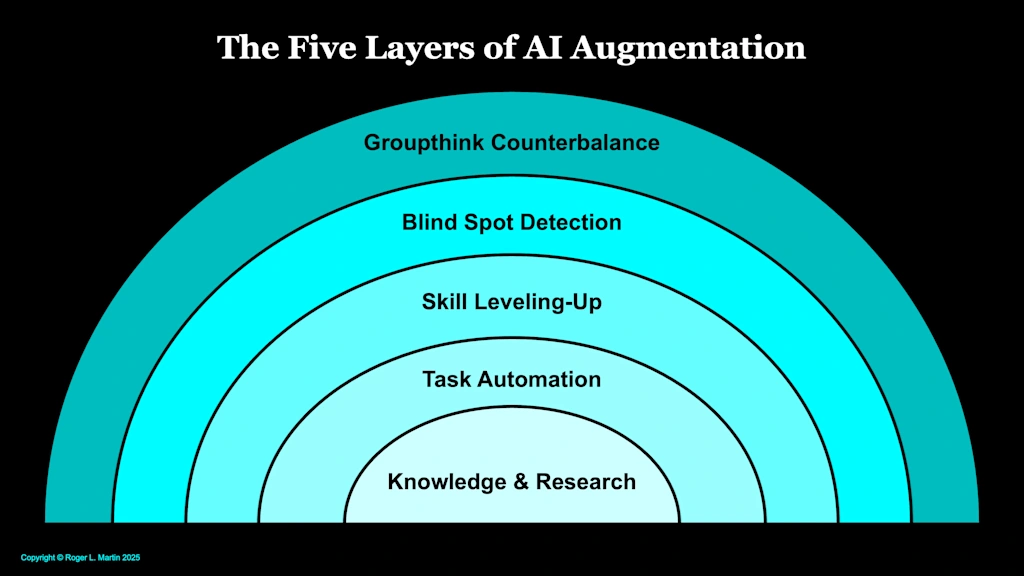
First level: How AI augments knowledge & research
AI is now a common first-pass research assistant. It can map a space, surface sources, and draft a structured brief in minutes. Sophisticated deep research tools like iterative question decomposition, source triage, and synthesis passes that are incorporated into AI products help analysts quickly collect information that would have earlier taken days. That even includes the time it takes to verify sources and detect and correct the Achilles heel of AI, hallucinations.
For example, a mid-level manager might prompt AI to: “Size the Mexican hard-discount grocery market and identify three expansion risks.” On a task like this, AI can (1) outline demand drivers and competitor set, (2) pull public data points (market sizes, growth rates, store counts), (3) generate a comparison table, (4) list interview questions for two customer segments, and (5) draft a 1-page brief with assumptions and confidence levels. The human then validates numbers, adds confidential insights, and finalizes the narrative – augmented by AI.
Second level: How AI augments through task automation
Beyond research, AI can quietly take work off the plate of busy leaders, leveraging their time for other higher-value activities. AI can capture and crystallize notes, summarize meetings, tag decisions, extract owners and due dates, and push them to your tracker. It can cascade strategy, translating top-level objectives into team-level initiatives, propose KPIs, and keep a living “single source of truth” to ensure value delivery. This is the focus of the TransforML platform, which connects strategy choices to projects. It provides risks and weekly updates so leaders see progress, and accumulates blockers and deltas in one place. AI can automate routine operations such as converting emails to tickets, standardizing brief templates, generating weekly roll-ups, and pre-drafting stakeholder communications.
In this layer, leaders get leverage from AI by eliminating the necessity for countless monitoring meetings thanks to more and better machine-assisted follow-through.
Third level: How AI augments through skill leveling-up
AI is a force multiplier for uneven skill profiles. Very few of us have completely consistent skill levels across the spectrum required in our jobs. Each of us has our stronger and weaker skill areas. AI can be used to level-up those weaker skill areas to give us a more consistent skill set through AI augmentation.
For example, we have seen a front-end engineer, who is brilliant in user experience design but less confident with logic structuring, use AI to propose architecture options and trade-offs, generate scaffolded components and tests, and help with complex logical flows. As a result, the front-end engineer has been able to add a disproportionate amount of impact through her unique strengths in developing user experiences that truly delight customers, without being held back by her skill deficits.
Fourth level: How AI augments through blind spot detection
AI is relentless at checklisting the things we forget. Thanks to Atul Gawande and The Checklist Manifesto, we know that even highly skilled professionals need checklists to avoid blindspots. But AI can go far beyond a simple standard checklist. Point AI at a plan and ask: What’s missing? What could fail? It will probe dependencies, non-obvious stakeholders, compliance constraints, and capacity cliffs. It will test for coverage gaps. Used well, it becomes a second pair of eyes that flags risks early and attaches mitigation options with owner, time requirements, and resulting cost estimates. AI’s ability to sift through innumerable documents in minutes allows it to do this at a scale and speed that augments beyond human capacity.
Fifth level: How AI augments through counterbalancing groupthink
Groupthink is a well-documented problem (popularized by Yale professor Irving Janis in a 1971 article and 1972 book) by which teams converge too quickly on suboptimal decisions. To counterbalance groupthink, leaders can assign AI the role of devil’s advocate. Prompt it to argue the strongest opposing case, quantify downside scenarios, and stress-test assumptions. Which single assumption, if wrong, breaks this plan? This keeps debate vigorous and constructive without putting the interpersonal burden on a single brave colleague.
What leaders can do to move teams through the five layers of augmentation
- Set the strategy for AI
The leader must set the overall role of AI in fulfilling the company’s strategy. For example, Gui’s boss (Walmart corporate CEO) declared that Walmart will be people led, powered by technology. That helped Walmart employees understand that it wasn’t going to be technology first and people second – which would have indicated a substitution rather than augmentation agenda. As strategy evolves, it is important that people know what the company is ultimately trying to accomplish, and how.
- Set the bar & the rituals
Be specific on ‘what good looks like’ for AI augmentation. For example, mandate AI-first drafts for research memos, require AI-generated action lists after meetings, and add a “devil’s advocate” AI check before big decisions. Make these part of the operating rituals, not optional extras. Once it becomes part of the ritual, people will quickly overcome any initial fear or hesitation. - Pair tools with training & metrics
The challenge is less with intelligent use – that will come quickly with practice – and more with adoption. Provide training on the approved tools to ease and sped adoption. Set guardrails to help users avoids unpleasant and unproductive downsides. Set and track usage with simple metrics such as percentage of meetings with AI action summaries or percentage of projects with AI risk reviews. Celebrate wins and coach the laggards. - Role-model and de-risk.
As with most things in company life, this won’t take root unless leaders set a positive example. That lowers the implied risk for everybody else in the company. For example, leaders should show their own AI-assisted work (redlines, drafts, risk logs) and make it safe to iterate. Create a sandbox for sensitive work, define guardrails (privacy, IP, accuracy checks), and reward teams for using AI to improve outcomes, not just for “using AI.”
Practitioner insights
Strategy is choice and as a leader (whether at the top or somewhere in the middle of your organization) in the modern era, you have the choice to focus on substitution or augmentation in your utilization of AI. It is a true strategic choice because the opposite is not stupid on its face. Some will focus more on substitution while others on augmentation. And we predict both will succeed in creating value – though in very different ways with differing societal implications.
That having been said, we believe the greatest upside will come setting goals focused on augmentation. That will require cleverness in defining how AI can most powerfully augment your business and then demonstrating the leadership to take advantage of all five levels of augmentation.
AI can give teams superpowers, but only leaders can help unlock them.
A few blocks from my home sits a small Japanese grocery store that has been in the neighborhood for years. It’s the kind of place that once felt irreplaceable—carefully sourced ingredients, shelves stocked with items I couldn’t find in mainstream supermarkets, and an owner who knows her regulars.
But much as I love this store, it has been in steady decline for a few years now. Whole Foods opened up nearby and it now stocks all the basics—miso paste, kombu, dashi packets, nori—that I, or anyone else, could want for weeknight Japanese cooking. Suddenly, the extra trip to the specialty shop felt unnecessary most of the time. The big chain became “good enough,” and in a world where convenience dictates behavior, good enough tends to win.
What happened to that shop isn’t really about Japanese groceries. The same story is playing out across sectors as the mass market parts of many businesses are being swallowed up by bigger players. If a small business competes on anything that a large company can copy and make money from, you can bet your bottom dollar that a large company will eventually start providing those goods or services. And thanks to globalized supply, online storefronts, and the ever-increasing speed of information flows about trends and consumer needs, that copying can happen almost instantly.
That’s why many small businesses need to rethink their business models. Market segments that once seemed niche are quickly becoming part of the mass market. And small businesses have never been able to compete in broad market sectors on the provision of products or services alone. In today’s environment, the only defensible strategy is to go narrow—much narrower than often feels comfortable.
Taking this path can be particularly difficult because when times are tough. The instinct of a small business owner is normally to try harder at everything: better service, longer hours, more products, lower prices. But that’s a trap. When you compete broadly against players with structural advantages, you’re fighting a war of attrition you cannot win. So, instead of trying to beat big companies at their game, SME’s should play a different game altogether, a game they have advantages that the big beasts can’t replicate.
The three shifts that define survival
Small businesses that want to thrive in the future need to make three fundamental shifts in how they operate.
1. From Generalist to Specialist: The Power of Expertise
When business gets tough, owners often broaden the offering—they add more products and try to serve more customer types to become all things to all people. This is understandable but counterproductive. Instead, the path to survival runs through radical specialization: owning a territory so narrow and deep that competition becomes nearly irrelevant.
The point is that while generalist businesses compete with everyone, specialists compete with almost no one. An accounting firm serving all small businesses faces constant price pressures from the commoditization of services in their sector. The same firm focusing exclusively on assisting craft breweries as they navigate excise tax regulations, inter-state distribution challenges, equipment depreciation schedules, and seasonal cash flow patterns can add value in ways that a large firm selling generalized services never could. They are not competing on price anymore—they are competing on irreplaceable expertise.
This matters now more than ever because AI and automation are rapidly commoditizing general knowledge. ChatGPT can generate useful general marketing advice. But it cannot replicate 15 years of navigating the specific regulatory environment of biotech fundraising or identifying which Japanese suppliers source sustainably today. Only the deepest moats can be defended when breadth can be automated.
2. From Customers to Community: Building Tribal Loyalty
In an age in which more and more interactions are becoming digital and transactional, the hunger for genuine connection intensifies. People will pay premiums and make extra trips for businesses that make them feel they belong to something—business that don’t just sell products but that create communities.
Radical specialization creates the conditions for community, because the people who walk through the door aren’t just customers anymore. They are people who share something in common: a deep focus on and interest in a specific activity, product, or type of knowledge. This is the foundation on which small businesses can build their tribes.
For example, instead of simply selling products, the Japanese grocery store in my neighborhood could cultivate a community of serious home cooks who care about authentic Japanese cuisine. It could organize monthly sake tastings, knife skills workshops, cooking demonstrations—anything that helps create a community of people who come to the store because it’s their store, a place where people like them hang out and shop. In this way, the business becomes not just a vendor but the center of a shared identity.
3. From Corporate Speak to Real Humanity: The Power of Authenticity
Small businesses often try to sound like big companies. The irony is that this erases the one advantage small businesses will always have over their larger competitors—the ability to be distinctively, recognizably human.
Big companies have no choice but to be bland, because when a business serves millions of customers with diverse values and preferences, it cannot afford to be polarizing. Every piece of marketing content, branding, and presentation is smoothed into a form that is maximally inoffensive, and which almost inevitably tends to fade into forgettable corporate messaging. But small businesses that specialize do not face this constraint. They can afford to have opinions, quirks, and personality. And in a world where AI can generate perfectly polished content and every brand sounds the same, being recognizably yourself becomes a competitive advantage that cannot be replicated.
This isn’t just about being quirky for its own sake. An authentic voice does three things that corporate polish cannot. First, it makes expertise tangible—strong opinions come from deep knowledge, and customers can sense the difference between an earned perspective and generic advice. Second, it attracts the right people while repelling everyone else, which is exactly what a specialized business needs. Third, it creates connection before transaction. When someone has been following the grocery store owner’s social media posts for months, seeing her passion for real ingredients and deep knowledge of the products she sells, the first visit feels less like shopping and more like finally meeting someone they already know.
Three things to do right now
Here are three concrete steps you can take immediately as a small business owner to help your business survive into 2026 and beyond.
1. Map your territory
Pick your top 10 customers and write down what they have in common. What do they care about that others don’t? What expertise do they value that general competitors can’t provide?
This exercise reveals where the business already has traction with a specific group—the foundation for radical specialization. Most small businesses discover they’re already serving a niche without realizing it. The work is recognizing it and leaning into it fully rather than hedging with broader offerings.
2. Choose one thing to stop doing
Radical specialization requires subtraction. This week, identify one product line, service offering, or customer segment that pulls the business away from its core expertise.
Then stop serving it.
This can feel terrifying. The instinct is to worry about lost revenue. But the store that stops trying to compete as a general grocer and embraces a new identity as a specialty shop for serious home cooks isn’t limiting itself—it’s claiming territory it can actually defend.
3. Show up as a human being
Pick one platform—Instagram, LinkedIn, a blog, whatever feels natural—and commit to posting three times this week as an actual person with actual opinions.
The goal isn’t to go viral or be provocative for its own sake. It is to demonstrate that there is a real human with real expertise and real opinions behind the business—someone worth paying attention to and someone eventually worth paying to do business with.
This may feel uncomfortable at first. That discomfort is a good sign. If it feels too polished and safe, it’s not quite working yet.
The path forward
That Japanese grocery store near my house is still there—for now. But if it wants to survive in the long term, it will need to make choices that feel counterintuitive: going narrower instead of broader, becoming smaller instead of bigger.
In a world in which large companies are serving broader and broader markets, small businesses need to lean into becoming specialists. This gives them not just something feasible to defend but the tools they will need to fight for their territory.
This marks another escalation in the global race to build powerful AI “thinking” systems.
The post DeepSeek Unleashes New AI Models to Challenge Google and OpenAI appeared first on TechRepublic.
Google’s RCS Archival update lets companies log Google Messages on managed Pixel work phones, sharpening compliance while testing privacy and trust at work.
The post New Google Pixel Update Lets Companies Peek Into Your Messages appeared first on TechR…
As 2025 winds down, here are some moves to help you finish the year strong financially. Morningstar’s director of personal finance and retirement planning, Christine Benz, discusses strategies.This interview has been edited for length and clarit…


