


After the news broke that Taylor Swift and Kansas City Chiefs tight end Travis Kelce were dating, the impact was immediate and dazzling. Viewership at the Chiefs game against the Chicago Bears that she attended exceeded 27 million, making it the most-watched NFL game since the 2022 Super Bowl, and StubHub saw a 175% increase in sales for the next Chief’s game against the Jets.
Social media mentions of Kelce and the NFL skyrocketed, with hashtags #traviskelce and #nfl receiving 2.27 million and 1.02 million engagements, respectively, in the two weeks following the game, according to data compiled by influencer platform Captiv8.
This was, of course, after Swift demonstrated her enormous star power through both her record-breaking Eras Tour, which could gross more than $2.2 billion, and set box office records with The Eras Tour movie, which took cinemas by storm this month after a first-of-its-kind distribution deal her team negotiated directly with AMC.
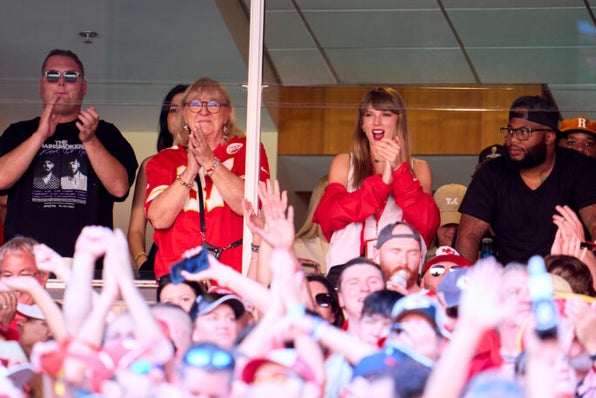
And while there are plenty of iconic stars who can command a hefty box office draw or fill stadiums with concert-goers, fewer have the power to create such economic ripples with virtually every move they make. Fans follow Swift’s moves from the clothing she wears to the snacks she chooses. (A recent viral social media post that included a photo of Swift next to a plate with a chicken nugget, ketchup, and what appeared to be ranch dressing sparked the “seemingly ranch” wave of new limited edition products and attention for the condiments.)
Creating a bond
That influence is not an accident, experts say. Swift is adept at cultivating loyalty and engagement within her fan base, says Ashley Graham, founder of The Conscious Publicist, a public and media relations firm. “Taylor Swift’s fans feel a deep connection to her, and it’s not by chance. She has mastered the art of inviting her audience into her life, sharing the glamorous moments and her vulnerabilities. This transparency builds a strong emotional bond,” she says.
Public relations expert Jordan McAuley, founder of ContactAnyCelebrity.com, says that Taylor Swift is “one of the most approachable and relatable celebrities of her stature” because of her personal touch with fans. “From the beginning, when she was a country singer, Swift hugged fans and still does, took selfies with them, dropped ‘Easter eggs’ for fans to decode, and sends fans gifts in the mail,” he says. Swift’s mother even chooses fans to meet the star backstage at her concerts, he adds.
Unlike other influencers who might give a peek at what they’re eating for breakfast or what products they recommend, Swift gives fans insight into her personal life and even her vulnerabilities and private thoughts through her music, social media presence, and other interactions, says Sarah Saffari is the CEO of influencer marketing agency InfluencerNexus.
Swift is known for answering direct messages and commenting publicly on fans’ social media comments. She may post a video with her father one minute and a silly cat video in another. All of this creates a feeling of familiarity and care. “She makes her fans feel like ‘Wow, I know Taylor Swift personally,’” Saffi says. “So that makes them feel like this person is my best friend. I know them like my best friend, and I trust them like my best friend.”
The connection that echoes
So, what makes Swift’s influence so powerful? It’s a process, says cultural contagion expert Marcus Collins, a clinical assistant professor of marketing at the University of Michigan and author of For the Culture: The Power Behind What We Buy, What We Do, And Who We Want to Be.
By way of explanation, he points to the work of Elihu Katz and Paul Lazarsfeld and others who identified the two-step model of personal influence. We often think of influence as a bowling ball, where mass media shares messages with a lot of people and persuades people through its power and reach. But the way influence really works, they found, is more like a pinball machine—a network effect based on thought leaders voicing their opinions, which then reverberate and affect other people’s actions and decisions within smaller communities that, collectively, have an impact.
Collins knows a thing or two about such influence, having worked on digital marketing for Beyoncé, who holds similar sway among her fans, the “BeyHive.” He says Swift’s influence holds lessons for brands and individuals who want to create loyal communities around them. It starts with an honest look at values and priorities.
“Beyond being an artist, beyond selling sneakers, beyond making razor blades: What’s your point of view of the world—your ideology, the cultural characteristics—that frames the way you see the world as an entity and governs what you do?” he asks. Once you define those aspects, you can begin to seek out people and customers “who see the world the way you do and preach the gospel to them,” he says. Those people share an ideology and are more likely to connect with your brand—personally or commercially—as an expression of their identity.
“Everyone’s wearing this and everyone’s doing that. ‘Nothing draws a crowd like a crowd’ is the social proof effect. People like ourselves act a certain way, and it creates a signal that is how we should act, also,” he adds. And while not all of us will achieve that kind of network effect at Swift’s level, even a far more modest model can make an impact.


