


 Many Strategy frameworks are based on the premise: we can’t be everything to everyone. An organization that pursues too many strategies usually ends up stuck in the middle offering average products for average prices. Thus, much of strategic thinking is focused on prioritization of resources, so we can make the greatest, timeliest impact given our limited resources.
The Value Disciplines Model, a classic Strategy framework by Michael Treacy and Fred Wiersema in the mid-90s, follows this same line of thinking. Specifically, Treacy and Wiersema suggests 3 “Value Disciplines” to choose from that can act as a central piece that shapes every subsequent plan and decision a company makes. These 3 Value Disciplines are depicted below.
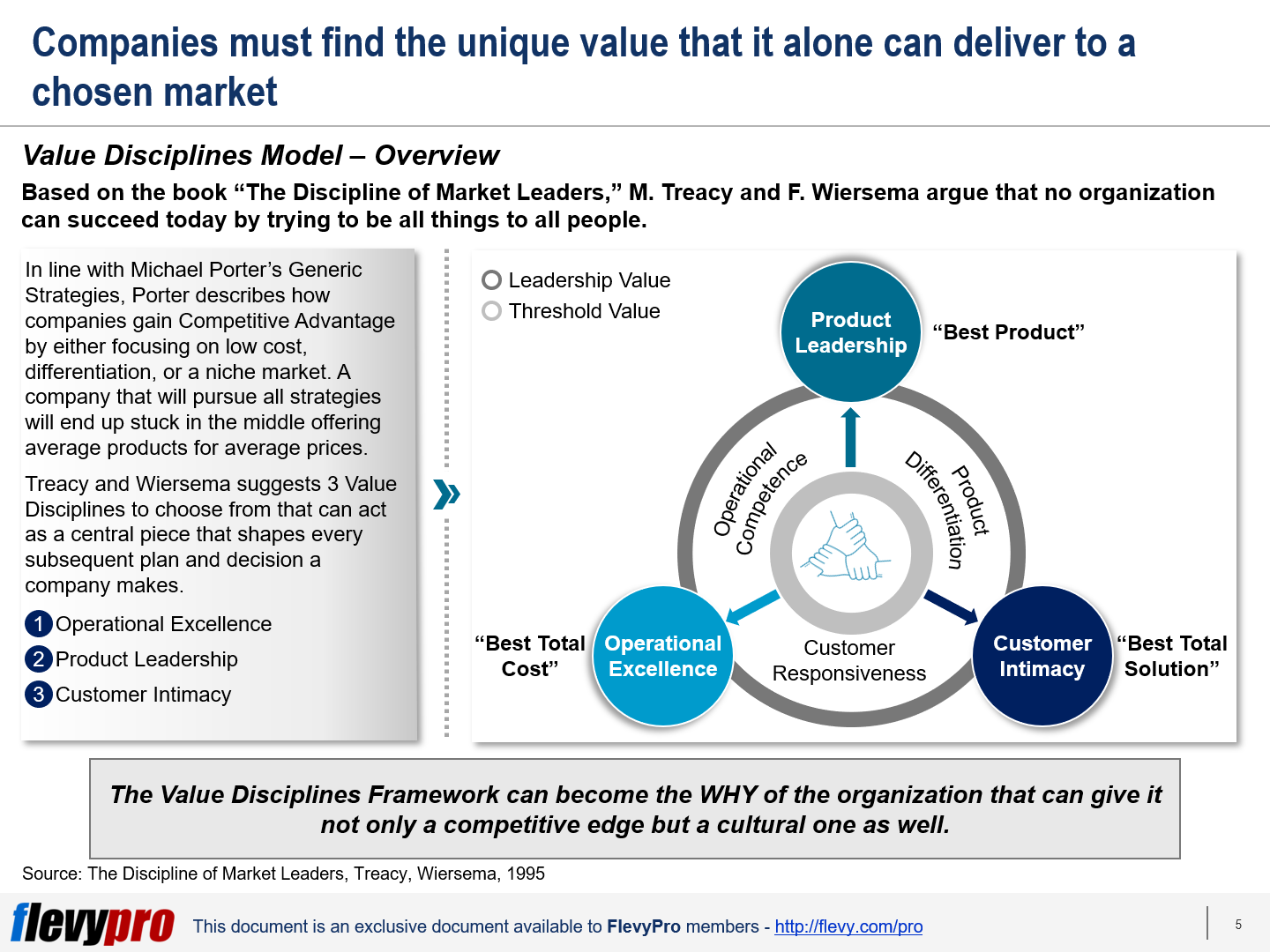
Operational Excellence (OpEx)
OpEx is the first Value Discipline, focused on providing customers with reliable products at competitive prices, delivered with minimal difficulty. Strength in OpEx ensures delivery of a combination of quality, price, and ease of purchase that no one in the market can match.
Achieving Operational Excellence requires the successful implementation of an Integrated Business Execution System, comprised of 4 building blocks:
- Strategy Deployment – The process that aligns and links business strategy and execution. A common Lean framework for Strategy Deployment is Hoshin Kanri.
- Performance Management – Performance Management that translates strategic initiatives into measurable KPIs and goals.
- Process Excellence – Process Excellence is all about continuous business process improvement. The well designed, efficient, and effective Management, Value Chain, and Support Processes necessary to deliver world class results.
- High Performance Work Teams – The team with the right attitude, right mindset, and the right competencies. A high performance team that has the highest level of empowerment with sufficient resources, information, and accountability.
Blue-chip companies that have demonstrated Operational Excellence include McDonalds, IKEA, and Walmart.
Product Leadership
This 2nd Value Discipline focused on being creative, agile, and fast. Organizations demonstrating Product Leadership are consistently striving to provide customers with leading-edge products or useful new applications of existing products or services.
Product leaders avoid bureaucracy at all costs, as it slows down the commercialization of ideas. Similarly, a central feature to Product Leadership is the strength to react to situations as they occur.
Examples of organizations showing strength in Product Leadership include Apple, Nike, and Rolex.
Customer Intimacy
The final Value Discipline is focused on delivery value to customers. These organizations are focused on building bonds with customers like those between good neighbors.
These companies are continually tailoring their products and services to the customer in a way that it can offer the best total solution. They also are focused on practicing principles of Customer-centric Design (CCD).
Examples of organizations with strong Customer Intimacy include Amazon, Home Depot, and Salesforce.
Are you a management consultant?
You can download this and hundreds of other consulting frameworks and consulting training guides from the FlevyPro library.


