


Each time I walk into a bookstore I choose a book of poetry off the shelf and open it to random pages. The day I walked into Godmothers, the new bookstore and cultural gathering space in Summerland, California, I picked up a book from the Persian poet, Hafiz, and then read poems about longing and finding peace.
Serendipitously, as the ritual often inspires, both topics were illuminated when I spoke to Godmothers’ founders Jennifer Rudolph Walsh and Victoria Jackson. Rudolph Walsh is the former global head of literary, lectures, and conferences at WME. Jackson is a cosmetics entrepreneur and medical research pioneer.
In our conversation, Rudolph Walsh says she’s no longer on the “road-to-find-out.” When I mentioned that I was, she left me with advice that I’ve reflected on since. When she moved out West to connect with nature, her family named their farm “EasyWay Farm.” Their motto is: “Try easier.” It’s the same wisdom she imparted to me: “You don’t have to try so hard. Try easier.”

Her insight reflected an observation I’ve made across a series of intergenerational interviews: When people embrace life or career transitions, it’s not simply that what they’re doing is different. They’re doing it with a different energy. Most noticeably, a sense of ease, joy, and trust. I was eager to ask Rudolph Walsh and Jackson what inspired that.
Here, we discuss how to navigate the liminal space during transitions, create space for serendipity, and balance letting things happen and making them happen.
This interview has been edited for length and clarity.
Fast Company: As I was preparing for our conversation, a Rumi quote resurfaced that reflected the wisdom I’ve heard from you both: “When I run after what I think I want, my days are a furnace of stress and anxiety. If I sit in my place of patience, what I need flows to me without pain. From this, I understand that what I want also wants me, is looking for me and attracting me. There’s a great secret here for anyone who can grasp it.” How do you embody this philosophy differently today than you did before?
Jennifer Rudolph Walsh: Victoria and I talk a lot about the felt truth and allowing and emerging. As opposed to making something happen, we find that balance between letting it happen and making it happen. But, not forcing or controlling.
It has been a journey in trusting the universe and following what I call the breadcrumbs. When I follow the breadcrumbs, everything is always going my way, because I’m going in the direction of the flow. It’s not always easy, but it’s always simple. It’s never let me down. Godmothers and my friendship with Victoria is a perfect example of that. It went with the flow of what felt right and led to this cocreation.
Victoria Jackson: Even as I sit under these 8,000 mantras above my head, I try to sit in stillness. I’ve always been a seeker. I’m open to different things. I form a lot of pictures in my head. Then, I try to manifest them. But, for me, it’s when I get quiet with myself. I try to listen and go. I don’t analyze things for hours or days. I just go to the next thing.
I don’t think there are too many accidents. It’s all meant to be for a reason; Sometimes I don’t like the reason or what I’m in. But, then there’s the beautiful surprises along the way. That’s a lot of what Godmothers is for me. It certainly wasn’t on the big plan that I had for myself. But, I don’t really have one anymore.
Jennifer, when you spoke about your sacred pause (the period in between leaving WME and starting Godmothers) you shared that you “could feel the need for stillness, silence, and to hear my own voice.” And, that you didn’t know what your voice would sound like. For both of you, what was your experience of hearing your own voice? What did it sound like and where did it lead you?
VJ: I’m always listening to my voice; Sometimes it’s whispering, sometimes it’s yelling. But, I always tune into it. It even tells me how I need to spend my day; What I need to be focusing on and not, what feels toxic or healthy, right or wrong. It’s always speaking to me, in the stillness or the middle of the noisiest place. It’s more of a challenge for me to turn it off.
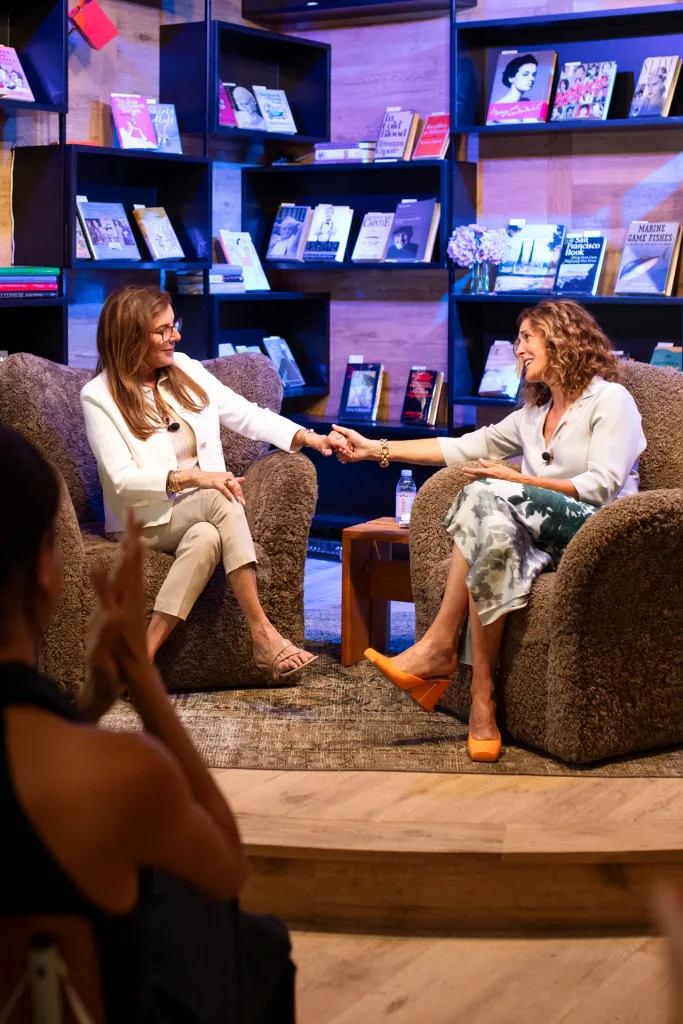
JRW: I’ve also always been tuned into my voice. But, in the process of deciding to finish my career in New York and follow a calling out West to prioritize a relationship with nature, I had to listen with a different set of ears. As I completed the part of my life in the city—where I had children in the home and was a representative of others—I had to start listening to a softer, more open light that didn’t have a clear journey or destination. It was speaking to me in a different language that I had to learn.
It was a beautiful process. I’m still in that process. It led me two miles up a mountain to live with donkeys, goats, cows, and avocado trees. All of these things are new and exciting to me. In that creative space, the cocreation for Godmothers was born on my side.
The liminal space during those times can be uncomfortable because you’re in between who you were and who you’re becoming. You’re in the chrysalis. How do you navigate that space and make it generative amidst the uncertainty?
JRW: I had to let go of one rung on the monkey bars before I could catch the other and trust my belief system that the universe has a plan unfolding for you. I had to put my belief system into play in the most profound way.
The way I described it was: I’m driving by my high beams at night. I can see six feet in front of me and I’m trusting that I’m going to find my way home. That’s where I stayed for four years. It was a challenge for people who loved me, wanted certainty, or a data point. But, I trusted it. I trusted the people that the universe brought my way, Victoria being chief among them, and that they were there for my highest good. They were light posts. Then, that liminal space became something that I ultimately could exhale, trust, and feel comfortable in. I had no sense of urgency in getting to shore.
Jennifer you’ve said: “The intention drives the energy. If the intention is pure and transparent, then I feel the energy will follow in a positive way.” And, Victoria, your mantra is: “With love and intention, anything is possible.” Tell us about the power of gaining clarity on and embodying your intention. How does that drive energy?
VJ: I learned with intention, hearing from my kids, that there’s something to be said about intention and experience. My intention might be one thing. Their experience might be something else. I try to tune into my intention, and how people might experience it, and always put that under the umbrella of love.
To me, intention and purpose is everything. It’s my North Star and starting point. Now, I add not just the love, but how other people are going to experience it, which isn’t always the same as my intention.
JRW: For me, to always begin with the intention has helped me be clear. As Brené Brown says: Clear is kind. Unclear is unkind. I have a gift of clarity. I have to first align with my intention. Then, through that alignment, I’m able to give the gift of clarity.
Like Victoria, my intention is love. My intention is also to create spaces where people can share their authentic stories and feel safe to be witnessed in their full humanity. I believe there’s more than enough to go around and that, under the skin, we’re more alike than we’re different. Our stories reveal that. My intention is to create opportunities for that and to take the wisdom from the smallest rooms to the largest rooms possible. I’ve always been on this idea that our stories connect, elevate, and heal us.
Victoria, you’ve been open about the journey of learning to give yourself grace after your dream came true to go on the Oprah show and you weren’t able to attend. And, Jennifer, you’ve shared that “eliminating negative self-talk has been the biggest transformational tool.” How did your lives change when the conversation that you had with yourself changed?
VJ: When you can give yourself grace, it’s a breath of fresh air. It’s like giving yourself more breath and space. So, doing that has been a gift. It’s one thing to do it now, turning 70 next year. That’s different from when I was having a hard time doing it when that opportunity came up in my mid-thirties. When you can allow yourself that, it’s transformative. I’m so much kinder to myself.
I’m still hard on myself. I have very high expectations of myself and others. I’m always trying to find that part in people that they haven’t tapped into yet, because I’ve seen that I’m doing things I never thought I could. I want to foster that in others as well.
JRW: When it comes to bringing out the best in others or self-talk, for me, it’s more about making sure that I am who I say I am; to do what I say and say what I do, so that I’m a model. Even in my transition, I wanted to be very transparent with my goddaughters, who are sometimes my godmothers, through the process. So, that one day when they found themselves in a transition, they might have these seeds that I planted that ended up to be little trailheads.
Victoria, in referencing doing things you never thought you could, when you were asked to describe yourself as a child and today, you said: In childhood, you were a survivor. Now, you are a survivor and a thriver. What was most transformative in rewiring that pattern and shifting from surviving to thriving?
VJ: It’s time, experience, and relationships. There hasn’t been any one thing. Although, two things happened that I thought would never happen in my life: One was a moment of realization that Gloria Steinem was inducting me into the National Women’s Hall of Fame, which was one of the most extraordinary moments.
I’m not a religious person. But, a rather unusual moment of being at the Vatican, standing up there, and receiving this award for the work that I’m doing. I don’t think it was until that moment, when everybody stood up, that I picked my head up and looked out for the first time. It still chokes me up, because I never actually picked my head up. I’ve been on this mission for so long. I looked out and it was like: I’m at the Vatican. How did this all happen?
It takes a lot for me to go: Victoria, you could take this in. At the same time, realizing that if I was given that kind of acknowledgment, I take it very seriously and the work continues. But, it was a moment that I could go: If you die tomorrow, you did some good work here.
As I see people embark on new career chapters, I’ve observed that they have fewer expectations. Jennifer, you echoed that when you said: “I’m integrating all of the experiences into one giant tapestry. I’m not competing against my last chapter . . . It doesn’t need to be big or huge. It just needs to be authentic, true, and beautiful.” I’d love for you to expand on that. How have you learned to let go of expectations and trust the unfolding in your endeavors?
JRW: Something that has come to me in the last few years is that I no longer consider myself a seeker. I’ve had to let go of a lot of identities and labels. That’s one that served me beautifully for close to 30 years. But, I feel found. I’m not seeking anymore. It doesn’t mean that I’m not curious, learning, or open. In fact, more than ever. But, I no longer feel that I’m on a journey. I call it the road-to-find-out (with that being one word). I’m off that road.
For me, that’s been an exciting arrival. It informs the way that I feel about Godmothers. I don’t feel like I’m a fellow seeker there. I feel like I’m a guidepost, like: The trail starts here. I’m waving people in and giving them coffee or a bagel with eggs and pastrami.
By the way, 10 years from now, I might tell you that I’m back on the road-to-find-out. I don’t know. I just know that right now, that label no longer resonates for me.
Victoria, in referencing the launch of Godmothers, you shared that “you have to leave space for the room to dream” and because you left that space, you serendipitously met Jennifer. I’d love to close with how you both keep your dreams alive and your philosophy on serendipity.
JRW: To me, it’s serendipity. But, it’s actually the divine plan unfolding. I say, DST: Divine Standard Time. Was it synchronicity that I was sat next to Victoria at a dinner party? Who knows? Maybe. In my belief, it was part of a soul contract and a perfect unfolding. I keep my heart open and listen. Peace and joy are my guideposts.
I don’t set calls. It drives people crazy. I’m like: Let’s use the old school system. You try me. If it’s not a good time, I’ll try you. DST will find that perfect moment. It seems to work without fail. When it doesn’t come together, my version of that is that it wasn’t meant to be yet. See you down the road.
VJ: There aren’t any accidents. Experiencing the medical things and going through really troubling times, at times I wonder, not in a victim way, but why was this meant to be? I get that things happened because I’ve been able to get certain things done that maybe others couldn’t. I struggle with that at times. But, then I think that it’s all meant to be. It’s how we not just survive in it, but thrive in it.
Godmothers, like I said, wasn’t on the life plan. Even my kids go: Mom, you don’t even finish the books in your book club, you have a bookstore? When something feels like: I’m going to take this leap of faith. I’m always very open.
JRW: We’re okay with letting the mystery be.


