



A strong, positive Organizational Culture fosters a good feeling in employees about their work and the work environment.
Nourishing such a culture demands key behaviors to be keenly managed by looking for and recurrently strengthening Bedrock Behaviors.
Bedrock Behaviors is a set of acts that has the influence to initiate a domino effect, altering other Behaviors as they travel through an organization. Organizations that identify and embrace such Behaviors, are in a position to create cultures with sway that go further than employee engagement and directly improve performance.
Not many leaders become aware of the massive effect of these crucial Behaviors, with their attempts to increase performance staying vague and dispersed.
Also leaders find the enticement of amassing instructions one after another very difficult to forbear.
These instructions frequently enfeeble each other even if these actions are lined up to the same eventual objectives.
Additionally, when these actions are aimed at substantial transformations to the culture, they are virtually always too inclusive, systematic, abstruse, and immediate.
Culture is quite profoundly entrenched in employees’ convictions and habits and this is something leaders are mostly unable to realize. Failure of this realization makes it difficult to bring about change in behaviors that has a lasting impact.
Generating change in behavior is more effective when organizations keep it simple, rather than taking the all-encompassing cultural change approach.
Organizations that focus on the following 3 key elements of Culture—that drive Performance—are the ones that succeed in causing lasting change:
- Critical Behaviors—those methods of accomplishing tasks, in the existing operations, that can be effortlessly disseminated from one employee to the next.
- Existing Cultural Traits—point to 3 or 4 poignant elements of the present Culture that are uniquely well-defined, sagaciously deep, passionately profound, and broadly familiar.
- Critical, Informal Leaders—those few employees who genuinely inspire others by what they do and the manner in which they do it.
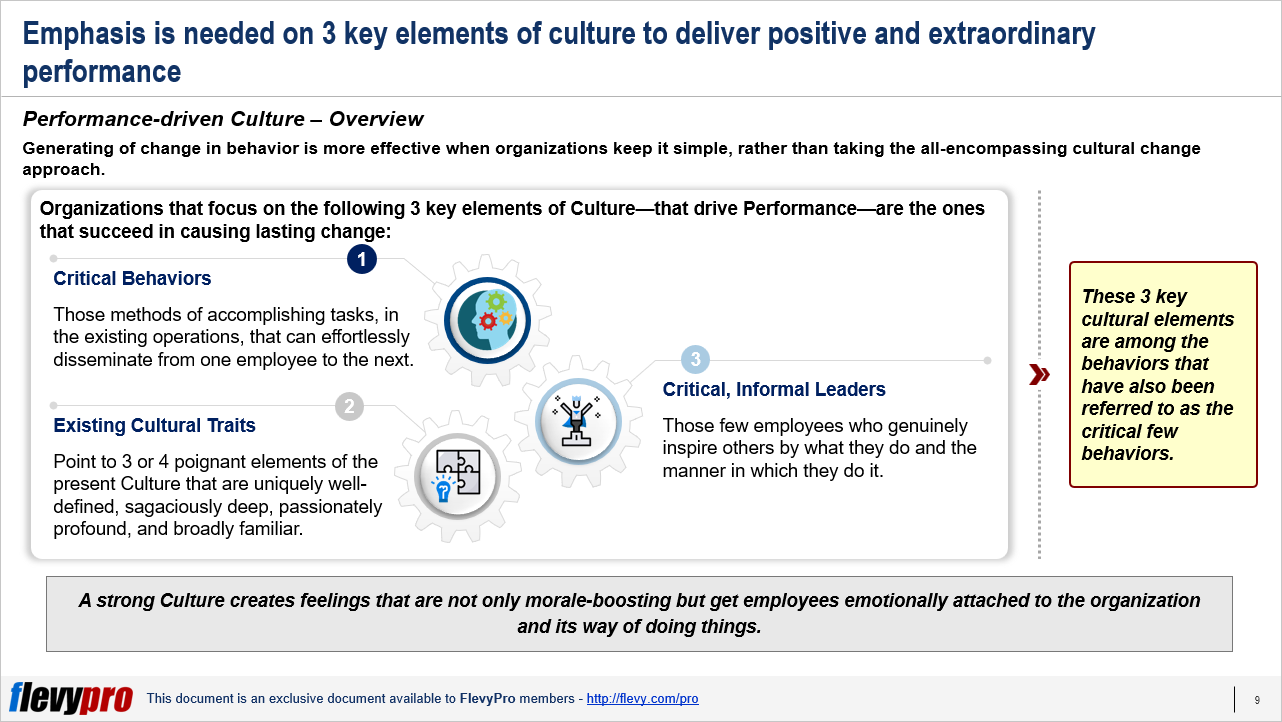
These 3 key cultural elements are among the behaviors that have also been referred to as the critical few behaviors. Clear focus on these 3 key elements of culture diminishes complexity and produces a more optimistic, comfortable, and permanent cultural impact on Performance.
Let us delve a little deeper into these elements.
Critical Behaviors
Identifying, elucidating, and garnering wide backing for a few critical behaviors—exemplifying the cultural priorities of the business—is the top most task in bringing cultural change.
Intricate and interwoven connection of the elements of the Critical Few will become instantly apparent when attempts are made to focus on critical behaviors.
While attempting to identify and prioritize the Critical Few Behaviors, urge to eradicate other behaviors that hold the business back should be checked.
Temptation to address the biggest pain points—e.g., lack of Innovation, lack of collaboration, and the like—should instead be channeled towards pinpointing and promoting desired behaviors.
Existing Cultural Traits
Virtually all organizations have a small number of significant existing cultural traits that are characteristically positive and they are an essential part of the authentic cultural scenario.
Leaders have the responsibility of ascertaining the Existing Cultural Traits that the business is supposed to uphold and add on to.
A business should focus on 3 or 4 traits, from among the numerous commendable traits, that are particularly clear, astutely thoughtful, emotionally formidable, and extensively well-known.
Looking for a large number of traits not only makes even the most solid traits appear, in some ways, unconvincing but also causes the whole process to lose credibility.
When appropriately identified and employed, these traits offer the employees a feeling of pride and purpose.
Critical Informal Leaders
Culture cannot be changed in haste since it is a self-sustaining way of behaving, contemplating, believing, and feeling, in a given group.
Focus and effort should be on a critical few groups and certain individuals, within the organization, who can assist in carrying out this Transformation and make it enduring.
Interested in learning more about Performance-driven Culture? You can download an editable PowerPoint presentation on Performance-driven Culture here on the Flevy documents marketplace.
Do You Find Value in This Framework?
You can download in-depth presentations on this and hundreds of similar business frameworks from the FlevyPro Library. FlevyPro is trusted and utilized by 1000s of management consultants and corporate executives.
For even more best practices available on Flevy, have a look at our top 100 lists:


