



A business remains viable as long as it keeps growing. However, forecasting how much the business will grow in a year, or in a certain period of time, is a difficult proposition for any business leader. Likewise, it isn’t easy for the leaders to envisage the following scenarios:
- How much growth is necessary for their business?
- Should we settle for revenue growth or margin improvement? How do we balance both?
- How to actually achieve growth?
Sustainable growth necessitates a Capabilities-driven Strategy (CDS), instead of the conventional market-driven approaches, focusing on anything that customers want.
The Capabilities-driven Growth Strategy entails capitalizing on the organization’s current strengths, utilizing all possible ways—e.g., existing or adjacent markets, organic channels (Marketing or Innovation), or inorganic methods (Mergers & Acquisitions).
The Capabilities-driven Strategy allows the leaders to achieve growth by combining all means in an Agile way, as long as they are in alignment with the firm’s existing competences and Competitive Advantages. A coherent Capabilities-driven Growth Strategy demands from the organizations to establish 3 main factors prior to its execution:
- An assortment of product or service offerings
- A unique capabilities system, which competitors can’t imitate
- A value proposition reverberating with what customers need
Organizations should have the ability to transform ideas into a strong position, having a practical Business Model that is able to create revenue and profits in the long term.
Organizations looking to compete into new business segments must have a clear vision to generate value and the resources needed to compete. Once an enterprise has attained a position of strength to compete, i.e. a Capabilities-driven Strategy and the means to take advantage of it, senior leaders should then outline a path to achieve profitable long-term development by blending together 4 approaches to Growth Strategy:
- In-market Opportunities
- Near-market Opportunities
- Disruptive Opportunities
- Capability Development
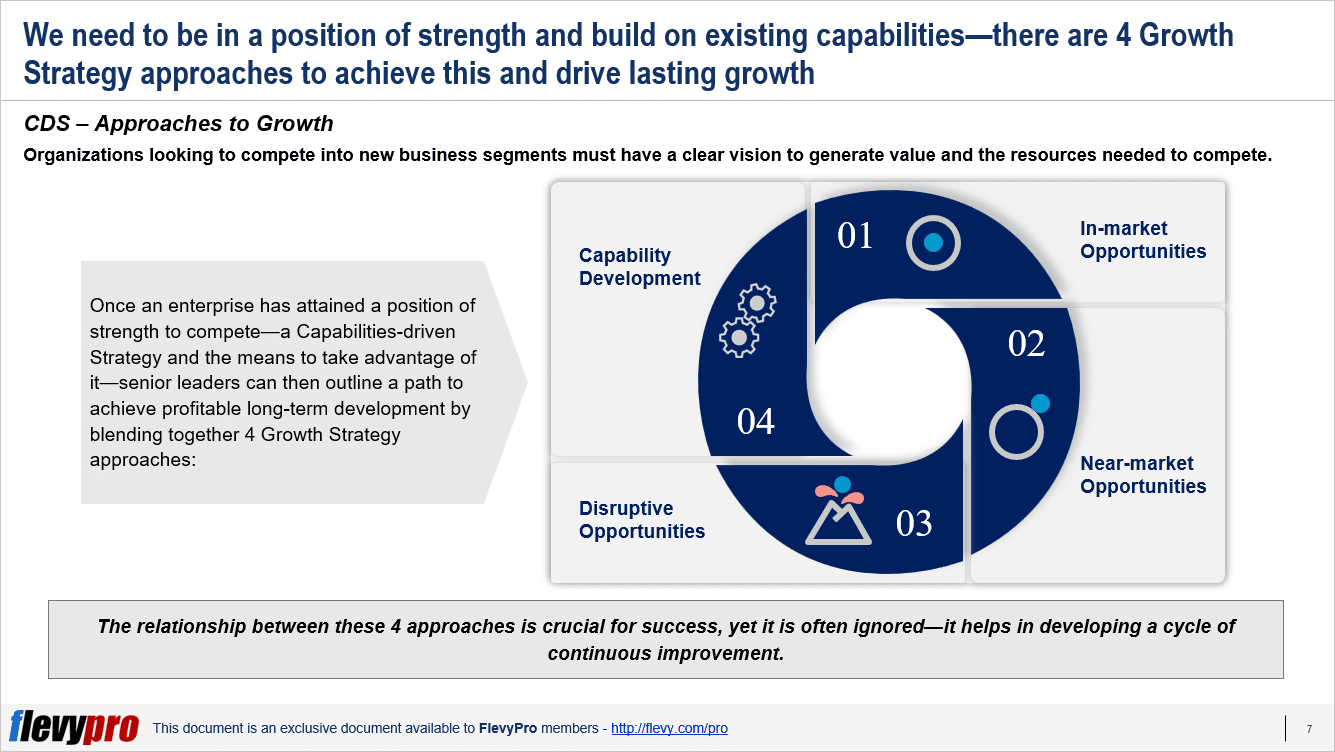
The relationship between these 4 approaches is crucial for success, yet it is often ignored. It helps in developing a cycle of continuous improvement.
Let’s dive deeper into the first 2 of these Capabilities-driven Growth Strategy approaches.
In-market Opportunities
The first approach to growth entails mining maximum potential from the existing market. Leaders often neglect additional growth prospects in their existing markets. They are enticed by potential in other businesses and foreign markets. Before looking into other businesses and diversifying into new markets, a lucid approach should be to carefully analyze the existing markets with a fresh perspective first and unearth new business and revenue sources. Gauging the magnitude of these untapped opportunities in the existing markets necessitates 3 key actions, i.e.:
- Identify gaps between customers’ requirements and products/services available in the market and bridge that gap with new or improved offerings.
- Ascertain elements to influence customers to shift to those new offerings—e.g. attributes, benefits, and communication.
- Build, improve, reorganize, or divert your distinct organizational capabilities to bridge the gap and encourage customers to shift.
For instance, fast-food restaurants can improve growth potential in their existing market by offering premium coffee, dessert, or drinks in addition to their regular breakfast or lunch offers. This is additional revenue which would otherwise be captured by coffee houses, juice bars, and the like by expanding their menus, offering meals, and making customers switch to them.
Near-market Opportunities
It is typical for organizations to look into nearby markets when thinking of expansion. These adjacent markets although seem attractive, but are developed by other enterprises using their capabilities systems that aren’t straightforward to emulate. Therefore, the decision to expand your capabilities in the adjacent markets should be made very cautiously.
Enterprises aspiring to expand into adjacent markets or to other industries should first undertake an in-depth analysis of their capabilities and their suitability for nearby markets—e.g. cost reduction, operational strengths, IT infrastructure and systems, supply chain, or customers data. They should qualify those markets where they can serve their unique capabilities, identify new customers for existing offerings, or build new offerings using their capabilities.
Interested in learning more about the other approaches to Growth Strategy? You can download an editable PowerPoint presentation on Capabilities-driven Growth Strategy here on the Flevy documents marketplace.
Do You Find Value in This Framework?
You can download in-depth presentations on this and hundreds of similar business frameworks from the FlevyPro Library. FlevyPro is trusted and utilized by 1000s of management consultants and corporate executives.
For even more best practices available on Flevy, have a look at our top 100 lists:


