


As President Trump has cracked down on all kinds of immigration, tech workers and students have been caught in the crosshairs. In a bid to curb use of the H-1B visa—a program that allows employers to hire skilled talent from abroad and is widely used across the tech industry—Trump imposed a whopping $100,000 fee on new applications last year.
The steep cost of hiring H-1B workers has already had an impact on tech companies and other employers that have come to rely on the visa, leaving many students and aspiring H-1B workers with few options to remain in the country. Some employers have been forced to reevaluate their hiring strategy and have opted to sit out the H-1B lottery this year. For small companies, the fee has made an already challenging, expensive process virtually impossible to navigate.
Amid this political climate, the immigration law firm Ellis wants to simplify work visa applications for companies—and workers—through a tech-enabled platform that uses AI to automate parts of the process, which remains complex and largely paper-based. With a new subscription service, Ellis is now offering employers a tiered option that starts at $2,000 a month, which allows smaller startups with under 50 employees to file unlimited visa applications. That includes most of the common work visa types, from the H-1B to the J-1 student visa or TN visa for workers from Mexico and Canada.
Most immigration lawyers still bill by the hour or by case, which means companies can spend thousands of dollars per application just on legal fees. (On an individual basis, Ellis charges anywhere from $2,500 to $12,000 to prepare applications; the H-1B visa, for example, costs $3,000 in legal fees.) By bundling its services, Ellis hopes to encourage employers to sponsor more immigrant workers. “If you have a fixed platform fee, like you would with Ellis, your marginal cost of sponsoring a visa actually goes down, which is an incentive we’d like to encourage,” says Sampei Omichi, the founder and CEO of Ellis.

There are other immigration law firms like Manifest Law that also have a flat fee option, which is more cost-effective for employers, as well as tech platforms like Boundless that provide on-demand legal support for visa applications. Some products are fully automating the visa application process, which means there is limited input from actual immigration attorneys. Ellis is pitching its platform as a more comprehensive solution for companies—and especially tech employers—that are looking for tech-forward legal support and the full services of an immigration law firm.
Ellis has managed to bring down the legal costs associated with visa applications in part by employing AI agents where appropriate—and only with the oversight of full-time staff attorneys. “By automating a lot of the rote and manual work that comes with a more operational type of law, you actually open up the attorneys to do what they do best, which is case strategy,” Omichi says. “Frankly, most of their job now is acting as a therapist for the folks that are going through the immigration process.”

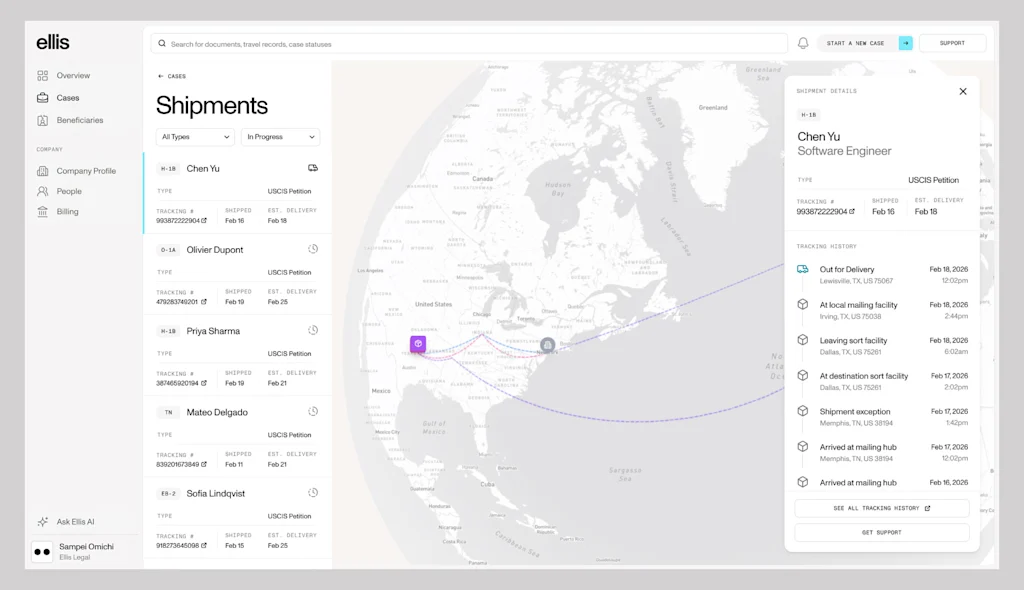
For workers seeking visas, Ellis not only offers a smoother, more streamlined application process but also holds the promise that employers might be more inclined to sponsor their visa, even in a hostile environment for immigration. Omichi says the platform aims to provide more transparency into the process, allowing workers to keep tabs on their application through a dashboard and additional elements like shipment tracking. (Applications for the H-1B visa, for example, typically involve hundreds of pages and need to be assembled by hand and shipped out.) In advance of the H-1B lottery opening up next month, the firm also introduced an H-1B lottery odds calculator, to give applicants a sense of how likely they are to get approved for a visa based on their title and location.
Perhaps most importantly, Ellis claims to have a 99.4% approval rate on its visa applications; when a visa is denied, the applicant gets a full refund of their legal fees or can file again free of charge. Over the last year, Ellis has filed over 400 applications on behalf of employees at AI startups like Adaptive and Wordware; by the end of 2026, Omichi says the firm is aiming to help 1,000 people secure visas.
At a particularly volatile moment, Ellis also hopes to help workers wade through the morass of immigration policy, which can change on a dime under the current administration. “We really try to be like an extension of their people team,” Omichi says. The use of automation allows Ellis to be more responsive to its clients than other lawyers might be. In addition, the firm invests in education and resources to help both employers and workers who are scrambling to keep up with policy changes, along with giving companies a direct line to Ellis via a dedicated Slack channel.
“Our job is to kind of simplify a traditionally very, very, very complex process into something a layman can understand,” Omichi says. “For employers, it means retaining their best talent. And for employees, it’s their livelihood. It’s often the most important thing in their life. If they don’t have stable immigration status, nothing else really matters.”


