


For a man reportedly worth more than $10 billion, entrepreneur Mark Cuban spends a lot of time talking about wealth inequality—and how to distribute it more evenly.
The Shark Tank star has long shared suggestions—and has enacted his plans—to better balance income throughout the U.S. economy. One of Cuban’s ideas was to give employees company stock: He told a recent episode of the What It Takes podcast that he awarded 330 employees at his media company, Broadcast.com, stock ahead of Yahoo’s $5.7 billion acquisition of the company in 1999. Three hundred of those employees became millionaires as a result, he said.
Cuban also awarded equity and cash bonuses to employees of his first IT consulting company, MicroSolutions.
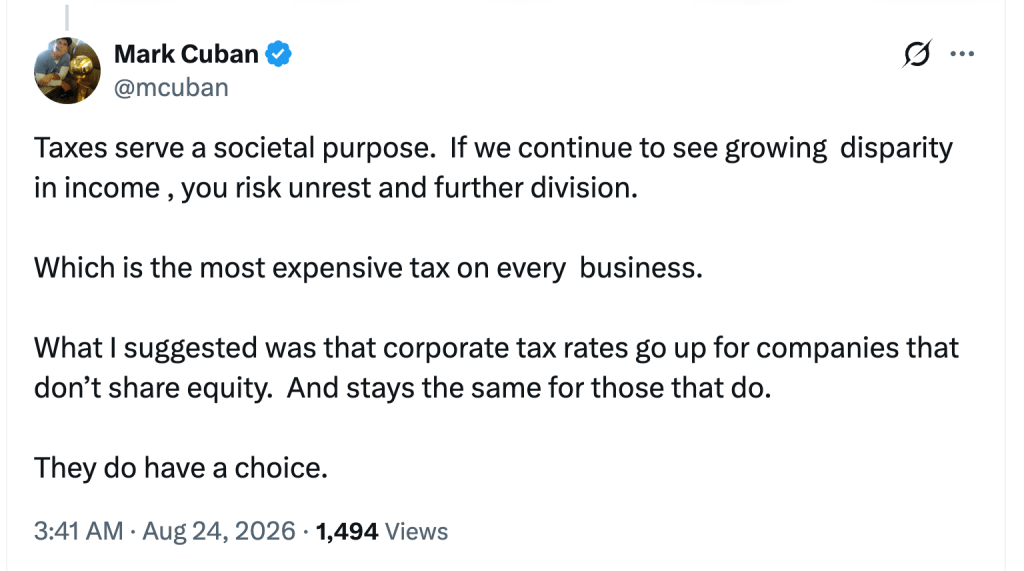
But the famed investor has now taken the suggestion a step further: If founders and CEOs don’t seek to share the wealth generated by their companies with their employees, they should be forced to give back to society by paying higher corporate taxes.
Writing on X, the cofounder of online pharmacy Cost Plus Drugs, was asked what his plan would be to reduce wealth inequality across the country. He responded: “Increase the taxes of any company that doesn’t offer equity to every employee on a pro rata basis to non-founder executives. If they get rich from the market, so do they.
“It’s exactly what I have done for employees in companies I have started. Most wealthy people get that way from selling their companies or taking them public.”
While Cuban proposes increased taxes as a motivator to get business leaders to share equity more broadly, a criticism of higher taxes (and tariffs, as consumers have learned the hard way) is that increases to company costs are often passed back to customers and ultimately the public. This represents a further stretch on budgets of consumers already dealing with above-target inflation, and without the boon of company stock to fall back on.
But Cuban disagrees, sharing his thinking on the social media platform owned by Tesla CEO Elon Musk: “Each entrepreneur decides what margins, gross or net, they are willing to accept. For competitive or any other reason.”
He continued, “Some of us realize that even though we might not enjoy paying taxes, and know that maybe 40% of the taxes paid actually get to people who need it, that’s still a value for the community, which can help your business. As far as equity: Every founder worth a damn knows that the greatest success, economic and personal, comes from aligning the goals and interests of as many stakeholders as possible. Everyone will benefit more, when everyone benefits more.”
Wealth imbalance is tipping
Wealth distribution has shifted toward the top end of the income ladder in recent years and is expected to do so courtesy of the wealth effects generated by artificial intelligence.
According to Federal Reserve data, in Q1 of 2016, the bottom 50% of the wealth distribution chart owned $1.02 trillion in assets. The top 0.1% owned $10.75 trillion.
Compared to Q1 of 2026, the bottom 50% now own $4.27 trillion, a more than 300% increase over the past decade. However, the top 0.1% own $25.07 trillion in assets—a smaller percentage increase but a much higher leap in value.
Cuban’s suggestion can also be observed in the Fed data another way: At the time of writing, the top 90% to 99% of the wealth percentile own $20.5 trillion in corporate equities and mutual funds, while the bottom 50% own a little under $0.6 trillion.
Cuban isn’t the only entrepreneur thinking about wealth inequality, particularly when the AI stock boom is powering wealth creation in the U.S. at present. Jensen Huang, whose wealth has rocketed courtesy of his chipmaking company Nvidia, has been joined in billionaire rankings by members of his leadership team. Per calculations by the Bloomberg Billionaires Index, Nvidia’s CFO Colette Kress and its executive vice president of worldwide field operations, Jay Puri, are now both worth more than a billion dollars courtesy of their stock holdings.
Tech companies may be forced to grapple with the effects of rewarding their staff so well: After all, how do you keep teams motivated if they’re worth 10 figures?
Huang reasoned it out on a panel hosted by venture capitalists running the All-In podcast last year, saying: “I review everybody’s compensation up to this day. I sort through all 42,000 employees, and 100% of the time, I increase the company’s spend on [operating expenses]. And the reason for that is because you take care of people, everything else takes care of itself.”
Cuban is inclined to agree, writing on X overnight: “If we continue to see growing disparity in income, you risk unrest and further division, which is the most expensive tax on every business.”
This story was originally featured on Fortune.com


