


If you are a manager, you have likely been paying close attention to the factors behind the Great Resignation: No sense of purpose, low wages, lack of childcare, inflexible schedules. All of those play a part in the record numbers of people who have q…
My mother grew up in Ughelli-South, a small village located in Delta State, South-South region of Nigeria. Right after finishing high school, she married my father, a pastor, and abandoned her plans of going to college. Together, they moved to Lagos an…
Business leaders predict that by 2026, half of their revenues will come from products, services, or businesses that haven’t yet been created. Here’s how new-business building can help bridge that gap through sustainable, inclusive growth.
When Yvonne Orji’s agent sent her a role to audition for last year, it finally hit her: “I’m back in this world again,” Orji recalls. “I freaked out.”
For six years, Orji has starred in the groundbreaking show Insecure as Molly Carter, the type A best friend to Issa Dee (show creator Issa Rae). Insecure bloomed from the scrappy web series The MisAdventures of Awkward Black Girl to five seasons on HBO—and the impact along the way can’t be overstated.
From authentic representation that centered Black women to a major platform on HBO giving Black creators the resources and room to develop, Insecure, now in its final season, has meant just as much to audiences as it has to the actors, writers, and directors who made the show what it is. “For six years, I’ve had this security blanket of a dope show, phenomenal writers—I don’t even have to question what they’re bringing to me, because I know it’s going to be good. And even if it’s something I’m not familiar with, I know they’re going to challenge me,” Orji says. “It’s the unspoken trust that you have in the show.”
Hence Orji freaking out while on the phone with her costar Jay Ellis.
“He was like, ‘Yvonne, I’m trying to tell you, you’re chasing a high that you will never get. It’s so hard to have what we had. The camaraderie that we have, the chemistry that we have, the writing for nuanced Black characters and nobody being a token,’” Orji says. “I want to believe that there are now more Black creators and creatives in spaces of power to greenlight shows, to work behind the scenes and in front of the scenes to create the same environment. But I’m not going to front: What we had was very special.”
Orji charts her personal and professional growth after five seasons, the legacy she hopes Insecure will leave in TV history, and the impact that the show has (and will continue to have) for Black creators.
Insecure about Insecure
Prior to landing the role of Molly, Orji was pursuing a career in stand-up with no real acting credits to her name.
“My biggest challenge to overcome was that I was enough to take this on,” Orji says. “In the beginning, there was that moment of, ‘Oh my God, they’re about to fire me, because they’re going to realize I was only good at the audition.’ That was a little imposter syndrome kicking in.
“It’s like, you’ve been practicing and then they drafted you,” she continues. “Can you now rise to the occasion?”
Orji not only rose to the occasion but she also found herself in a role that showed her another side of what she’s able to do as a comedian. “As a stand-up, I am big onstage. I am bold. I’m basically like the Kelli character [played by Natasha Rothwell],” Orji says. “But tapping into the Molly character, I have to be more nuanced. I have to tell a joke with a single look or a head tilt or a quick sarcasm that’s muted or understated. And so for that, I’m grateful, because it’s easy to stick to the thing that you do so naturally, which [for me was] big, broad, bold comedy. But then to be challenged to get the same effect by being a little bit more nuanced, that’s the gift that Insecure has definitely given me.”
Relationship goals
Orji not only had to navigate playing Molly a certain way, but also playing a character that became a lightning rod in the Insecure fandom primarily for dating choices that amounted to a track record of self-sabotage. That heat around Molly hit a fever pitch in season four, which focused on Molly and Issa’s friendship disintegrating nearly to the brink of no return.
With season five, Orji is hoping audiences will see Molly as less of a lightning rod and more of a mirror to the uglier sides of personal growth.
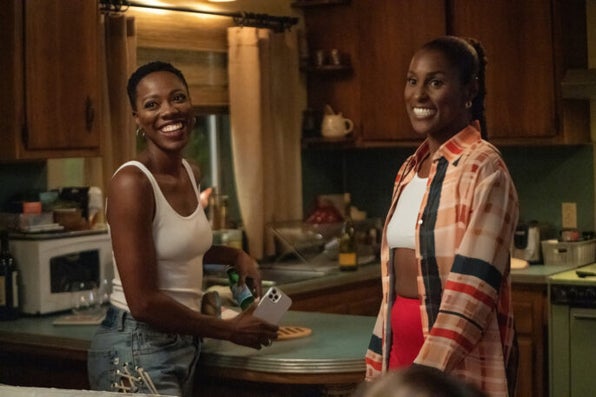
“It’s easy to misunderstand and it’s easy to judge. But I definitely want Molly’s legacy to be one where people can identify and see themselves in her and not be ashamed or afraid of it,” Orji says. “When you go to school, they teach you but they also give you tests to see if you’re understanding the material. So in Molly’s case life is her test. And sometimes she understood the assignment. And other times she had to repeat the class a couple of times.”
While the romantic storylines in Insecure certainly have their time and place, the primary relationship of the series has always been between Molly and Issa.
As Rothwell, a costar and writer on Insecure, told Fast Company last year:
“Female friendships are so nuanced, and the fights and the hurt can be so subtle. As a woman of color, to have these specific stories told in this way, it’s not something we’ve always gotten. It’s usually ‘Black girl magic’ where we have to save the day. But just having a show about these regular-ass women who have our problems is such a treat.”
It’s that genuine depiction of friendship in all its bruises and bliss that Orji hopes will be part of the show’s overall legacy.
“Selfishly, we hope that this show goes down in history like In Living Color, like Fresh Prince, like A Different World, like Girlfriends—all the classic shows we grew up with,” Orji says. “Hopefully, it is that friendship that’s pointed to in years to come like, ‘Yo that was a friendship that they had to grow into.’ And sometimes everything’s not so linear. Sometimes friendships can be fractured, but not broken. And if they’re fractured, it’s just like with a bone, you heal them, you bring them back, and they are stronger than ever.
“I don’t think necessarily Issa or the writers set out to be an iconic show,” Orji continues. “We just set out to tell real, true, authentic stories that stem from the real life of the writers and characters and people that we know. Anytime you stick close to the truth, it really rings true for a lot of people.”
The legacy of Insecure
Broader still, Orji also wants Insecure’s legacy to be a reminder for major platforms to give overlooked creators an opportunity in the way that HBO gave Prentice Penny and Melina Matsoukas an opportunity on Insecure as the showrunner and an executive producer-director, respectively.
“The fact that it would even be called a risk is laughable. Prentice has been a writer for decades and was just now given his shot to be a showrunner. It’s not a risk. He could do it, and he proved that he could do it,” Orji says. “It’s the same thing with Melina. I would imagine anybody who works with Rhianna or Beyoncé has to have a certain level of excellence, because these are people who demand it.
“I hope that that’s the legacy,” Orji continues. “I mean, we really have to credit Issa Rae. This was her baby. She was new in so many things and was like, let me bring on other people who are also new [or haven’t been given bigger opportunities]. I’m forever grateful for that.”
Looking forward, Orji is aiming to do the same as a producer working with more African-centered stories and creators.
“The same thing Issa did for Inglewood, let me do that for Nigeria, for West Africa,” says Orji, who is Nigerian. “What this opportunity has cemented in me, it’s always been a thing I’m passionate about, but now seeing how it was doable, I’m totally here for opening the door for the next wave of creatives from the diaspora.”
You’ve lined up a coveted job interview. You spend time preparing to make a great first impression, researching the company, anticipating questions, practicing your answers, and thinking of your own questions about growth opportunities and what …
There are always plenty of problems to be solved. Just open your email inbox and surely there will be something in there that isn’t quite right and requires intervention. You certainly don’t have time or capacity to solve them all, and so…
In my experience as a consultant who has transformed 16 companies, and as an entrepreneur who has built or bought almost as many of my own enterprises, I’ve learned that managers and leaders often miss one crucial point about emotional int…
James Clear first experienced the power of habits when he was seriously injured during a high school baseball game. Struck in the face with a baseball bat, he fell into a coma. He was determined to play baseball again one day and went through painstaki…
A record breaking 4.4 million Americans quit their jobs in September, bringing 2021’s total resignations to 34.5 million and counting, but some may soon find themselves trying to get their old job back.
According to a study conducted by the Workplace Institute, 15% of employees have returned—or “boomeranged”—back to a former employer, and 40% would consider applying for a position at a company they had worked for previously, including 46% of millennial workers. Plus, 76% of human resources professionals say they are more accepting of hiring boomerang employees than they were in the past, and 40% say they have rehired about half of those who reapplied with the company after leaving.
“So much of our world—and our world of work—has changed substantially, and people have been psychologically taxed, especially parents, navigating the pandemic. It’s taken its toll,” says Jacinta Jiménez, the vice president of coaching innovations at BetterUp, which provides professional coaching. “More employees are putting a greater emphasis on wellbeing at work and are re-examining priorities. Some folks are thinking, ‘Where was there a work environment where I felt connected, and how can I return, and come back in a more optimal way?’”
With record numbers of Americans calling it quits, historical trends suggest that millions will apply for a position with a former employer in the months ahead. Here’s how to gracefully boomerang back to a company after you’ve handed in your resignation:
Step 1: Swallow your pride
Quitting a job is not a decision most take likely, and choosing to reverse that decision can come with a lot of psychological barriers. Overcoming those barriers, however, is key to returning with confidence, and setting more favorable terms for your return.
“Pride can sometimes get in the way of us going back on a previous decision we made,” says Jiménez. “It’s important to remind yourself that you made the best decision you could with the information you had at the time. But circumstances change, so it’s important to be patient with yourself.”
Andres Lares—a managing partner at the Shapiro Negotiations Institute, a Baltimore-based company that provides sales and negotiation training—recommends reframing the situation as a win-win opportunity for both parties. In fact, research suggests that employers save between one-third and two-thirds on recruiting costs when hiring a former employee.
“It shouldn’t feel like you’re crawling back to your past employer; it should feel like you’ve got leverage and you bring a lot of value to the table coming back, because you don’t need to be retrained,” he says. “Companies tend to be risk averse, turnover is very costly, so if you put yourself in their shoes it should give you the confidence to come back.”
Step 2: Renegotiate terms
Once you’ve gotten over the psychological barrier of returning to a former employers it’s important to consider how your circumstances have changed since your departure, and what you want out of your next work opportunity.
“List the seven or eight things that are most important to you, because those are the things you’re going to negotiate over,” says Lares, adding that the list could include anything from salary and benefits to more flexible working options to career growth opportunities. Lares explains that boomerang employees have a unique opportunity to address some of the issues that may have caused them to leave in the first place.
“If one of the reasons you left was because you were burnt out, I would ask about a part-time or contractor role. If one of the reasons you left is because there is no upward mobility, make sure there’s a plan, if things go well, for what your career development looks like,” he says. “It’s the perfect time to do it, because when you’re in a role as a full time employee you lose sight of those things, so now is your chance to go in with a fresh perspective.”
Step 3: Address the elephant in the room
When you sit down with a former employer to discuss new opportunities, it’s important to acknowledge the reasons for your prior departure. After all, if you left the company once before, your former employer has reason to question why they should trust you again.
“The research shows that on average, people who do boomerang back are more satisfied and more committed than external hires,” explains Brian Swider, an associate professor at the University of Florida’s Warrington College of Business. “But it still is a natural human response to question someone who is returning back and swearing they’ll stick around this time, especially if the cause for the initial exit was not purely an external motivator.”
Rather than avoiding the subject, Swider recommends being upfront about why you left and explaining why things will be different this time around. “For any boomerang employee, especially those who maybe had a more tenuous departure route than others, it’s about trying to justify or explain motives for the departure,” he says.
Step 4: Emphasize what you’ve accomplished
People change over time, but your former employer is far better acquainted with the person who left than the person who is seeking to return. Whether you left to take care of a family member, took time off to travel, or left to work for a competitor, it’s important to acknowledge the ways in which you’ve developed as an individual and as an employee since your last interaction.
“Lean into explaining the experience in the interim—what you learned at your new company, what kind of skills you developed, what things you realized you really missed about the organization—those are all things to underscore to sell your new self to the rehiring organization,” says Swider. “Be sure the rehiring employer recognizes and appreciates the value and skills you gained in your time away.”
Step 5: Don’t wait too long
If you’re considering returning to a former employer it’s important not to wait too long, as each day you spend outside of the company decreases the additional value you provide as a former employee.
“If you’re hiring someone who used to work at your organization in an entirely different role, or working for an entirely different supervisor, or on an entirely new team, you don’t get as many of the benefits associated with boomerang employment as you otherwise would,” says Swider.
He explains that boomerang employees are in a strong position to negotiate better terms for their return because of their familiarity with the organization’s people and processes, but that familiarity fades over time. “The longer they have been gone, the less valuable they potentially are as a boomerang employee.”
Business Transformation initiatives are typically undertaken to solve a pressing issue, bring about improved performance, or to serve customers better. A critical element of the success of such initiatives entails transforming the existing behaviors of the employees across the organization. However, this isn’t a straightforward task. Attitudes and practices get reinforced in people by following […]


