


One thing CEOs love to talk about is how much sleep they get. Some are vigilant about their sleeping hours. “I will usually sleep eight hours a night,” Warren Buffet has said. “I have no desire to get to work at four in the morning.” For others, sleep is more of an afterthought: Indra Nooyi reportedly slept no more than four hours a night while running PepsiCo. And last year, Elon Musk told the New York Times that he was working 120-hour weeks to meet Tesla production targets. “There were times when I didn’t leave the factory for three or four days—days when I didn’t go outside,” he said.
The early risers—amongst them Tim Cook and Sallie Krawcheck—are prone to sharing their proclivity for the wee hours.
Got some extra rest for today’s event. Slept in ’til 4:30.
— Tim Cook (@tim_cook) March 9, 2015
More than 50% of people, however, are genetically predisposed to have relatively normal sleeping patterns. We asked a number of CEOs about their sleeping habits—most of which are a bit less extreme than you might think.
James Park, CEO of fitness startup Fitbit
“While I don’t get as much sleep as I’d like, it’s still a priority for me and something I always have to work at,” says Park, who heads to bed around 1 a.m. and typically gets about six hours of sleep a night. One thing that helps Park sleep well is exercise. “I’ve found that getting exercise helps me get the best night of rest and feel most energetic, so I try to stick to a consistent schedule of at least 20-30 minutes of exercise each day,” he says.
Park adds that while research points to seven to eight hours of sleep, everyone is different. “At Fitbit, we’ve tracked over nine billion nights of sleep—and it has shown us that there is no set amount that works for everyone,” he says.
Kathrin Hamm, CEO of bedding startup Bearaby
Hamm aims for eight hours of sleep but usually manages only seven, with a bedtime of 11 p.m. She uses naps to give her an extra boost in the afternoon. “I make sleep a priority—after all, running a business is not a sprint but a marathon,” she says. “Naps have become my secret weapon. I try to divide my day in two shifts, where I get a 30-minute nap around 5 p.m., before I work a couple of hours more in the evening.”
Hamm points out that the majority of people are lighter sleepers. “There might be a few lucky ones out there who don’t have to think much about their sleep, because it literally comes naturally to them,” she says. “Unfortunately, I am not one of them, which means I have to be more mindful about my sleep.” As a CEO of a startup that makes sleep aids, Hamm encourages her team to take naps, as well. “It’s important that we shift the conversation from ‘high performance equals long hours and little sleep’ to thinking around more flexible options to fit different sleep patterns and preferences—and a culture where its actually ‘cool’ to take a nap in the middle of the day,” she says.
Craig Elbert, CEO of vitamin startup Care/of
As a parent to a 3-year-old and 9-month-old, Elbert’s sleep schedule can be unpredictable. “Sometimes I pleasantly get seven to eight hours of sleep,” he says. “Other times, if I’m working and the baby wakes up? Four hours.” He admits that on the whole, he doesn’t get enough sleep, albeit not for a lack of trying. “It’s a priority, but at this life stage, children supersede that priority,” he says. “I think bragging about lack of sleep is overrated. Sleep is great if you can get it!”
Christina Stembel, CEO of flower startup Farmgirl Flowers
For Stembel, sleep takes a backseat to work most days of the week. She consistently wakes up around 7 a.m. but usually after no more than three to four hours of sleep. “I don’t generally have a set bedtime,” she says. “I go to bed when my work is mostly done.” The exception is Friday night, when she usually gets to bed by 10 p.m. and lets herself sleep for upwards of 10 hours. “I do feel lucky that I’m not one of those people who wrestles with insomnia or other sleep issues,” she says. “When I’m out, I’m out. I sleep very deeply and, at least I like to think, efficiently, making the most of the few hours I get.”
Stembel thinks of her sleep schedule as a sacrifice she is willing to make while she scales her business. “Your time is one of the most precious but also most necessary resources you have when you’re scaling a business,” she says. “You can never make more hours in the day, but you can take advantage of the hours most normal people dedicate to resting.”
Tom Smith, CEO of fertility startup Dadi
Smith usually only sleeps at 1 a.m. but makes a point of sleeping six hours a night. “I can operate with less sleep, but my effectiveness and mood suffer,” he says. “I’ve met people who live well on three hours of sleep, but that’s uncommon, and I believe everyone is different. People should start by understanding their bodies and what habits work best for them—then design a routine to support those habits.”
Philip Krim, CEO of mattress startup Casper
Krim has always needed a lot of sleep. “I’ve been that way since I was a baby,” he says. That’s why he aims for between seven and eight hours of sleep each night, despite having a newborn; he typically goes to sleep around 11 p.m. and wakes up no earlier than 6:30 a.m. “When I do, I’m at my best the next day,” Krim says. “I’m more productive and focused.”
Ashley Merrill, CEO of sleepwear brand Lunya
Merrill shares her wake-up time with the likes of Tim Cook. During the week, she sleeps four to six hours a night and rises between the hours of 3 and 5 a.m. Merrill tries to make up for her lack of sleep at the end of the workweek. “On the weekends, I sleep close to nine hours a night, plus I nap Saturday and Sunday for about two hours both days,” she says.
Running a startup makes it difficult to sleep more on a daily basis. “I would love to get more sleep, but startup life isn’t conducive to a super restorative and balanced lifestyle,” she says. “Sleep is a huge priority for me, and and that is why I make sure I get to bed early, decline almost all evening events, and ensure that I nap on the weekends.” Merrill also makes it clear that her sleep habits should not set the tone for the rest of her team. “I am vocal about wanting to get more life balance,” she says. “I tell my team that just because that is the time of day I can do emails does not in any way indicate they should be responding then.”
Susana Saeliu, CEO of custom pillow startup Pluto
Saeliu now sleeps at least seven hours a night—if not eight—but that wasn’t always the case. “I absolutely loved to burn the midnight oil, night after night,” she says. “But sleep deprivation gradually caught up, and I felt myself having less clarity throughout the day. I began taking longer than usual to finish a set amount of work.” She found her self-awareness, decision-making, and mood were all negatively affected.
“Not only does priding yourself on sleeping less set an unhealthy standard, it also creates a delusion of true productivity,” she says. “My feeling is that sleeping less, or believing that you can adapt—or have already adapted to less sleep—is not the best path toward being the best leader you can be.”
Jessica Mulligan, CEO of CBD product line Winged
When it comes to her sleep schedule, Mulligan keeps things flexible. “I do the exact thing that the experts say not to do,” she says. “The time I go to sleep and wake up varies every day. I listen to my body, and when I’m tired, I sleep. But if not, I use the night to do big picture thinking for my life and business that can be hard to do during the constant daytime pinging of email, phone, and meetings.”
A key to waking up early, according to Mulligan, is being passionate about your work. “I can tell you that when you are excited about what you’re doing, popping out of bed is a whole lot easier,” she says. “It’s about finding what’s best for you and what makes you excited to get out of bed.”
Nick Stafford, CEO of pet startup Ollie
“I’m typically in bed by 9:30-10 p.m. and up by 6:30 a.m. to exercise,” Stafford says. “I was a professional cricketer, so working out has always been important to me.” Though Stafford finds it easy to fall asleep, he makes a point of not taking his phone to bed. “One rule I have is to always leave my phone downstairs or out of the bedroom,” he says. “It’s a simple and effective way to place my mind and body into sleep mode.”
Sarah Ahmed, CEO of denim brand Warp + Weft
Like many founders, Ahmed struggled to prioritize sleep when she started Warp + Weft. “I was always running on adrenaline and found that although I was getting stuff done, I wasn’t centered,” she says. “My ideas plateaued. I wasn’t able to do long-term strategic thinking and wasn’t as attentive of a manager as I wanted to be.” Now, she doesn’t go without eight hours of sleep, hitting the sack at 9:30 p.m. “I’m extremely rigid, almost protective about my sleep schedule—and my productively has skyrocketed,” she says.
But Ahmed also recognizes that while this schedule works for her, it doesn’t suit everyone—and the same is true of the 9-to-5 workday. “We are testing a more flexible schedule that gives the team a more work-life balance,” she says. “It’s resulted in not only an increase in productivity and overall commitment to the company but happiness, wellness, and accountability amongst the team.”
Hilary McCain, CEO of CBD brand Sweet Reason
“I can’t imagine being an entrepreneur and not sleeping,” says McCain, who sleeps at least 7.5 hours per night. “I wouldn’t think as clearly, I would be a nightmare to work with, and I would almost certainly burn out.” Unsurprisingly, she uses CBD for a more restful sleep. “It takes the edge off and calms me down,” she says. “It helps me feel more in my body and less in my head.”
She notes that even CEOs with seemingly exacting sleep schedules—those who wake up before the crack of dawn—often make a point of not only sleeping early but also sticking to a consistent bedtime. “I think entrepreneurs and CEOs have less spare time and are therefore forced to really prioritize what they do outside of work, but I don’t think people are compromising sleep as much these days,” she says. “There’s too much research now about how crucial sleep is to your health and longevity.”
Javier Evelyn, CEO of healthcare startup Alerje
For Evelyn, six hours of sleep is manageable, though he would prefer to get seven. But what he can’t go without is his morning routine, which begins at 6 a.m. “Every morning, I also need to ensure that I work out, meditate, and take my vitamins,” he says. “I also try not to look at my phone for the first 30 minutes of my day to get a better command of my day. I’ve seen a distinct difference in my energy for the day if I skip on my morning routine.”
Ron Rudzin, CEO of mattress company Saatva
“Sleep, to me, is an activity,” Rudzin says. “I tell whoever will listen that they have to view sleep as an activity and prepare for it, the same way they would if they were going to work out or play a sport.” That’s why Rudzin has a series of bedtime rituals before he goes to bed at 11 p.m. “I make sure that the temperature of the room is right, and it has to be extremely dark,” he says. “I turn off all my electronics about 15 minutes beforehand, and I take a warm shower before I go to sleep. And I do the same preparation for sleep every single night.”
Though he aims for seven hours of sleep a night, Rudzin does usually stay up later one day of the week to connect with Saatva’s night staff. “But I try to limit myself so I still get 5 or 6 hours of sleep—and only on a certain night,” he says.
Anna Palmer, CEO of e-commerce platform Dough
“On a regular night without any deadlines, I’ll usually fall asleep around 12:30 a.m. and wake up at 7:30,” Palmer says. But as a night owl, Palmer finds she focuses best between the hours of 10 p.m. and 2 a.m. “We have a number of late-night workers on our key team, so we purposefully don’t schedule meetings before 10:30 a.m. to make sure people have the option to sleep if they were up working late,” she says.
However late she sleeps, Palmer shoots for seven hours of shut-eye a night. “With my first company, I was always sacrificing sleep to get things done because I thought sleeping was inefficient,” she says. “That schedule would end with me getting sick and crashing hard in a way that would impact my personal health and the team for weeks. It took a while to learn, but the second time around, I’ve learned that to take care of your team and your company, you have to take care of yourself first.”
“Change comes gradually� is an assumption.
It’s a sexy story often told: A handful of college roommates have that aha moment, scribble some code or put a spin on some process, and end up making a pile of money disrupting an industry run by the olds. All the experience you need to start a…
Would you like to learn the skill set to become a great leader? Here are the three pillars of leadership.

I originally wrote this post for Forbes.com. It appeared on the Forbes site on November 14, 2018.
When you work at a small business with a limited budget, it’s not really possible to shell out $340,000 for a 30-second TV commercial, or $10,000 for an email marketing campaign.
It can be frustrating when your budget dictates how many people your business can reach.
Surprisingly, there are a lot of free ways to supplement your paid advertising efforts. By incorporating free advertising tactics into your strategy, you can remove some nonessential costs and dedicate your budget to deeper, more longterm plays.
In fact, we suggest some of these methods regardless of your budget.
To help you spread the word about your business without breaking the bank, we’ve compiled 14 ways to get advertising for free.
1. Use Google My Business to optimize for local search.
One of the most powerful free ways to advertise your business is through Google My Business, which enables companies to manage their presence on Google Search and Google Maps. The tool can bolster your rankings in local search results.
Ranking high in local search shows you’re a legitimate and relevant company: you wouldn’t rank #1 in Google for “pizza places near me� if you’d closed down six months ago. Plus, if you rank high in local search, more consumers will choose your business over a competitor’s. In today’s fast-paced world, convenience is key.
Click here or scroll to the bottom of this post to learn how to advertise on Google for free and find out more about this process.
2. Check out Yext
The more places your business is listed online, the better your chances of showing up in search results, and the easier it is for potential customers to find you. To ensure great local SEO, the details of your listings on every website and online directory need to match up.
For instance, if your website lists your company’s new phone number, but Yelp lists your old one, this inconsistency could hurt your SEO. Yext scans the web to find every place your business is listed, so you can tweak your listings to guarantee accuracy.
3. Write guest posts for other blogs
There are a few major advantages to guest posting for a well-established blog. You can benefit from connecting to that blog’s audience, and you can also start establishing yourself as a thought leader in your industry.
Since guest posting on a popular blog allows you access to an established audience and high domain authority, this practice can sometimes be more beneficial than posting to your own blog. Plus, you can link back to your own website from your article, giving you an inbound link that boosts your domain authority and can increase your own website’s ranking in search engines.
4. Answer Quora questions.
Writing content for Quora can expose your business to a large audience: TechCrunch reported that some of Quora’s active contributors receive more than 30,000 monthly views.
Besides the large built-in audience, your business can answer direct questions from prospective customers. This lets you interact with high-quality potential leads and establish yourself as an expert in the subjects that matter most in your industry.
5. Publish content on LinkedIn.
LinkedIn is an platform to connect with professionals, which is why it’s also a great place to share business-related content. LinkedIn’s blogging platform lets you demonstrate your expertise within your industry.
Your connections and other LinkedIn members will engage with your posts and share them, doing the free promotion for you. With almost half of all social media traffic coming to B2B company sites from LinkedIn, it’s a missed opportunity if you don’t publish and promote content on LinkedIn.
6. Offer to do interviews on other business’ podcasts.
To figure out which platforms your team should priortize, it’s important to diversify your promotion platforms to discover where your audience is already consuming content. Some of your audience might prefer listening to podcasts over reading articles. To reach those people, contact a few businesses with podcasts and pitch interview ideas.
7. Promote your website on your email signature.
With all the emails you send every day, it’s a shame if you aren’t taking advantage of the promotional potential of your email signature. Your email signature can also be unexpected property to promote a sale, contest, event, or even a new blog post. Add a link to your business’ website on your Facebook, Twitter, and Instagram profiles, as well.
8. Send email newsletters.
An email newsletter can be a useful vehicle to promote content, share business-related news, and build deeper relationships with both potential and existing customers. There are plenty of free tools out there that assist you in designing, sending, and optimizing your newsletter.
With the right time investment, an email newsletter can be the perfect place to share quality content with leads and potential consumers, establishing your brand as helpful and informative.
9. Network at in-person events.
Connecting with fellow professionals at industry networking events is a great opportunity to meet potential consumers in a place where they are eager to discuss your business. The niche topics of networking events ensures you’re meeting high-qualified leads. For example, a “Best Technology Startups of 2018� event will primarily be filled with participants who are interested in technology and startups.
Particularly for small businesses looking to make their first connections, networking is a chance to get your name out there, meet potential partners, and find opportunities for growth. Plus, it’ll keep you up-to-date on trends in your industry.
10. Speak at an event.
Similar to networking, speaking at an event about a topic related to your industry is another way to exhibit your expertise. Giving a thought-provoking and powerful speech will draw attention to you and, by association, your business, which can increase brand awareness and prove your business is qualified to tackle consumer’s challenges.
To start, brainstorm different topics and volunteer at various upcoming networking events and trade association conventions. If you’re afraid of public speaking (don’t worry, a lot of us are), you could enroll in a local Toastmasters chapter to improve your game.
11. Do a free product giveaway or contest
A product giveaway or contest is an easy way to incentivize new viewers to check out and subscribe to your social media channels or website. Plus, handing out inexpensive branded products like t-shirts or mugs is a good way to spread your brand name. Word of mouth is alive and well — and a little swag can go a long way.
12. Put up brochures or flyers.
Putting up brochures or flyers in local libraries, coffee shops, and businesses is a unique way to market to offline locations where people spend a good deal of their time.
You can create free brochures and flyers on PowerPoint. Depending on your industry, it might even help you reach an ideal clientele: if you’re a physical therapist, for example, perhaps you could hand out brochures to local gyms or nearby hospitals.
13. Create YouTube videos.
YouTube has more than a billion active users, which accounts for almost one-third of everyone on the internet. Plus, 59% of executives — i.e. decision makers — go to videos before written content.
Creating engaging and informative YouTube videos is one of the most efficient ways to sell your brand. If done right, your YouTube videos will entertain viewers enough to seek out your website.
14. Take advantage of your partnerships.
Partnerships are an opportunity to offer supplementary services that you don’t provide. For example, a web design company and a copywriting agency might choose to partner together, so when a client requires written content for her web pages, the web design company can offer copywriting services from their partner.
This increases consumer satisfaction, and it also provides exceptional advertising opportunities. When your partner’s consumers need your services, your partner will point them in your direction.
15. Post on social media.
Nowadays, social media is crucial to most marketing strategies. Luckily, most types of social media platforms and posts are free — even to businesses. While many platforms will let you advertise, you can still post or tweet for no cost if you’re on a budget.
Pick the platforms that best suit your audience. Then, post links, photos, videos, or text posts about your company, product launches, or any other occurrence that you’d like to promote. Facebook, Twitter, and LinkedIn are a suitable place to start for most businesses. They all offer a way to share video, text, photo, and link-based posts and have large user bases. To learn more about other forms of social media, check out this post.
16. Experiment with photo and video platforms.
While Facebook, Twitter, and LinkedIn could be great platforms to start on, expanding to platforms like Instagram or Pinterest will give you more opportunities to show product shots or embrace the heavily-visual strategy of influencer marketing.
Aside from spreading awareness with free images of your product or service, most social platforms, including Facebook, offer live video and story features which can allow you to create video promotion related to your products. For example, you might use Instagram Stories or Facebook Live as an outlet to publish tutorials of how to use your products.
Because these videos and photos are on social, you can also boost their shareability by hashtagging them, creating interesting captions, and encouraging fans to react with actions like “likes” or comments.
17. Encourage happy customers to give online reviews.
Word of mouth is still one of the best ways to market your product. Consumers trust the opinions of other consumers, especially when there are many great testimonies.
If you have happy customers, encourage them to write a review about their experience on popular review platforms like Google, Facebook, and Yelp. If you want great reviews on Facebook, be sure to create a Facebook Business page if you don’t have one already.
How to Advertise on Google for Free
As mentioned above, you can create a free page on Google My Business which can help you rank higher or first in search results. Here’s how it works.
Create Your Google My Business Account
First, you’ll want to create a GMail account for your business. Then you’ll want to register for Google My Business with that account.
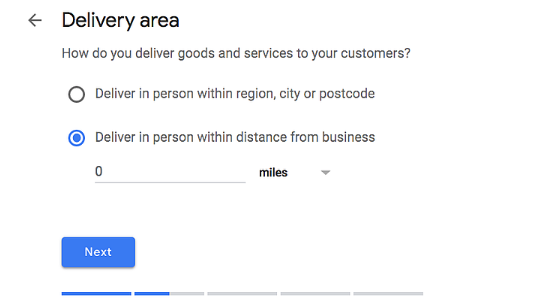
Google will first ask you to enter the name of your business. Then, you’ll be asked to select a “Delivery Area.” In this form, note the mileage and area where your target audience lives.
Optimizing Your Business Page
After your setup process is complete, you’ll be able to fill out your profile. As you do this, you ideally want to fill out all the information Google requests for the best search optimization. A few key things you’ll want to include will be:
- Your address
- A phone number, email address, and other contact information.
- Your website
- Hours of operation
- Photos of your business and products
- A detailed description on what your business offers
- Pricing or menu information
- The year your company opened
- Other business attributes such as “free Wi-Fi.”
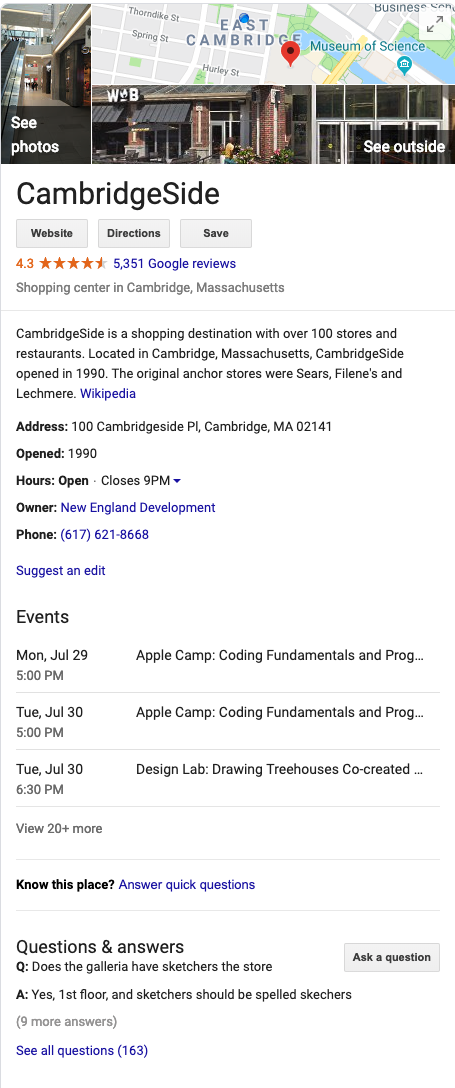
The above items are things locals might search specifically for. For example, if someone searches for a “cheap Mexican restaurant open after 8 p.m.”, Google will examine your business profile’s details and prioritize your restaurant if it seems like a great match.
Here’s an example of what it looks like when a Google business fills out all their information:
Verify and Monitor Your Business Page
Once you’ve created your Google My Business profile, be sure to verify your listing so Google knows it’s a real, legitimate business. There are a few ways to do this including email, postcard, and phone verification.
You can also download the GMB app to monitor how your business is doing on a smartphone. This post walks you through the different verification processes.
Don’t Forget About SEO
Along with Google My Business, taking advantage of free SEO strategies can also help your website rise higher in search results. These tactics can be simple and easy to work into blogging, web design, or other processes. Here’s a template that can help you plan your SEO strategy this year.

As they become the dominant adults in society, millennials are interacting with nonprofits and causes totally differently than their predecessors.
Golf, chain restaurants, American cheese, and in-person conversations—that’s just the super short list of things millennials have been accused of ruining. Now there’s another entire sector to add to that list: traditional philanthropy. A decade of research now shows that this generation—which now represents the largest group of adults—wants to help humanity and save the planet in ways that are far different from those inspired during the age of dial-up internet or rotary landlines. Given how many problems humanity has been unable to solve, that might be a very good thing.
If you’re looking to advance in your career, thinking about the way you communicate is a good place to start. After all, it’s a skill that’s always in demand and goes a long way toward shaping others’ perceptions of you.
But a handful of irritating—and common—words and phrases can undermine your hard work. “Words are powerful things, and some words and phrases can really have a negative kind of energy,” says communication coach Alan Samuel Cohen, author of The Connection Challenge: How Executives Create Power and Possibility in the Age of Distraction. At best, such phrases are distracting. In the worst-case scenario, they can actually trigger a strong negative reaction in your counterpart, either to the conversation or to you.
While it’s impossible to police every word you say—and people are going to hear what they’re going to hear, Cohen says—there are better options to consider.
“But”
Whenever you use the word “but” as a conjunction, the first part of your sentence immediately becomes qualified by the second part. Saying “I love you, but . . .” or “That’s a great idea, but . . . ” calls the first phrase into question, says leadership and career coach Jennifer McKay, founder of Mckay Coaching and Consulting. “In the second half of the sentence we’ve already moved on to something contrary,” she says.
Say it better: Simply stop after the statement. If you must add a conjunction and second phrase, use “and.” For example, “That’s a great idea, and we can look at it more closely.”
“This might be stupid/silly”
When you use self-deprecating language before you put forth your ideas, you’re immediately diluting others’ confidence in you and giving them permission to dismiss you, says Ellie Eckhoff, senior vice president at ClearRock, a leadership-development and executive-coaching firm.
“Some people might start with, ‘This might not be a good idea, maybe we’ve already done this, this might not work,’” she says. “So, starting the conversation with minimizing what they’re going to offer.”
Say it better: Simply state your idea without qualifying it. You’ll be more valued for your contributions.
“Respectfully”
If you have to qualify your statement with “respectfully” or “with all due respect,” what follows isn’t likely to be respectful and often won’t be productive, says Toni Harrison, CEO and founder of Etched Communication, a public-relations and communications firm. And even if what you’re going to say is respectful, you’ve introduced the concept that it isn’t. “Why would I think you’re about to say something to disrespect me in a conversation?” she says.
Cohen agrees and says the same goes for the word “honestly.”
Say it better: If you’re reacting out of anger, take a moment to collect your thoughts to respond appropriately. You can argue your point without a disingenuous lead-in. Otherwise, drop the reference to “respect” entirely and just say what you have to say.
“I’m so busy”
When you respond to “How are you?” with “I’m so busy,” you may make people reluctant to continue the conversation because they may think they’re taking up time you don’t have, McKay says. Or others may feel that you are positioning yourself as more important than they are. “‘Busy’ has become a way of life for many people, and some of my clients have expressed frustration when colleagues go on about the demands on their time,” she says.
Say it better: If you’re strapped for time in the moment, say so. For example, “I’d love to chat, but I have a meeting in five minutes. Could we catch up at 2 p.m.?” If you are overwhelmed, you may wish to confide in a trusted friend or colleague to help find solutions. But it’s rarely a good idea to just respond with a general “I’m busy,” as there’s little anyone can do about that except you.
“Try”
When people work together to complete projects or tasks, it’s essential to know who is working on what, McKay says. “When someone says they will try to complete something, it leaves the requester with doubts about the person’s commitment level to the task and whether the need will ultimately be met,” she says.
In other instances, if you ask someone to “try,” you may seem as if you’re calling their capabilities into question, she says. For example, “Try to understand” sounds like the speaker doesn’t believe the receiver is capable of understanding.
Say it better: If you’re not convinced you can complete a task, give specifics about the challenges or concerns. That can help you get the clarity, assistance, or resources you need. When you’re addressing someone else and asking them to try, ask a question instead.” For example, “Do you have questions?” is better than “Try to understand.”
Want to improve your interviewing skills? Improve your preparation.
Even if you think the answer is “no,” it might be “yes.”


