


This story is the final in a three-part series exploring Trader Joe’s business practices.
Click here to read the first story on Trader Joe’s brand identity and environmental violations.
Click here for the second installment on Trader Joe’s record number of food recalls, and secret product sourcing.
In mid-2020, Michaelann Ferro mustered up the courage to complain to her manager at Trader Joe’s about a male colleague she claimed was sexually harassing women at her suburban Boston store. When the man tried kissing her on the mouth, she said that put her over the edge. “I was only dealing with him for a few months,” she told Fast Company. “But the other women said the incidents they had with him lasted multiple years.”
After Ferro spoke up, she says that nine more women filed complaints about the same man. At least five claimed he had harassed them in the past year. The man had been a Trader Joe’s employee since the early 2000s. He denied their claims. According to the women who made the allegations, the company investigated the claims but never provided any details about their findings, and ultimately decided that the women’s statements (both firsthand complaints and secondhand accounts) were inconclusive. Ferro, who quit shortly afterwards, recalled seeing Brookline store colleagues get fired for infractions that struck her as minor by comparison, like arriving late a couple times, “but here was someone who touched a bunch of the women and he stays actively employed.”
About a dozen employees then signed a letter demanding Trader Joe’s be more transparent about its findings from inquiries into sexual harassment complaints. Trader Joe’s didn’t respond directly to the employees, but it reassured the public its process for resolving workplace abuse allegations was “robust.”
“We take sexual harassment very seriously and will always respond quickly and thoroughly, addressing any allegation and taking action when appropriate,” the company told The Boston Globe. “That is exactly what we did in this case.”
Trader Joe’s declined to comment to Fast Company about these claims of sexual harassment or any of the allegations detailed below. A spokesperson said personnel issues are private matters that the company keeps confidential.
The alleged harasser left the Brookline store shortly after the Globe article ran. His accusers worried that wherever he’d landed, he could cause the same problems again. They learned later that he was working at another nearby Trader Joe’s. In our reporting, Fast Company confirmed he was still employed there.
A troubling pattern emerges
For this story, Fast Company conducted hundreds of interviews and pored through a thousand pages of documents that describe a previously unreported systemic pattern in which inappropriate sexual advances and unwanted physical contact go unpunished by Trader Joe’s. Sources from half a dozen locations claimed the bad behavior they witnessed at their stores, sometimes lasting years, stopped only once Trader Joe’s transferred the harasser to a different workplace.
Related: Inside ‘Teflon Joe’s’: Why your favorite grocery store is not what you think
Our reporting also points to a pattern of corporate inaction stretching beyond workplace harassment into the company’s response to employee concerns about their physical safety.
At root, these concerns about their physical safety were what pushed Trader Joe’s workers to finally, after almost 60 years, form their first union. Employees in Hadley, Massachusetts made the first move in July 2022. Workers at stores in Minneapolis, Louisville, and Oakland followed by the spring of 2023, forming Trader Joe’s United—a rare kind of union in America because it was formed by workers themselves, without the support of a national labor organization. There was no proven playbook or deep pockets, they say; just an organic movement spurred by foundering discussions with the company about prioritizing their safety.
Since then, employees at stores across the country have told Fast Company that working conditions have continued to worsen. “It was a wonderful place to work, and then it wasn’t,” explained Maeg Yosef, a 20-year company veteran who led the organizing effort at the Hadley store.
Amid employees’ concerns about safety and harassment, Dan Bane, Trader Joe’s CEO until 2023, showed a keen and sudden interest in protecting workers . . . from the dangers of labor unions. In May of 2020, Bane sent a memo to all employees that warned, “A host of union campaigns have been launched that seek to capitalize on the current unstable environment in America—one in which misinformation and fear are spreading unchecked in the media.” He then shared a website the company created, www.union-contracts.com, that included four union contracts with other grocery stores. In his email, he emphasized his belief that Trader Joe’s employees had better protections than union employees.
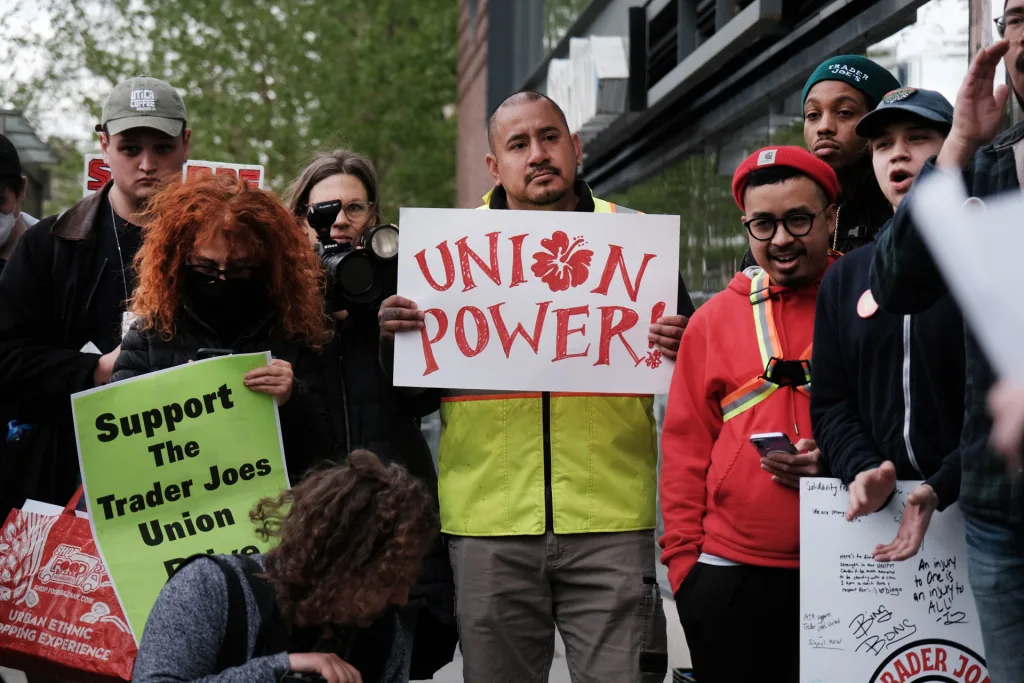
Sarah Beth Ryther, Yosef’s organizing counterpart in Minneapolis, argues a “disconnect about the company’s image” has emerged in recent years, eroding morale further.
In fall of 2021, she and two coworkers accused a male colleague at their store of sexually harassing them. He was terminated after a weeks-long investigation, but was not put on leave during the inquiry, according to Ryther, and used that time “to intimidate us.” Trader Joe’s declined to respond to questions about this episode.
In an unrelated incident that happened around the same time, a teenager stumbled in with a gunshot wound to his head. Ryther was the first person to aid the victim. Later she learned that he survived, but she says Trader Joe’s didn’t close the store or even send her home for the day. “I held this kid in my lap until the ambulance came, then worked for four more hours,” Ryther said, adding that at this point, “I decided it was time to join the union effort.”
Initially, Ryther wondered whether her Minneapolis experience might be an outlier. Now vice president of Trader Joe’s United and in charge of organizing nationwide, she said she’s spoken to hundreds of workers across the country. “The stories are so similar that I can essentially predict what people will say,” she told us, citing alleged harassment and inappropriate behavior by customers and workplace discrimination, confusion over corporate policies, and complaints ignored by managers. “There are real cracks in how the company presents itself when it comes to handling sexual harassment and employee safety.”
In 2024, the National Labor Relations Board (NLRB) has filed 21 unfair labor practice complaints against Trader Joe’s in eight states, and it filed 70 in 2023—a significant increase from the 51 total complaints filed between 2004 when the first complaint was lodged and 2022. The NLRB has also accused Trader Joe’s of retaliatory firing and shuttering popular stores on the eve of their union votes.
Part of the company’s defense has been to go after the NLRB itself. At a hearing earlier this year where Trader Joe’s was accused of firing Hadley organizers, the company surprised the NLRB administrative law judge by announcing plans to argue that “the NLRB and its administrative law judges are unconstitutional,” a defense built on gutting the foundations of American labor law, the National Labor Relations Act of 1935.
It’s an attack being spearheaded by the corporate law firm Morgan Lewis, which has enlisted the same defense for other two clients, SpaceX and Amazon, to help them defeat their union drives.
Joseph McCartin, a labor historian for four decades and founding director of Georgetown University’s Kalmanovitz Initiative for Labor and the Working Poor, told us that the union busting efforts he is seeing from Trader Joe’s represent “a shift to a whole new level of radicalism” that “we hadn’t seen before.”
Putting on a strong performance
If you’ve ever been to a Trader Joe’s, this picture of the employee experience is likely shocking. A hallmark of Trader Joe’s is the friendly, upbeat staff in Hawaiian shirts. In an August 2023 appearance on the company’s popular podcast Inside Trader Joe’s, Jon Basalone, the company’s president and vice CEO, said this comes by way of a winning corporate formula “to hire nice, kind, empathetic individuals, and then just turn them loose.” Founder Joe Coulombe put it even more directly in 2014: “Forget about the merchandise. It’s the quality of the people in the stores.”
But this schtick relies on some rich theatrics, and Trader Joe’s has had to categorically deny that its crew members are told to flirt with guests. Until this year, the employee handbook was littered with acting references and instructions to treat each customer interaction as a chance for “witty repartée.” “Without you,” it told new hires, customers are “just wandering around an empty set with good lighting.” While reporting this story, Fast Company ran across theater kids, MFA grads, part-time DJs, aspiring novelists, and musical theater writers. Several workers said that concentration felt confusing at first, until they realized Trader Joe’s seeks those skills out—who better to put on a strong performance?
Employees told us that this playacting has a pitfall: It encourages workers to push boundaries while on the clock. This gives Trader Joe’s a marketing edge. But edges are safer with guardrails, and workers say the company has shown little initiative in establishing any.
Back at the Hadley store, Sarah Yosef, a former captain (Trader Joe’s term for store manager) and wife of Maeg, said there was another male colleague that multiple women accused of harassment in the 2010s.
Yosef was asked by corporate HR to investigate, and the stories she heard alarmed her: “I documented at least a dozen cases of unwanted advances from this guy going back years. There were offers of ‘I’ll give you a car for sex.’” She said many of the women told her the man propositioned them for sex multiple times even after they asked him to stop.
Trader Joe’s official employee handbook states that for any worker who files a report of sexual harassment, the company “will provide reasonable accommodations to ensure crew member safety and comfort” and that “the company’s determination and related company action will be communicated to you and steps will be taken to prevent further harassment.”
Yosef presented her findings to HR, alongside the women’s written testimonies, and recommended the male colleague be fired. She wasn’t told what happened next, but he remained employed there—albeit on a “final written warning,” according to Yosef. Months later, he left the store. Employees heard (and Fast Company confirmed) that he was working at a different location. Yosef said she tried to confirm the new manager had at least read his personnel file: “I asked my regional [vice president], ‘Is his new captain aware he’s on a final written warning for sexual harassment? He’s around hundreds of employees where nobody knows his history—are we opening a playground for him?’” According to Yosef, her boss responded, “It’s too late. He already transferred.”
That employee, now in his 17th year with the company, still works for Trader Joe’s, in a large East Coast store with a workforce about four times larger than Hadley’s. Trader Joe’s declined to comment on this case, and it did not respond to Fast Company’s more general inquiries to better understand its corporate sexual harassment policies.
Last year, workers at the now-unionized Oakland store accused their manager of ignoring sexual harassment, making racist remarks, and showing a general pattern of “disregard for the safety of the crew.” When the regional vice president defended the manager’s actions, the employees contacted the corporate office. Among their claims was that their captain had shown employees topless Miley Cyrus photos, made comments about hiring “very young blonde women,” and used the N-word several times. The employees said that, when six female workers complained that their male superiors were harassing them, the captain referred to them as “a lynch mob.” According to the employees, sexual harassment was so rampant at the store that even the female shoppers were complaining about male employees “stalking” them through the aisles.
In April 2024, the NLRB accused the Oakland captain of violating federal labor law by threatening workers who were actively unionizing. But as workers were petitioning HR to fire their manager, he vanished. They wrote a letter asking what steps Trader Joe’s was taking to ensure he wouldn’t do “the same things to another group of unsuspecting crew members.” Bobby Kendall, executive vice president of stores at Trader Joe’s, responded to the employees in an email saying, “I will not be sharing those details.”
Last month, Trader Joe’s congratulated the manager in their internal employee newsletter on reaching his 40th work anniversary, now as captain of a Bay Area store located 15 minutes from his old one.
Safety is ‘a consistent problem’
It’s not just a toxic workplace environment that some Trader Joe’s employees claim they contend with—they also told Fast Company it is a physically dangerous one, for both workers and customers.
In recent years, Trader Joe’s has been reprimanded by local governments for not upholding state COVID-19 requirements, sued by 29 California DAs and city attorneys after workers were said to be dumping toxic waste, and fined by the Department of Labor for violating OSHA workplace safety guidelines. That last infraction, a $217,000 penalty imposed in April, is the second biggest for the grocery sector since 2015. An OSHA spokesperson told Fast Company the fine was so high because Trader Joe’s has continued “to violate the same standard” despite warnings. Four times in four states over the past five years, the company has failed to properly inspect forklifts and train forklift operators, and “repeatedly” blocked electrical equipment in ways that could have caused “fatal incidents.”
Employees in half a dozen states described hazards that they encountered, ranging from stomach-turning one-time offenses like raw sewage dripping from the ceiling onto produce to more routine incidents like stacks of boxes toppling once they exceeded the 6-foot-high companywide limit. Workers shared photos of mold growing on the walk-in refrigerator shelves, and pallets that collapsed after workers tried moving them.
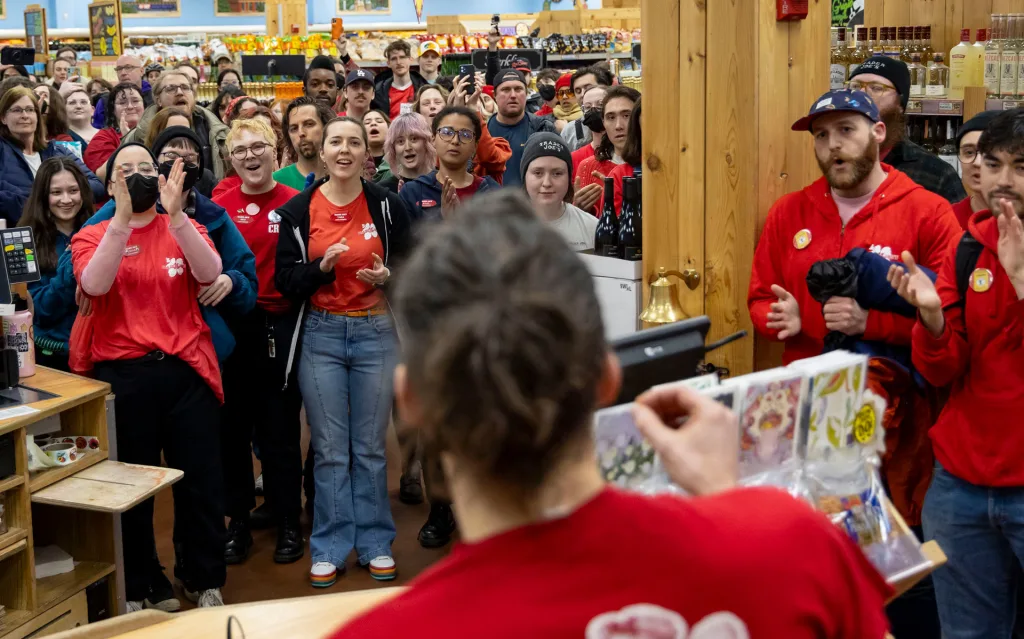
“We had probably six or seven serious injuries—sprained ankles, broken wrists, surgeries,” says Zac Whidby, a former worker at a Trader Joe’s in Burlington, Vermont. Whidby says workplace safety complaints went largely unaddressed in his store and that, over time, exasperated colleagues began to quit. “Three people in their 60s threw out their backs permanently. Working here changed their bodies forever.”
When Fast Company asked Trader Joe’s about the safety issues outlined in this story, it declined to comment on specific instances, but gave this statement: “Each store has a Safety Committee that takes ownership of identifying all potential safety issues in their store, and once identified, we act swiftly to address the concern.” It also pointed to an app-based training program saying, “We continue to create content for the app which will include training in harassment, proper use of equipment, de-escalation, and how to handle external safety threats.”
Yet employee safety concerns stretch beyond Jenga-like stacks of boxes into something of higher stakes: the company’s approach to addressing crime.
In Trader Joe’s backyard, California, a new group of stores seemingly gets targeted by criminals every handful of months—a pattern that goes back years and continues to this day. In 2018, eight L.A. locations were robbed at gunpoint, prompting Dan Bane to write another rare letter to workers, explaining that while it was law enforcement’s job to protect stores, “We do not hesitate to take appropriate action, including but not limited to having security cameras and security guards in our stores, to help ensure safety.” In 2020, an armed man with a “serious and violent criminal history,” according to the LAPD, robbed 21 more—with his son acting as the getaway car driver in two of the incidents. Since February 2024, police have warned the public about thieves swiping cell phones from at least eight San Diego Trader Joe’s locations, and wallets from stores across the Bay Area.
During the father-son spree in 2020, one source—a captain whose store was robbed—said the company instructed him not to tell workers that private security was stationed in the parking lot to pursue a robber who escaped with the cash.
This captain, in his third decade with the company, was himself fired in 2022. His termination followed two coincidental events: He had just filed for workers’ compensation after injuring his foot at work, and he had just reported a sexual harassment incident that he claimed he witnessed at a work event. Days after both, his regional vice president reported that an anonymous complaint had been filed accusing him of eating a lunch item without paying for it, and they had to fire him for that. (In July, he filed a wrongful termination lawsuit that is still pending.)
Trader Joe’s did not respond to questions about this specific worker or the L.A. robberies more generally. It said in a statement: “For the continuing safety of our crew and customers, we do not think it’s appropriate to comment on the specific measures we take to prevent theft in our stores.”
Employees around the country told Fast Company that, regardless of where they worked, they never received specific training on how to respond to robberies, thefts, or other workplace emergencies.
This lack of training contributed to a scandal on the other coast around that same time. In June 2022, an employee threatened to open fire after an altercation with a manager in the Murray Hill store in Manhattan. The store closed early and workers say they were sent home suddenly without explanation. Many said they only learned a gun might have been inside the store the next day, during a workplace-wide freakout.
Over 60 of them presented a letter asking their manager to enact better safety protocols to handle emergency situations and replace the store’s safety team, arguing Trader Joe’s had “prioritized profits over the safety, mental health, and wellbeing of our crew members.” The captain reportedly responded by saying nobody was replacing the store’s current safety team, and then taping a list of the safety team members’ names over the workers’ petition.
This followed a worse scare during the pandemic. In July 2020, two young male shoppers who were asked to follow New York’s face-covering requirement responded by ripping the mask off one employee, throwing grocery baskets at others, smashing a chair into the front window, and hospitalizing a worker by bashing them over the head until they bled with one of the wooden paddles cashiers use at checkout to signal they’re ready for the next customer. According to the NYPD, one of the attackers yelled out, “Don’t make me get my gun.”
After the attack was over, crew members said 10 employees had been assaulted. Trader Joe’s told the media later that crew were offered time off, and measures were taken to protect Murray Hill store staff and shoppers in the future. But workers had grown cynical that the company would take their concerns seriously. They deployed a different tactic, leaking the attack story to Vice and saying the goal was “just trying to stay safe and not die.”
‘Are they the company I was led to believe?’
What draws people to work for Trader Joe’s is often the same thing that turns customers into brand fanatics: a feeling that the company is aligned with their belief system. But over eight months of reporting for this series, a drastically different picture has emerged.
Workers expressed a wide variety of frustrations to Fast Company. But the common thread was a feeling of being treated like potential threats instead of valuable assets—a feeling that fundamentally clashes with Trader Joe’s brand identity. However, a close read of Joe Coulombe’s 2021 memoir, Becoming Trader Joe, reveals this shouldn’t be surprising at all. Coulombe is fixated on employee theft, referencing his concern that workers will steal from you at least eight times over the book’s 230 pages.
In one particularly revealing passage, Coulombe wrote that even though private detective agencies typically recruit “unstable people” who are potentially “worse than criminals,” he believed “they can be worth it” to keep employees honest. That loss-prevention tactic reflected a chilling corporate philosophy in Coulombe’s book: “Ask not what you can do for your customers, but what your employees, vendors, customers, and druggies can do to you.”
Now in her 21st year at Trader Joe’s, Maeg Yosef describes herself as frustrated by inaction from a company she once thought looked after its tight-knit worker family. “They say, ‘We’re the best in the country. This is a place where you can make a career and stay for a long time,’” she said. “Well, then they need to make choices that cost them a little bit, but give employees a better quality of life.”
“Loyal superfans will continue doing their TikTok haul videos, and that’s fine,” Yosef said. “But all shoppers should take a moment to do a quick reset and ask, ‘Are they the company I was led to believe?’”


