Women have been earning college degrees at higher rates than men since the 1980s. But we’re just starting to see that shift reflected in the makeup of the workforce. College-educated women now account for more than half of the workforce, and in December, the overall share of American women on payrolls crossed 50%.
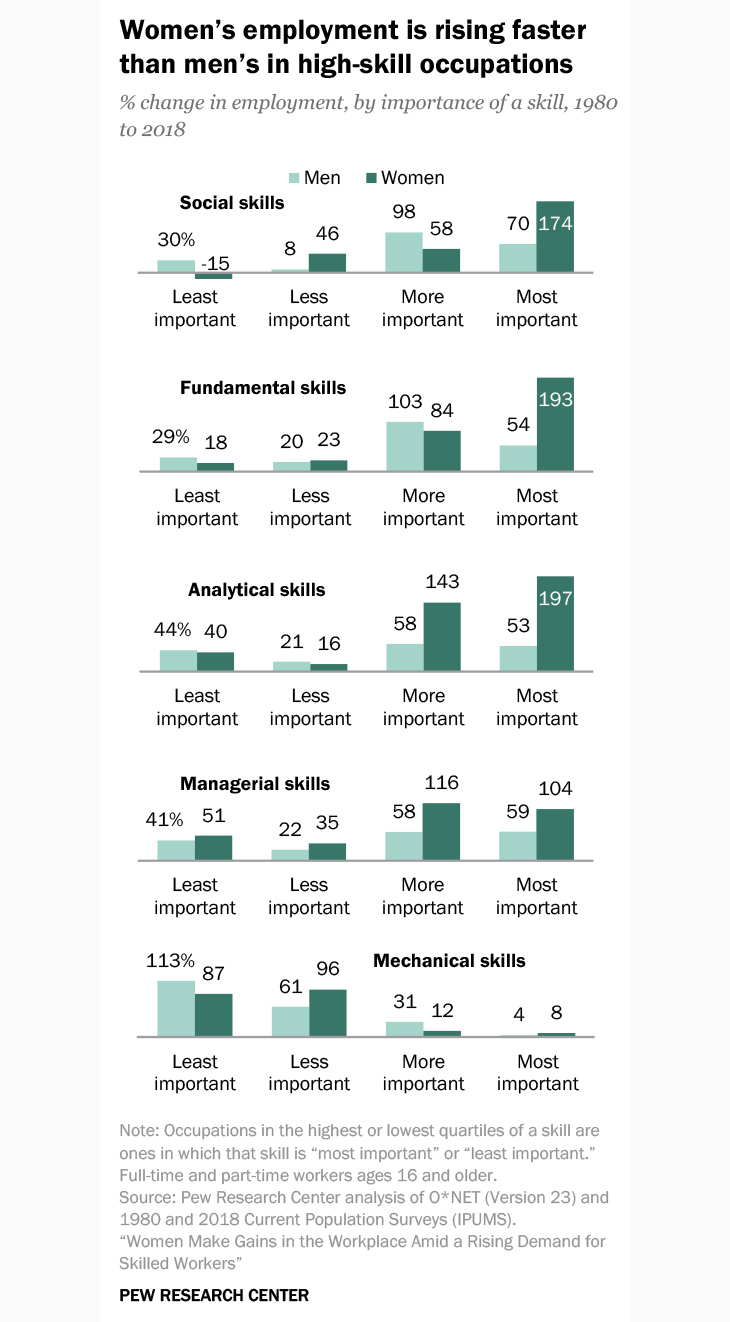
A new study by the Pew Research Center offers more insight into why that is. Between 1980 and 2018, women’s employment has grown by 74% while men’s employment has seen an increase of just 45%. The demand for high-skilled workers is especially high in sectors that have long attracted more women, such as education and health services, which jointly added 36,000 jobs in December. The Pew study reveals that employers are looking for workers who boast social skills and fundamental skills such as critical thinking and writing—and that women are leading the way, and in turn increasing their earnings.
“Women have steadily raised their profile in high-skilled jobs since 1980,” says Rakesh Kocchar, the researcher behind the Pew report. “They’re now in the majority in jobs that draw most heavily on social or fundamental skills. These changes combined have helped to narrow the gender wage gap.”
From 1980 to 2018, average hourly wages for women have jumped by 45%, from $15 to $22; while men’s wages remain higher on average, their earnings have only inched up 13%, from $23 to $26. That means that, as of 2018, women earn $0.85 for every dollar earned by men—an improvement on the yawning gap from 1980, when women earned just $0.67 for every dollar of men’s earnings. (The wage gap is, however, significantly larger for black and Latinx women, who earn $0.62 and $0.54, respectively, for every dollar earned by men.)
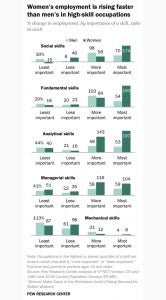
The Pew findings indicate that women are also flocking to STEM fields, which favor “analytical skills.” But the fields where social and fundamental skills are most valued, which range from teaching and counseling roles to the legal profession, have seen the most drastic growth since 1980, as women have permeated the workforce—not much of a surprise, given that some of those jobs tend to be populated by women. The Pew results suggest that men are also joining industries that favor social and fundamental skills, albeit at far lower rates: Employment for women in jobs where social skills are “most important,” for example, increased 174% from 1980 to 2018, while employment for men increased 70%.
So while women have made strides in the labor force and chipped away at wage disparities, a driving force behind the gender pay gap remains unchanged: Men and women still make different career choices. So long as that’s the case, it seems likely that gender-based wage disparities will persist—even as women move up in the workplace.