


The Fast Company Grill hit SXSW this year. Couldn’t make it to Austin? Here are some Fast Bites: Your handy recap of panel discussions.
There’s been an undeniable groundswell across women’s collegiate and professional sports in recent years. The question now is how to turn that uptick in attention into lasting equity for athletes—from professional ranks all the way on down to kids who are just learning to love the game.
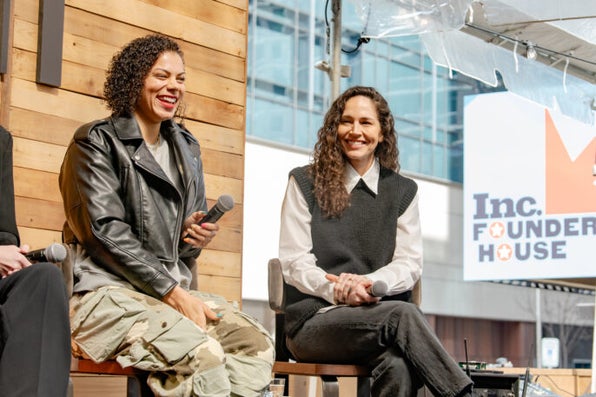
At the Fast Company Grill at SXSW this past weekend, we gathered a dream team of sports innovators to discuss the next steps for women athletes: Jessica Robertson, the cofounder of Togethxr, the commerce and media company that’s using storytelling to elevate women athletes; WNBA legend and Togethxr cofounder Sue Bird; Stef Strack, founder and CEO of VoiceinSport (VIS), a digital platform that provides women athletes with access to mentorship, experts, and content; and Las Vegas Aces forward and three-time WNBA champion Alysha Clark.
The group discussed how this past year has been a tipping point for women’s sports, with milestones accumulating quickly, from Caitlin Clark’s NCAA scoring and three-points records to the Kansas City Current’s new National Women’s Soccer League stadium—the first-ever purpose-built for a women’s team.
Tipping points
Clark said that beyond the greater monetary investment in practice facilities and team resources, the growth in accessibility and visibility for women’s sports on television is an important milestone. “On television, it went from 4% to 15% [of total sports media coverage], and it’s only going to keep getting better because companies like Togethxr and VoiceinSport [are] making us more accessible and visible to young girls in sport,” Clark said.
Bird cited the increase in data that shows the power of women’s sports to capture viewers and convert them into fans. “The beauty about what’s happening right now is that the numbers and the data, it’s matching what we all knew the whole time, what we’ve been preaching, what we’ve been saying, what we’ve been experiencing,” she said. “Now we have the data and the numbers to actually just show it to people’s faces.”
Robertson pointed to the weight room inequities at the March Madness Tournament in 2021 (made viral from a TikTok posted by player Sedona Prince) as evidence of the growing consciousness and attention to the gender bias in sports. “It was a massive cultural moment and also a mirror for anyone who hadn’t invested in the space yet, but really for those who were investing in the space but more on the men’s side than on the women’s side,” Robertson said.
Strack, however, noted that even with these milestones, women athletes still lack resources and the sponsorship dollars of their male counterparts. “Only 10% of brand sponsorship dollars is going to women athletes,” she said. “It’s just absolutely absurd. So you have the 1% [of athletes] at the top. They are making millions, which is great. But you have the massive middle here that is not even making enough money to have it as their full-time job. They have to take a side hustle. And then you have a whole base that’s not even getting paid.”
Raising the profile
One of the most important ways to get the flywheel spinning for women’s sports is through content which can raise the profiles of both athletes and leagues. It pulls in sponsors, nets better media rights deals, and ultimately leads to better salaries and sponsorship deals to keep the best women playing at the highest levels.
Robertson talked about some of the projects coming out of Togethxr, including the show Surf Girls, with Amazon Studios and Hello Sunshine, which follows a group of women surfers around the globe. There’s also the unscripted comedy The Syd + TP Show, in partnership with Ryan Reynolds’ Maximum Effort Channel and FuboTV, which features WNBA athletes, Sydney “Syd” Colson and Theresa “TP” Plaisance.
Bird pointed to Togethxr’s forthcoming documentary Power of the Dream, which will debut in June with Amazon Studios, as an example of the kinds of storytelling that can come from women’s sports. The documentary follows the efforts of players from the Atlanta Dream team and across the WNBA to get out the vote for Raphael Warnock’s runoff election for the Georgia senate seat, defeating Kelly Loafler, who was the then-owner of the team and who opposed the league’s embrace of the Black Lives Matter movement.
“It’s about what we did in order to just own our voice and not really acknowledge her,” Bird said. “We essentially helped a senator get elected.”
Strack noted that content is also a powerful way to keep young women and girls in the game. Her company has a new partnership with the WNBA that taps into the league’s Changemakers collection of brands to provide young athletes access to virtual mentorship through the VIS platform. VIS has tapped 12 WNBA players, Clark among them, as mentors who will provide virtual sessions to girls around the globe.
Strack says this is a great opportunity for brands to align with women’s sports not just through media buys, but through supporting gender equity at all levels of sports. “Unfortunately, girls are dropping out of sport at a faster rate than boys, twice the rate of boys at age 14,” Strack said. “The WNBA wants to make a difference in that space.”
The NIL effect
The group discussed how the arrival of name, image, likeness (NIL) compensation in the NCAA is amplifying women’s power—and posed to change the pro leagues.
“All these women who are in college now, they’re developing these relationships early with the brands,” Bird said. “The brands are now able to invest in them as kids and watch them grow.” And especially as March Madness has popularized women’s college basketball, those players are going to take their brand partnerships “with them into the pros, and I think it’s going to actually make the WNBA and the program even better,” Bird added.

Clark noted that the arrival of these younger NIL players in the pro leagues will be important as the WNBA renegotiates both its broadcast deals and its Collective Bargaining Agreement with the players association.
“So much of success off the court comes from your network. A lot of times, these opportunities haven’t been presented to us as female athletes, and so now there’s a plethora of opportunities and brands coming to the table early on,” Clark said. “Now these players can carry that into the league and have them a part of their network. So as they grow as a professional, they’ll have those resources to look back and leverage with as they continue to grow. It’s only going to make everything better in the trickle down effect. You’re going to see a completely different league in six, seven years.”
A primary connection
Strack reminded the audience that athletes need support all the way down to primary school. She and VIS helped introduce the Fair Play for Women Act, a federal bill that would strengthen Title IX down to K through 12. “The reason why we could write it, as people who have no legislative experience, is because these women were living it every single day, seeing the current issues in the system,” Strack said. The act has three main components, including better education on Title IX for public schools, reporting and transparency of Title IX data at all schools, and creating an enforcement mechanism for Title IX at all public K-12 schools and colleges.
“I know we’re talking a lot about the top of the pyramid, but imagine if you go through your entire first 12 years of your life as a young girl, and you feel like you’re second best to the boys, through the gear that you get, the fields that you play on, the coaches’ salaries that they’re being paid,” Strack said. “That sets a societal precedence that we must crush.”
As for what’s next for women’s sports, all said that the Paris Olympics this summer will be a big test. They’ll be watching to see if the flood of attention and sponsorship dollars that always flows to women during the Olympics will ebb once the games are over.
“We typically see a swell of investment around female athletes [during] the Women’s World Cup and the Olympics,” explains Robertson. “So I’m very interested, especially coming off the heels of what is going to be an insane March Madness and Final Four, to see how the visibility stat and, more importantly, the sponsorship stat goes up, and how long it sustains.”


