


How can we all, as leaders, have a “multiplier effect”? How can we manage our impact on others so that we are multipliers who enable, encourage, and excite them to continuously raise the performance bar?
What I mean by this is ensuring that everyone understands that to work here, you have two jobs:
- the job you were hired to do
- to continuously look for faster, better, cheaper ways of doing things.
Lovely notion, but in many organizations, the weight of day-to-day activities stops them from doing this. They don’t realize that it’s a false economy to see an irritatingly slow process and wait for someone else to do something about it because they “just don’t have the time.” They don’t see the dividend that would be paid next week if they stopped and fixed the problem today.
You might be thinking that this is just la-la land. There’s no way we can get everyone to do this. But think of it this way: The opposite of continuously driving the performance bar upward is not stasis, it’s drifting backward. Your competitors will snack on your market share until they’ve gorged themselves and left you starving.
So how can this high-performance culture be realized? By creating a multiplier effect: meaning that employees not only do their job brilliantly well, but they enable everyone they come into contact with to do their job brilliantly well too. Not just their teammates. Not just their peers. Everyone. The other people in the meeting they’re in. The person from another department who needs some information. The junior employee who’s learning how to do their job. The team whose project is going to heavily impact their department. Everyone.
This diagram shows the alternatives to being a multiplier. None of them are performing. None of them are adequate. None of them are acceptable.
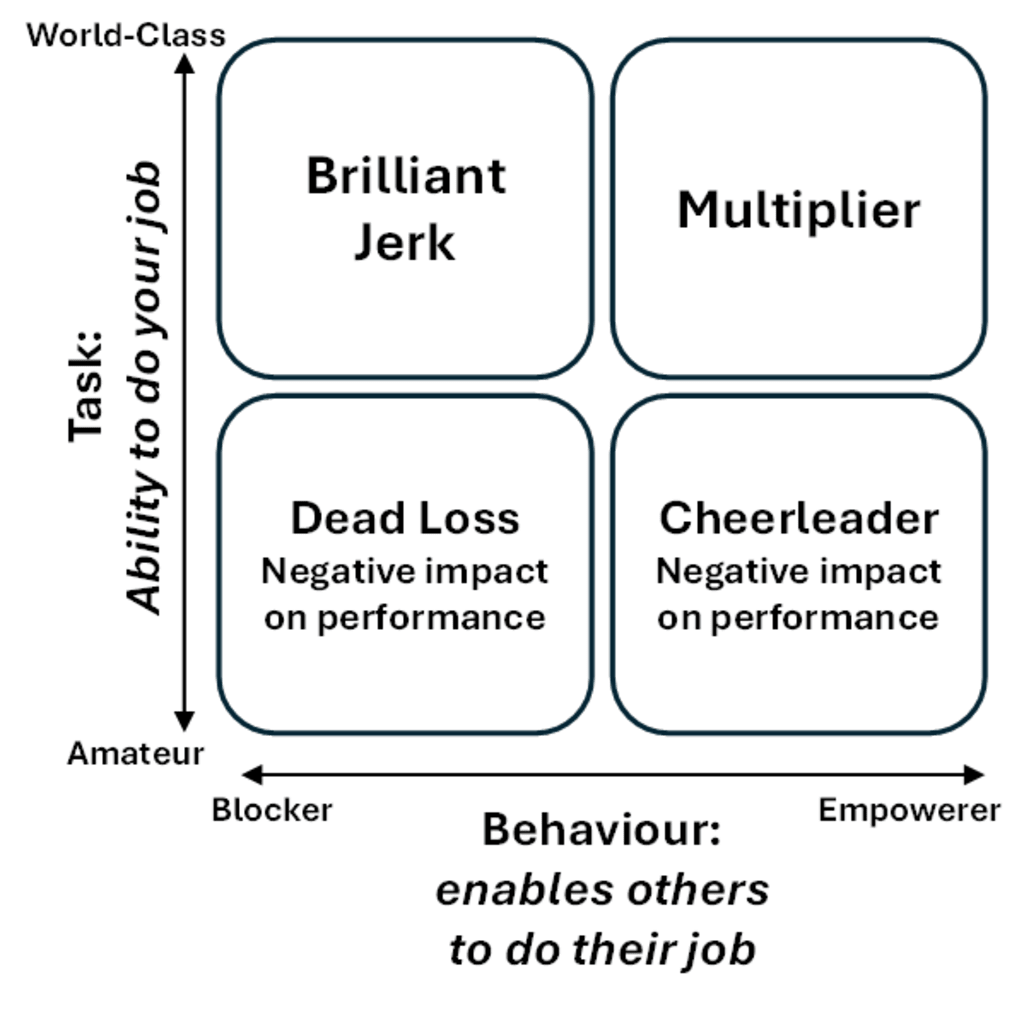
Bottom-left quadrant: Dead Loss These people hurt performance. They don’t do their job properly and they get in the way of others doing their job properly.
Bottom-right quadrant: Cheerleaders These people might seem great at first (particularly if they’ve just replaced someone horrible), but it won’t take long before their people realize that because their task skills aren’t up to scratch, they can’t set direction, can’t challenge them, can’t answer their questions. So, their impact might initially be positive, but it will drift through neutral and end up being negative.
Top-left quadrant: Brilliant Jerk This is the tricky one. You could argue that because of their great technical skills, they’re actually adding something to the organization. Yes, they might add something at first. But I believe—in fact, I know—that this is a short-term thing. It doesn’t take long for the impact of these people’s poor behavior to start impacting other people’s ability to do their jobs.
Top-right quadrant: Multipliers Once again, people operating in this quadrant are having a multiplier effect because they do their job brilliantly well AND they enable everyone they work with to do their job brilliantly well.
So, how do you ensure that you are a multiplier? There are three key behaviors:
Empowerment
It’s a much overused and abused term, but I define empowerment as “devolving decision-making authority to the place of greatest information.” That is, letting the people who know most about something get on with it. What, without checking their work? Yes. What, without weighing in with my huge intellect and exceptional experience? Yes.
A lack of empowerment is a productivity issue (decisions getting escalated into a bottleneck), it’s a quality issue (decisions being made by those with less knowledge than the person who escalated), and it’s a customer service issue (as a result of suboptimal productivity and quality).
And if you’re thinking I can’t possibly let that person make the decision. They won’t do as good a job of it as I would, that’s your fault—either because you haven’t given them the skills to be able to do it well, or you’ve tried to give them the skills, they haven’t learned, and you’ve done nothing about it.
Helpfulness
I truly believe that helpfulness is a key distinguishing feature of high-performing organizations. Everyone is enabled and encouraged to think about how they can be of greatest service to others in the organization. Some think of helpfulness as a bit anemic, a bit cutesy. They’re wrong. Imagine if everyone in your organization were doing their best to help everyone else in the organization get the best result.
Focus
Empowerment and helpfulness are useless unless you’re very clear about what needs to get done when it needs to get done, the resources required to deliver, and that people are held to account for delivery.
Sounds like Management 101? Perhaps. But how often in your organization do people find themselves facing conflicting priorities, too many priorities, or changing priorities? A relentless drive to ensure that you’re clear about focus areas and that everyone else is 100% clear on them takes a lot of pressure out of the system.
Being a multiplier requires a big slab of self-awareness and the humility to know what you need to change. Start with yourself and then insist on this as a requisite to work on your team.
Illustration from Better Culture, Faster by Andrew Saffron, published by Practical Inspiration Publishing.


