


After decades of inaction, the U.S. is racing to reclaim its rare-earths supply chain from China’s grip before the next trade war begins.
What started as a simple promo for Microsoft’s Ignite conference turned into a debate on social media.
The post Windows President Responds to AI Critics: ‘We Know We Have Work to Do’ appeared first on TechRepublic.
Nearly 1,000 users reported an outage on X just before 7 a.m.
A curated list from one of HBR’s most popular newsletters.
Imagine you’re watching a basketball game. You’re not focused on the stat sheet—you’re watching how the players read the court, pivot when a play breaks down, and celebrate their teammates. Those moments tell you a lot more about how someone performs …
The update marks one of the most significant leaps yet in xAI’s push to create highly capable, emotionally aware, and human-aligned AI systems.
The post Grok 4.1 Now Available to All Users appeared first on TechRepublic.
Today marks a milestone: my 250th “Playing to Win/Practitioner Insights” series post. Back on October 5, 2020, when I published the first piece in this strategy series, “The Role of Management Systems in Strategy,” I was simply responding to a client’s question and trying to provide practical advice on the often-ignored fifth box of the Strategy Choice Cascade. I had no idea that first post would be the launch of a series that reaches 263,000 people (at last count) on a weekly basis. It feels fitting for this 250th post to return to the original topic in Revisiting Management Systems: The Nervous System of Strategy. And as always, you can find all the previous Playing to Win/Practitioner Insights here.
I’m delighted to be joined in coauthoring this post by Steve Goldbach and Geoff Tuff. Both are former colleagues I mentored at Monitor Group and are now senior partners at Deloitte. They are the coauthors of three books, and their latest, Hone: How Purposeful Leaders Defy Drift, is dedicated entirely to the power of enabling management systems (EMS) as a leadership tool. This represents the combined view of the three of us.
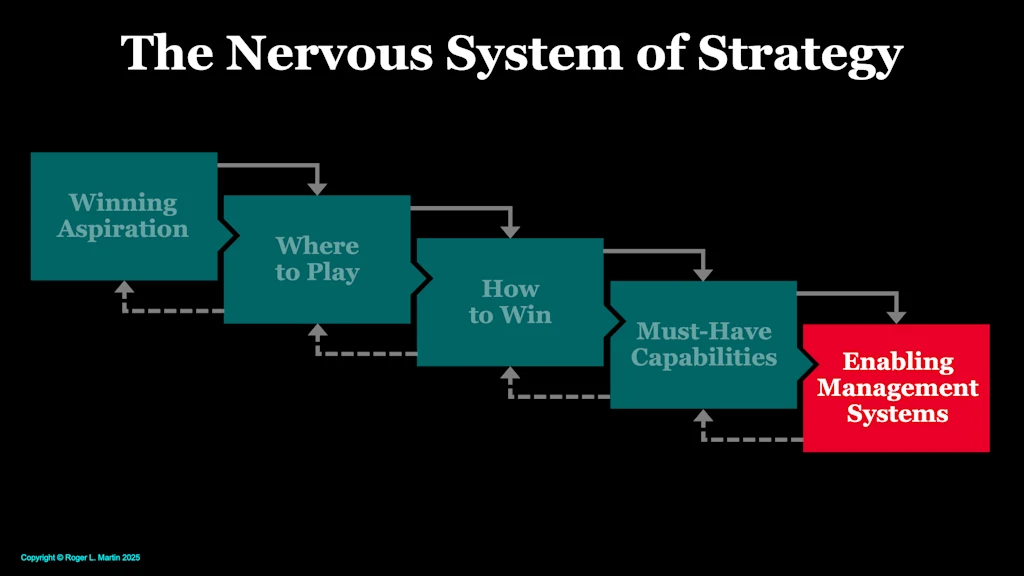
That original piece noted that many treat EMS as a lesser choice—a mere implementation detail tacked on at the end. It argued the opposite: that your strategy is not truly complete until you have specified the distinctive management systems (processes, structures, rules, and protocols) that will build, maintain, and reinforce the must-have capabilities that make your “where to play/how to win” (WTP/HTW) choice a reality. The emphasis in that first piece was distinctiveness, noting that generic management systems that simply replicate so-called best practices are a route to mediocrity.
Hone offers a critical and complementary observation. While it is vital to have distinctive management systems to enable a distinctive strategy, all management systems—whether they are distinctive or not—motivate human behavior. Marshaling the right kind of human motivation is the critical underpinning of any successful strategy. Management systems frame “what good looks like” from a behavioral perspective in the organization. We believe nearly everyone shows up to work wanting to be successful; your systems should tell them how.
In this way, if the WTP/HTW choice is the heart of strategy, then MHC are the muscles and EMS its nervous system—the network of signals, incentives, and feedback loops that translate strategic intent into coherent, day-to-day action.
In biology, the nervous system is the body’s command center, regulating essential functions, processing inputs, and sending signals to muscles, allowing the body to react and control its functions. This is precisely what management systems do for an organization. They are the intricate web of formal rules and cultural norms that shape how people work together inside organizations. Formal systems might include how performance is evaluated, how financial targets are set, or promotion and hiring criteria. Cultural norms are the subtle cues and “unwritten rules” that dictate behavior, such as decision rights—who gets to make what choice, or even who is asked for an opinion. When all the management systems inside an organization are combined, they can either powerfully reinforce behavior consistent with what is necessary to support the strategy choices, or, all too often, hinder it entirely.
The Barnacle Problem: Drift Erodes Distinctiveness
A very common problem, particularly in large organizations, is that management systems tend to accumulate over time like barnacles on the hull of a ship. Barnacles create drag and can cause a ship to gradually drift off course. Layers of competing management systems have the same effect on organizations. The accumulation of management systems can happen for at least two core reasons:
- Many designers, narrow designs. Management systems are rarely designed as a set—they usually crop up to address a specific problem. A well-intentioned functional leader in finance creates a new budgeting process. HR adds a new performance metric. IT implements a new security protocol. Each system feels like a “good idea” in isolation, but they accumulate and often unintentionally conflict, sending mixed signals throughout the organization.
- Layering over, not uninstalling. Even when a company launches a “new strategy,” leaders rarely go back and remove or reshape the old systems. They just layer new ones on top while the old systems are still busily motivating the old behaviors.
This accumulation erodes distinctiveness. Your carefully chosen, distinctive EMS are drowned out by the cacophony of the other systems, all pulling people in various directions. Drift is often imperceptible in the moment, and each subsequent deviation is similarly hard to see from the new direction of travel. It is only when a company is way off course that alarm bells start to sound—and by that time, subtle course correction is ineffective.
A classic example of legacy management systems holding a company back happened at Sears decades ago. In the 1990s and early 2000s, leadership correctly identified e-commerce as a strategic imperative. They even had a massive advantage: a world-class catalog and fulfillment business. But the company’s formal management systems were barnacles. Its P&L structure and incentive plans were built entirely around the profitability of individual brick-and-mortar stores.
When Sears.com was set up as a separate, competing P&L (the conventional wisdom at that time), store managers were inadvertently punished for behaviors that supported the new strategy. For example, if a customer wanted to return an online purchase to a local store (which was considerably easier at that time relative to today), the return would show up on the store’s P&L, reducing its profitability. This motivated store managers to resist taking online returns, something that might have presumably given Sears a leg up in the new online world.
Drift tends to end badly. Organizations wake up and discover they are miles away from where they need to be to achieve their goals. They have no choice but to engage in so-called transformation—massive change at a rapid pace. These transformations are costly in terms of dollars, time, and human energy, and have very high failure rates. We are not “anti-transformation” per se; we just believe that with a bit more attention to day-to-day steering of the ship, much of that waste could be avoided.
The Antidote to Drift: Honing
Hone uses the metaphor of a chef’s knife. Good chefs don’t wait for their knives to become uselessly dull before fixing them. A dull knife is dangerous, so chefs hone it every single day before use. Honing is not sharpening. Sharpening grinds away metal to create a new edge—a transformative, costly act. Honing is a gentle, daily maintenance that realigns the existing edge, keeping it fit for purpose. Honing, as one chef described, is a “meditation and a maintenance” both keeping the knife serviceable and an act that reminds the chef of what’s needed in the forthcoming service.
This is the antidote to drift. The external landscape any organization faces is constantly in motion: Customer preferences shift, competitors take new actions, technology advances, and regulation varies constantly. Leaders must respond by honing their organization with small changes to their EMS to steer behaviors consistent with the external shifts. Ideally this can happen by making small changes to existing management systems. But sometimes it might require creating a new distinctive system or “uninstalling” management systems that are no longer needed.
The Four Seasons example from the first PTW/PI post impeccably illustrates honing. The “glitch reporting system”—where any employee, at any level, is empowered and rewarded for identifying and reporting a service “glitch”—is an EMS. But it’s not a static one. By its very design, it is a honing system, a feedback loop designed to identify and correct for small drifts (a slow room service order, a dirty light fixture, a slippery floor) in real time, long before they accumulate into a “bad service” barnacle.
The Role: The CEO as Chief System Designer
This leads to a final, critical point. If EMS are the nervous system of strategy, who is the brain?
We have consistently argued that an organization’s leadership must own its strategy, not outsource it. On this front, we believe that CEOs must own the overall design of their collection of EMS. The CEO must be the “chief system designer” because the CEO is the only person in the organization with both the authority and visibility to ensure coherence and congruence across all the organizational systems. While CEOs can (and should) delegate the detailed design of a sales incentive plan or a supply chain metric, they must own the theory of how all those systems interact to collectively motivate the desired behavior.
Bel Groupe (maker of brands such as BabyBel, GoGo squeeZ, and the Laughing Cow) is a terrific example of its CEO, Cécile Béliot-Zind, acting as the chief systems designer. Bel’s ownership and management team believe they can create competitive advantage by promoting a more sustainable food system. Béliot-Zind is fond of saying that “sustainability without profitability has no impact and profitability without sustainability has no future.”
Bel helps support farmers with whom it works to implement in necessary regenerative practices while enabling a better living. As a result, the company has access to a more resilient, long-term supply chain. To reinforce this commitment, Bel became a mission-led company by law (société à mission) in France, formalizing this commitment in its company by-laws: a very strong management system creating consistency and a long-term commitment to this strategy.
Béliot-Zind also knew there were other systems that needed to change to reduce the typical profit versus purpose friction that occurs in many organizations. Her solution was to redesign her finance department to fuse responsibility for both profit and societal impact into a single function. She created a chief impact officer role responsible simultaneously for profit and for societal impact, ensuring both are managed with the same rigor as a traditional P&L.
That CEOs must be chief system designers doesn’t mean non-CEOs are powerless. On the contrary, all leaders can and should act as a chief system designer for their own team, honing the management systems within their control. And, just as important, they have a responsibility to identify and elevate the inconsistencies they see, making the case for why a particular system is causing drift.
Practitioner Insights
Here are four things you can do to put this into practice:
- Audit your management systems. At the start of every strategy process, we suggest uncovering your “strategy-in-use,” including identifying the key management systems that drive behavior today (whether they are distinctive or not). An easy way to find these is to ask why people behave the way they do inside the organization. Then ask: Do these systems, in their current form, support or conflict with our new WTP/HTW?
- Connect honing to your What Would Have to Be True (WWHTBT). Use the WWHTBT tool to assess your management systems. We are all fond of saying that strategy doesn’t come with an expiration date. It is good until one of its WWHTBTs is no longer true. This is your signal to hone. When a WWHTBT fails, or is being strained, identify the new behavior you need and then determine which management system must be adjusted (or created, or uninstalled) to motivate it.
- Stop Blaming Culture. Culture isn’t some immutable bogeyman. As has been pointed out in this series, you can hone it to support your strategy through changes to leadership behavior and careful modification of management systems. Find the specific management systems that are rewarding the behavior that creates cultural defects and change them. Culture is, in the end, a strategy choice.
- Be aware of your “tells.” Leaders at all levels: Recognize that you are a powerful informal management system. Your attention, your questions, and your emotional reactions in meetings send the clearest signals of all about “what good looks like.” Make sure your personal cues are in alignment with your stated goals.
A full 249 PTW/PI later, the core message remains consistent. EMS is a critical element of strategy—its nervous system. Leverage it and hone it, and you will be generously rewarded.
What’s one thing every leader can do to make sure employees are happy at work and engaged with their jobs? Make sure they can trust in you, your organization, and one another. That’s the finding in a 2024 meta-analysis of studies with more than 1 mill…
Will it ‘rain’ supreme? The system can produce a wide range of physically coherent outcomes, critical for anticipating worst-case weather scenarios.
The post Google DeepMind’s WeatherNext 2 Brings High-Resolution Forecasting appeared first on TechRepub…
What does it mean to be “smart” or “dumb”? Few questions are more deceptively complex.
Most of us have strong opinions about what those words mean, but scratch the surface and it becomes clear that “smart” and “dumb” are slippery, subjective constructs.
What seems smart to one person may strike another as naive, arrogant, or shortsighted. Worse still, our own perception of what’s smart can shift over time. Yesterday’s clever decision can look like today’s regrettable blunder. Take Jay Gatsby, for instance. His grand plan to reinvent himself, amass a fortune, and win back Daisy once seemed like the height of romantic intelligence; but in the end, it revealed itself as delusional folly, built on illusions as fragile as the dream he chased.
For a famous path reversal (from allegedly dumb to obviously smart), consider Forrest Gump, whose simple, seemingly naive choices (e.g., running across America or investing in “some fruit company”) looked foolish to everyone around him. Yet his lack of overthinking and unpretentious sincerity led him to happiness, wealth, and a kind of quiet genius that outsmarted all the so-called smart people.
In hindsight, we often discover that our supposed genius was merely luck, and our “dumb” mistakes were actually learning opportunities in disguise.
In short: Being smart isn’t a fixed trait; it’s a moving target defined by outcomes, context, and time. In line with that, we tend to withhold judgment until we’ve seen enough evidence. After all, anyone can have flashes of brilliance or moments of foolishness—what matters is the overall pattern. That’s why we evaluate intelligence not by a single act, but by the consistency of choices and behaviors over time.
The science of adaptability
Charles Darwin famously noted, “It is not the strongest of the species that survives, nor the most intelligent, but the one most adaptable to change.”
Along the same lines, psychologists (who are often largely footnotes to Darwin) have a relatively simple and more objective way to define smart versus dumb behavior: adaptability. In that sense, what we call “intelligence” is largely the capacity to adjust one’s behavior to achieve desired outcomes in a changing environment. In other words, smart behavior increases your chances of success, survival, or well-being. Dumb behavior does the opposite.
When faced with different options, the smartness of your choice can be judged by its consequences. If your decision enhances your opportunities, relationships, reputation, or resilience, it’s smart. If it narrows your prospects or makes your life worse, it’s dumb.
Crucially, this definition also accommodates social consensus. One person’s opinion may be biased, but when many independent observers agree that an action was wise (or foolish), that consensus is usually a good proxy for truth. You can fool some people some of the time, but not everyone all the time.
IQ vs. EQ: 2 pathways to smart behavior
When it comes to predicting whether people will behave intelligently or not, two psychological constructs stand out: IQ and EQ.
IQ (intelligence quotient) reflects cognitive ability—that is, how effectively you learn, reason, and solve abstract problems. It’s the single best predictor of performance in well-defined, rule-bound contexts such as school exams, technical analysis, programming, or chess. People with higher IQs tend to make better decisions when the problem has a right answer.
EQ (emotional quotient), on the other hand, captures the capacity to understand and manage emotions, both your own and others’. It predicts success in less structured, interpersonal domains: leading teams, negotiating, managing conflict, or handling stress. In these fuzzy, ambiguous situations, there are rarely clear “right” answers, and emotional intelligence helps navigate the gray zones.
Both forms of intelligence matter. IQ helps you see patterns; EQ helps you see people.
False stereotypes: book-smart vs. street-smart
Part of the reason people resist IQ is that they equate it with cold, academic, or impractical intelligence: the “book-smart but clueless” archetype. Think of high-IQ figures who made disastrous real-world choices: the Enron executives with MBAs from top schools who engineered their own collapse, or Nobel laureates who lost fortunes day-trading because they overestimated their models. Brilliant analysts but poor decision-makers.
Conversely, high-EQ individuals (likable, empathetic, persuasive) are often celebrated as “street-smart.” They can read a room, defuse tension, and influence others. Yet this doesn’t mean they always make wise choices either.
Importantly, research shows that IQ and EQ are largely uncorrelated. You can be high on both, low on both, or excel in one and lag in the other. They’re complementary tools—like having both a hammer and a screwdriver. One won’t replace the other, but together they let you handle a wider range of problems.
Why high-IQ people do dumb things
So why do objectively intelligent people sometimes behave foolishly? A few recurring patterns explain it.
- Overconfidence in reasoning. High-IQ individuals often trust their logic too much, ignoring emotional or contextual cues. This “cognitive arrogance” leads to blind spots, especially in social or moral dilemmas.
- Complexification. Smart people can overcomplicate simple problems, mistaking verbosity or abstraction for insight. They build intricate arguments to justify poor decisions. True intelligence is making complex things simple, rather than vice versa.
- Confirmation bias. The cleverer you are, the better you become at rationalizing your mistakes. Intelligence amplifies self-deception when ego is at stake. Too often, smart people are more interested in lubricating their egos than in making the right decision—their desire to feel smart may surpass their appetite for getting to the solution of a problem.
- Risk illusion. Intelligent people often feel they can “outsmart” uncertainty, taking reckless bets (financial, professional, or personal) under the illusion of control. In particular, when intelligence combines with narcissistic tendencies, it may lead to intellectual underperformance at the expense of grandiosity.
- Narrow optimization. They focus on optimizing a specific variable (e.g., efficiency, profit, prestige) while ignoring broader consequences. A “smart” business strategy that erodes trust or well-being isn’t smart in the long run.
In short, high IQ can make you better at justifying dumb ideas, as well as defending your arguments and actions against others, leading to the “smartest person in the room” syndrome.
When emotional intelligence backfires
EQ provides no immunity against stupidity either. In fact, its virtues can become liabilities when taken too far.
- Empathy surplus. Being too attuned to others’ emotions can make you overly accommodating or reluctant to deliver hard truths.
- Agreeableness overdrive. High-EQ people often avoid conflict, even when confrontation is necessary to prevent bigger problems later. And people who focus on avoiding conflict end up causing a great deal of conflict in the long run.
- Emotional manipulation. The dark side of EQ is Machiavellian charm, using emotional awareness to manipulate rather than connect.
- Compassion fatigue. Caring too much can lead to burnout, especially in leadership or caregiving roles. In any job or organization, especially in competitive settings, if you optimize for getting along, you will impair people’s appetite for getting ahead.
- Emotional suppression. Some emotionally “mature” individuals regulate so well that they disconnect from their authentic feelings, losing spontaneity and creativity.
In essence, EQ without boundaries can make you a “nice fool”—liked by everyone, exploited by many.
The meta-skill: coachability and learning
If IQ and EQ help you make smart choices, what helps you stay smart? The answer is coachability, the willingness and ability to learn from mistakes. This meta-skill distinguishes the chronically dumb from the progressively smart. Everyone makes errors; only the adaptable learn from them.
Here are five evidence-based ways to improve your decision-making intelligence.
- Seek feedback relentlessly. Smart people solicit criticism before failure makes it unavoidable. The goal isn’t to be right; it’s to actually get better (evolve, develop, grow, etc.).
- Distinguish process from outcome. A good decision can lead to a bad result, and vice versa. Evaluate how you decided, not just what happened.
- Question your certainties. Treat your beliefs as hypotheses to test, not truths to defend.
- Balance emotion and logic. Before major decisions, ask: Am I thinking clearly and feeling right about this? IQ and EQ can actually work together to improve outcomes, but you will need to manage this tension and turn them into allies.
- Study your own patterns. Keep a decision diary, record choices, predictions, and outcomes . . . or at least reflect, get feedback, assess, and recalibrate. Over time, you’ll see which biases or emotions trip you up.
In short, the smartest people aren’t those who never err; they’re the ones who systematize their learning from errors. What ultimately separates wisdom from folly isn’t intellect or emotion alone, but the capacity to adapt—to learn, recalibrate, and improve.
As author and Harvard professor Amy Edmondson compellingly illustrates: In the end, smartness is less about having the right answers and more about asking better questions after you’ve been wrong. The truly intelligent person is not the one who avoids dumb mistakes, but the one who refuses to repeat them.


